
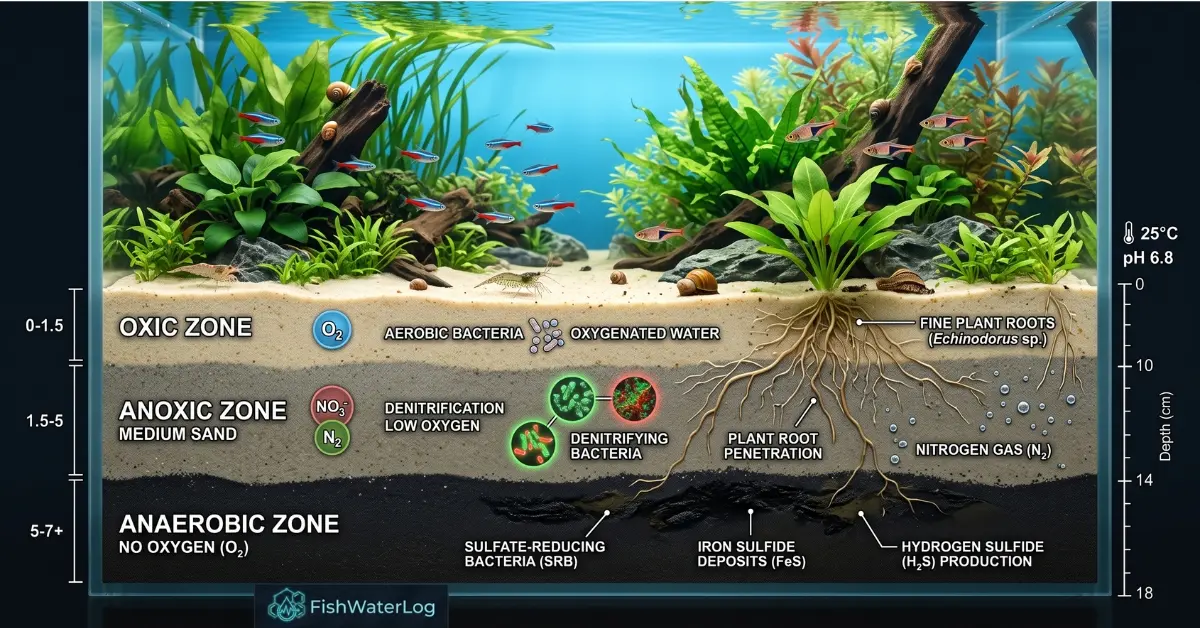
Life within a closed aquatic ecosystem is governed by a continuous biogeochemical balancing act, where the benthic substrate operates not as an inert gravel bed, but as a living thermodynamic engine. While long considered the exclusive domain of marine reef tanks, mastering freshwater deep sand bed denitrification provides the ultimate biological mechanism to permanently reduce accumulated nitrates into harmless dinitrogen gas without relying entirely on frequent, disruptive water changes. The primary objective of managing deep substrate architectures is the establishment of stable freshwater deep sand bed denitrification, a biological process wherein specific microbial consortia utilize the oxygen atoms bound in nitrate (NO3-) for anaerobic respiration, subsequently off-gassing harmless dinitrogen gas (N2) or nitrous oxide (N2O) into the atmosphere.
However, many aquarists hesitate to build deep benthic strata due to widespread myths surrounding toxic gas release. Achieving successful anaerobic zone denitrification freshwater tank conditions requires establishing a strict substrate grain size boundary using fine silica sand (typically 60-mesh). This physical density limits rapid fluid advection, allowing an anoxic transition layer to form just millimeters beneath the aerobic sediment-water interface. At this suboxic threshold, specialized heterotrophic microbial consortia initiate dissimilatory nitrate reduction, permanently exporting nitrogen rather than recycling it back into the water column.
The critical engineering challenge lies in preventing hydrogen sulfide pockets in sand substrate as deeper layers transition into absolute anoxia. Far from being a sign of biological failure, the formation of a localized black anaerobic sand layer actually confirms that bioavailable iron is actively binding with volatile sulfides to precipitate harmless, inert iron sulfide minerals. When supported by slow interstitial gas exchange in deep aquarium substrate and continuous malaysian trumpet snail aeration to gently prevent sediment compaction, a deep sand bed becomes a self-sustaining, bioactive filtration asset that mirrors natural riverine biogeochemistry.
Table of Contents
Substrate Architecture and the Substrate Grain Size Boundary
The structural efficiency of benthic biological filtration relies directly on establishing a precise substrate grain size boundary. The physical diameter and packing density of sediment particles dictate the rate of advective interstitial water flow versus molecular diffusion into the deeper zones of the aquarium bed. In coarse, highly porous substrates, advective pore water exchange continually carries dissolved oxygen deep into the benthic zone. For a complete comparison of physical grain dynamics, review our comprehensive substrate for planted tanks sand vs gravel guide to understand how pore space dictates flow.
In coarse, highly porous substrates, advective pore water exchange continually carries dissolved oxygen deep into the benthic zone. This continuous aeration prevents the drop in oxidation-reduction potential (ORP) required to induce bacterial nitrate reductase enzyme systems. Empirical laboratory trials show that coarse aggregates, such as 10-mesh gravel (~1.0 mm) and pea gravel (3.0 to 10.0 mm), fail to reduce ambient nitrate levels and frequently lead to steady nitrate accumulation.
Conversely, utilizing a fine-particulate media—specifically 60-mesh silica sand (0.05 mm to 0.5 mm diameter) installed at a minimum depth of 3 to 6 inches (7.5 to 15 cm)—drastically restricts advection. Disturbing the sand bed via deep siphon vacuuming artificially forces highly oxygenated water into established anaerobic strata. Aquarists should follow proper skimming techniques outlined in our aquarium vacuum siphon guide to clean surface waste without puncturing deeper horizons.
Furthermore, hydrodynamic stability is just as critical as substrate maintenance. The flow of water from filter outputs and powerheads directed across the sediment surface creates localized pressure gradients, inducing advective pore water flow. This physically drives highly oxygenated water much deeper into the sediment than diffusion alone would allow, completely collapsing the anoxic zone. To maintain strict stratification, wavemakers and outflow nozzles must always be directed across the upper water column, never downward at the deep sand bed.
| Substrate Type | Grain Size Range | Porosity & Permeability | Denitrification Capacity |
|---|---|---|---|
| Pea Gravel | 3.0 mm – 10.0 mm | Very High / Advection Dominant | Negligible / Strictly Aerobic |
| 10-Mesh Gravel | ~1.0 mm | High / Advection & Diffusion | Negligible / Nitrifying Only |
| 60-Mesh Sand | 0.05 mm – 0.5 mm | Low / Diffusion Strictly Limited | High / Supports Deep Anoxia |
| Terrestrial Soil | Variable (Clay / Silt / Sand) | Extremely Low | High (When capped with sand) |
Unlike marine deep sand beds that utilize calcium-rich aragonite to naturally buffer pH, freshwater beds must rely on chemically inert materials like quartz or pool filter sand. As deep organic matter breaks down anaerobically, it continuously releases organic acids. Over time, this acidifies the interstitial pore water and depletes the system’s Carbonate Hardness (KH). For aquarists keeping sensitive invertebrates like Neocaridina shrimp—which require a stable KH of 2-5 dKH to prevent fatal molting failures—a mature, unbuffered freshwater deep sand bed poses a silent threat that requires diligent alkalinity monitoring.
To maintain controlled, functional gas exchange in deep aquarium substrate, the system must rely on slow, passive concentration gradients rather than turbulent hydraulic flow. Heterotrophic biofilms within the topmost 10 to 20 millimeters consume downward-diffusing dissolved oxygen as they break down labile organic detritus. This active biological oxygen barrier seals the underlying layers, establishing the suboxic and anoxic strata necessary for sustained freshwater deep sand bed denitrification.
Deep siphon vacuuming disrupts this delicate physical architecture. Driving gravel vacs deep into fine sand forces highly oxygenated water into anaerobic strata, which arrests denitrification pathways, oxidizes beneficial anaerobic consortia, and compromises biological filtration. Mechanical maintenance must remain restricted to light skimming of the outermost surface layer.
Biogeochemical Stratification and Redox Ladders
Substrate ecology is governed by vertical metabolic stratification driven by oxygen limitation. Because oxygen diffuses through water thousands of times slower than through ambient air, the interstitial pore water within a fine-grained sand matrix is rapidly stripped of dissolved oxygen just millimeters below the sediment-water interface.
As downwelling oxygen is depleted, facultative and obligate anaerobic microorganisms are forced to harvest alternative terminal electron acceptors along a strict thermodynamic sequence known as the ecological redox ladder. As oxygen is exhausted, microorganisms exploit a predictable thermodynamic sequence of alternative electron acceptors. Aquarists tracking these millivolt thresholds can follow our guide on aquarium redox potential probe calibration to accurately measure suboxic shifts in real time. This shift establishes three distinct metabolic horizons characterized by specific oxidation-reduction potential (ORP) thresholds:
- The Oxic Horizon (Aerobic Zone): The topmost 5 to 15 mm of sand, where dissolved oxygen levels measure between 2.0 and 8.0 mg/L alongside highly positive redox potentials (+300 to +500 mV). In this top boundary, heterotrophic mineralizers break down labile organics while nitrifying autotrophs complete aerobic nitrification (NH4+ → NO2- → NO3-), consuming oxygen and creating a biological barrier for the zones beneath.
- The Suboxic Transition Horizon (Anoxic Zone): Located directly below the oxic boundary, where dissolved oxygen plummets below 0.5 mg/L and redox potential settles near +295 mV to +100 mV. This critical redox window drives anaerobic zone denitrification freshwater tank systems, activating microbial nitrate reductases that utilize nitrate (NO3-) as an electron acceptor, followed by oxidized manganese reduction (Mn4+ → Mn2+).
- The Highly Reduced Horizon (Anaerobic Zone): Found in the deepest zones where redox potential plunges into negative territory (-100 to -250 mV). Respiration sequentially shifts to ferric iron reduction (Fe3+ → Fe2+), followed by microbial sulfate reduction (SO4 2- → H2S), and eventually carbon dioxide reduction via methanogenesis (CO2 → CH4).
Maintaining strict physical stability across these vertical zones prevents localized biological crashes. Under stable oxic conditions, bioavailable orthophosphate remains tightly sequestered by oxidized iron compounds. When physical disturbance or catastrophic detrital loading forces suboxic zones to become excessively reducing, ferric iron dissolves into soluble ferrous iron (Fe2+), releasing free phosphates back into the bulk water column and fueling opportunistic microalgae blooms.
Microbial Ecology and Taxonomic Profiles in Benthic Zones
The reduction of oxidized nitrogen compounds within benthic strata is governed by complex, specialized microbial consortia. Advancements in 16S rRNA gene sequencing and functional biomarker tracking have identified the core bacterial taxa driving benthic nitrogen transformation in aquatic substrates.
Heterotrophic denitrification within freshwater substrates is executed primarily by members of the phylum Pseudomonadota (formerly Proteobacteria), specifically across the Alpha-, Beta-, and Gammaproteobacteria classes. Dominant genera identified in established denitrifying substrate matrices include Pseudomonas, Paracoccus, Thauera, Comamonas, Achromobacter, and Azoarcus. While surface autotrophs drive standard aerobic biofiltration, deep sediment denitrifiers complete the final removal cascade. To see how these two systems connect, explore our foundational breakdown of the aquarium nitrogen cycle and biofiltration dynamics.
Among these, the genus Pseudomonas often forms the backbone of active denitrifying biofilms. Strains such as Pseudomonas denitrificans, Pseudomonas stutzeri, and Pseudomonas fluorescens carry the complete enzymatic cascade required to reduce oxidized nitrogen fully to atmosphere-bound dinitrogen:
NO3- (via Nar/Nap) -> NO2- (via Nir) -> NO (via Nor) -> N2O (via Nos) -> N2
The expression of the nosZ gene, which encodes nitrous oxide reductase, is critical. Without a stable population expressing nosZ, denitrification stalls at nitrous oxide (N2O), releasing an intermediate oxide rather than harmless dinitrogen gas (N2).
The primary rate-limiting step—reducing nitrate to nitrite—is mediated by two distinct enzymes: membrane-bound nitrate reductase (narG) and periplasmic nitrate reductase (napA). These genes serve as definitive molecular biomarkers for total benthic denitrification capacity.
Taxonomic profiling reveals marked niche differentiation in carbon utilization among benthic strains:
- Aquaspirillum-related strains: Preferentially metabolize complex organic carbon forms, including amino acid complexes.
- Thauera and Azoarcus isolates: Specialize in assimilating short-chain volatile fatty acids.
Because different bacterial cohorts require distinct electron donors, maintaining a diverse pool of basal organic compounds—such as humic matter or mineralized leaf compost beneath a 60-mesh sand cap—is essential for sustaining freshwater deep sand bed denitrification over multi-year timeframes.
The C/N Ratio: Denitrification vs. Dissimilatory Nitrate Reduction
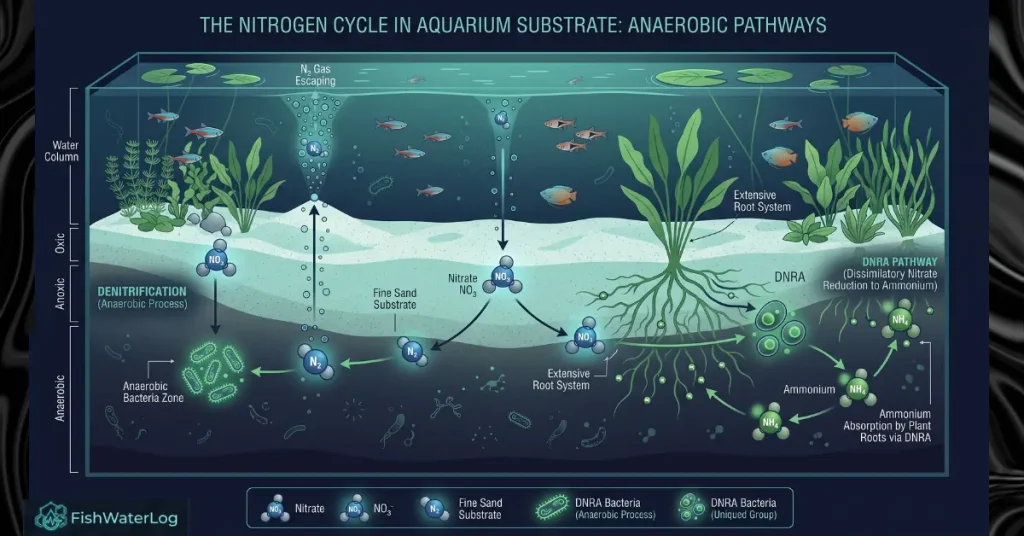
Nitrate reduction in suboxic benthic horizons does not proceed exclusively through the denitrification pathway. In oxygen-depleted substrate zones, true denitrification directly competes with dissimilatory nitrate reduction to ammonium (DNRA) for available nitrate (NO3-) ions.
While complete denitrification permanently strips nitrogen from the aquatic ecosystem by off-gassing dinitrogen (N2), DNRA reduces nitrate back into bioavailable ammonium (NH4+), recycling the nitrogen within the interstitial sediment matrix.
The primary biogeochemical switch governing which metabolic pathway dominates is the ratio of bioavailable organic carbon (electron donors) to oxidized nitrogen (electron acceptors), universally known as the C/N ratio. However, aquarists must be aware of the ‘Planted Tank Paradox.’ Heavy root-feeding macrophytes (such as Echinodorus or Cryptocoryne) actively exude molecular oxygen into the surrounding substrate to protect their delicate root hairs from phytotoxic hydrogen sulfide—a biological defense mechanism known as radial oxygen loss (ROL). This intense localized oxygenation effectively destroys the strict anaerobic zones required for dissimilatory denitrification wherever roots penetrate. Therefore, a densely planted deep sand bed functions primarily as an oxygenated assimilatory nutrient sink rather than a true gas-exporting anaerobic filter.
Because deep sand beds strictly limit oxygen and encourage anaerobic decomposition, epiphytic plants will rapidly decay if improperly planted. Aquarists must never bury rhizome-based plants in a deep sand bed; instead, follow our Anubias planting and pruning guide to safely attach them to upper hardscape elements where oxygen is plentiful.
| Environmental Matrix Condition | Carbon-to-Nitrogen (C/N) Ratio | Dominant Microbial Pathway | Primary Biochemical End-Product | Ecosystem Level Implication |
|---|---|---|---|---|
| High Organic Carbon, Low Nitrate | Elevated (> 8:1) | DNRA | Ammonium (NH4+) | Nitrogen retention; fuels macrophyte root zones |
| Low Organic Carbon, High Nitrate | Depleted (< 3:1) | Denitrification | Dinitrogen Gas (N2) | Permanent nitrogen export; reduces toxic load |
| Intermediate Substrate (e.g., Acetate) | Moderate (3:1 to 8:1) | Competitive Coexistence | N2 and NH4+ | Dynamic equilibrium based on localized pore microgradients |
Thermodynamically, DNRA yields higher free energy per molecule of nitrate consumed, conferring a survival advantage to DNRA-performing species (such as Shewanella loihica, Aeromonas, and Enterobacter) in nitrate-limited environments. In contrast, true denitrifiers harvest higher free energy per unit of organic carbon oxidized, making denitrification the dominant biological pathway in carbon-limited benthic sediments.
The molecular composition of available carbon also guides pathway selection. Labile, fermentable substrates like glucose stimulate DNRA activity, whereas non-fermentable organic acids like acetate or citrate favor true denitrification. To fully comprehend the thermodynamic constraints that govern whether a system exports nitrogen gas or retains it for plant growth, review the detailed microbial studies regarding dissimilatory nitrate reduction to ammonium available through leading biogeochemical research databases.
In densely planted substrates featuring organic soils beneath a silica sand cap, the slow decay of humic compounds produces a localized high C/N ratio, prompting beneficial DNRA that stores ammonium across negative cation exchange capacity (CEC) clay sites for plant uptake. Conversely, to maximize permanent nitrogen export via freshwater deep sand bed denitrification in unplanted or heavily stocked tanks, the benthic bed must be structured with a lower C/N balance so that electron-acceptor-rich denitrification remains the prevailing metabolic route.
Iron-Sulfur Biogeochemistry: Managing the Black Anaerobic Sand Layer
Directly beneath the suboxic transition horizon, benthic substrates enter an absolute anoxic regime. Once pore-water nitrate (NO3-) and bioavailable manganese are fully depleted, specialized heterotrophic sulfate-reducing bacteria (SRB) utilize sulfate (SO4 2-) as a terminal electron acceptor to break down residual organic matter, generating volatile hydrogen sulfide (H2S) as a metabolic byproduct.
Free hydrogen sulfide is a potent neurotoxin and phytotoxin that binds cellular cytochrome c oxidase, creating a severe biohazard for aquatic fauna if allowed to escape freely into the water column. However, natural benthic chemistry incorporates an automatic stoichiometric defense: the iron-sulfur geochemical nexus.
When biological sulfate reduction takes place alongside bioavailable, reduced ferrous iron (Fe2+), the iron instantly complexes with dissolved sulfide to form insoluble iron(II) sulfide (FeS), commonly identified as mackinawite:
Fe2+ + H2S -> FeS (s) + 2H+
Over time, further sulfur integration transforms mackinawite into greigite (Fe3S4) and ultimately stable pyrite (FeS2).
A pervasive myth in the hobby is that any gas bubble rising from a deep sand bed is lethal hydrogen sulfide. In reality, chemical analysis indicates that escaping bubbles are overwhelmingly composed of harmless carbon dioxide (CO2) and methane (CH4), the standard byproducts of anaerobic decomposition. Furthermore, nature provides a secondary biological failsafe: highly specialized chemosynthetic bacteria, such as Beggiatoa spp., colonize the exact chemocline where oxic and anoxic layers meet. These organisms aggressively oxidize trace hydrogen sulfide back into elemental sulfur or sulfate the moment it diffuses upward, preventing the toxin from ever reaching the water column.
Visually, this precipitation process is responsible for the distinct black anaerobic sand layer frequently observed along the bottom glass of mature aquariums. This localized darkening does not indicate systemic biological rot; rather, it provides visual confirmation that the substrate’s mineral buffer is actively functioning. The ferrous iron acts as an immovable chemical sponge, locking reactive sulfur into an inert mineral matrix.
Successfully preventing hydrogen sulfide pockets in sand substrate requires active iron balance management. As long as the stoichiometric abundance of interstitial iron exceeds the rate of bacterial sulfate reduction, hydrogen sulfide cannot accumulate as free gas pockets. Incorporating iron-bearing laterite, mineralized clay, or specialized iron-rich basal additives beneath a fine sand barrier provides a long-term buffer that neutralizes volatile sulfides while sustaining the deeper metabolic machinery of freshwater deep sand bed denitrification.
Furthermore, for a deeper understanding of how heavy metals neutralize sediment toxicity in deep aquatic zones, researchers can examine the specific precipitation kinetics of iron sulfide formation in anoxic environments.
Electrogenic Sulfur Oxidation and Cable Bacteria
Recent discoveries in sediment biogeochemistry highlight a unique biological mechanism that circumvents the traditional stepwise redox ladder: electrogenic sulfur oxidation mediated by multicellular, filamentous microorganisms termed cable bacteria.
Cable bacteria physically span across the vertical sediment horizons, bridging deep anaerobic strata to the aerobic sediment-water interface over distances spanning several centimeters. They act as living biological conductors, transferring electrons along their longitudinal cellular axes from the deep anoxic zones (the anode) directly to the oxygen-rich surface layer (the cathode). This internal electric current bypasses the physical requirement for downwelling dissolved oxygen to diffuse into the deep substrate bed.
This electrogenic pathway induces spatial decoupling of reduction-oxidation half-reactions, driving dramatic localized pH shifts across the benthic profile:
- Cathodic Surface Horizon: Oxygen reduction at the oxic surface consumes protons (H+), creating an alkaline microenvironment where pore water pH exceeds 8.5.
- Anodic Deep Horizon: Sulfide oxidation within deep horizons releases protons, generating highly localized acidic pockets where pH drops below 6.5.
This localized acidification at depth dissolves sequestered iron(II) sulfides (FeS), freeing ferrous iron (Fe2+) to migrate upward through concentration gradients and reprecipitate as fresh iron oxides within oxic boundaries. This biological recycling loop continually regenerates the substrate’s natural iron-buffering capacity, preventing free sulfide buildup and securing the stable baseline required for freshwater deep sand bed denitrification.
Infaunal Bioturbation: Malaysian Trumpet Snail Aeration
While maintaining vertical redox stratification is essential, a completely static substrate bed risks severe physical compaction, localized mineral depletion, and eventual unchecked progression into methanogenesis. In natural benthic habitats, substrate viability is preserved through infaunal bioturbation—the continuous physical reworking of sediments by benthic organisms.
In closed freshwater aquariums, deliberate malaysian trumpet snail aeration (Melanoides tuberculata, Thiara winteri, Stenomelania torulosa) provides this precise biomechanical service. Unlike standard ornamental snails that feed exclusively on surface biofilms, trumpet snails are obligate substrate sifters that burrow deeply into the sand matrix during illuminated hours.
Their bioturbating behavior supports the stability of a deep sand bed through three core mechanisms:
- Targeted Micro-Oxygenation: Burrowing generates microscopic, transient pore-water channels that draw minute amounts of oxygenated water into the upper fringes of the suboxic zone. This trace oxygen flux prevents the oxidation-reduction potential from dropping precipitously into toxic methanogenesis, all while keeping the broader anoxic gradients required for denitrification intact.
- Detrital Translocation: Snails consume labile organic detritus resting on the sediment surface and excrete processed metabolic byproducts deeper within the bed. This continuous transport delivers essential organic carbon electron donors directly to deep-dwelling denitrifiers and DNRA consortia, preventing surface eutrophication.
- Mineral Turnover and Surface Renewal: Constant mechanical shifting of fine sand particles exposes fresh surface areas of buried iron and manganese minerals to interstitial pore water. This maximises chemical contact efficiency, ensuring reactive iron remains available to precipitate free sulfides and stabilize the bed against toxic gas release.
By introducing these infaunal biological engineers, an otherwise hazardous, compacted substrate is converted into a self-regulating, bioactive filtration matrix that mirrors natural riverine biogeochemistry.
Structural Element Strategic Data Assignment and Gap Analysis
A critical distinction often missed in aquatic husbandry is the difference between dissimilatory and assimilatory denitrification. When hobbyists observe sudden nitrate drops in freshwater substrates, it is frequently due to assimilatory denitrification—where bacteria, fungi, and algae absorb nitrate to build cellular biomass (visible as ‘brown gunk’ or mulm). Unlike true dissimilatory denitrification that permanently exports inert dinitrogen gas (N2) into the atmosphere, assimilatory processes merely sequester nitrogen in the substrate, requiring the aquarist to physically vacuum out the detritus before it decomposes and causes ammonia spikes.
A detailed review of conventional aquarium husbandry literature reveals a widespread misconception: the claim that deep sand beds do not reduce nitrates in freshwater systems, or conversely, that they inevitably lead to sudden, lethal toxic gas releases.
This knowledge gap stems from a failure to address depth-to-porosity ratios, hydrodynamic constraints, and stoichiometric carbon balances:
- Substrate Depth and Pore Hydraulics: Many failed trials utilized shallow substrate beds under 3 inches, coarse pea gravel, or excessive water turnover, allowing advective oxygen flow to completely suppress suboxic enzyme induction.
- Carbon Priming Deficits: Heterotrophic denitrifiers require an organic electron donor. Unlike marine setups where coral exudates provide dissolved organics, unplanted freshwater substrates lacking humic basal layers rapidly become carbon-limited, stopping nitrate reduction entirely despite anoxic conditions.
- Engineered Stratification: Sustainable benthic filtration requires an organic-rich lower layer sealed by a dense 60-mesh sand cap to facilitate the slow, upward diffusion of dissolved organic carbon directly intersecting downwelling nitrates.
| Strategic Parameter | Conventional Aquarium Myth | Biogeochemical Reality | Target Implementation Standard |
|---|---|---|---|
| Benthic Substrate Depth | Sand depths over 2 inches cause toxic crashes. | Depths under 3 inches permit excessive oxygen infiltration. | Maintain 3.0 to 6.0 inches (7.5–15 cm) using fine sand. |
| Media Grain Size | Coarse gravel promotes better biological flow. | Coarse aggregates flush oxygen, blocking nitrate reductase. | 60-mesh fine silica sand (0.05–0.5 mm). |
| Carbon Availability | Substrates must be sterile and debris-free. | Denitrifiers halt activity without an electron donor. | Prime base with mineralized soil, humics, or root systems. |
| Sediment Infauna | Snails disrupt pristine substrate cleanliness. | Compaction leads to stagnant, runaway methanogenesis. | Stock obligate burrowing snails for micro-aeration. |
Conclusion
The successful implementation of benthic biological filtration in freshwater systems transcends basic aesthetic substrate choices; it is an exercise in applied biogeochemistry. By deliberately establishing a substrate grain size boundary utilizing fine 60-mesh sand at a minimum depth of three to six inches, aquarists can reliably induce the precise vertical stratification required to trigger the suboxic redox ladder. This stratification supports complex microbial communities capable of executing both true denitrification for permanent nitrogen export and dissimilatory nitrate reduction to ammonium (DNRA) for sustainable plant fertilization.
While the inevitable thermodynamic progression into sulfate reduction yields potentially hazardous hydrogen sulfide, the strategic inclusion of iron-rich compounds safely sequesters this gas as inert iron sulfide, forming the characteristic, yet highly protective, black anaerobic sand layer. Finally, the introduction of obligate infaunal engineers, notably Malaysian trumpet snails, provides the necessary bioturbation to maintain the chemical stability and longevity of the redox gradient. Ultimately, a freshwater deep sand bed is not merely a physical mechanical filter, but a highly complex, robust, and self-regulating biological ecosystem.
Frequently Asked Questions
What is the minimum substrate depth required to achieve denitrification in a freshwater tank?
To establish the strict suboxic and anoxic conditions necessary for heterotrophic denitrification, the fine-grained sand substrate must be poured to a minimum depth of three to four inches (7.5 to 10 cm). If using slightly larger or more porous materials, significantly deeper beds are required to exhaust the downward diffusion of oxygen.
Why is my deep sand bed turning black against the glass, and is it dangerous?
The black coloration is iron sulfide (FeS), a mineral precipitate formed when toxic hydrogen sulfide gas reacts with trace iron present in the substrate. This black layer is safe and serves as a visual indicator that your substrate’s chemical buffering capacity is actively neutralizing toxic sulfide before it can escape into the water column.
Should I use a gravel vacuum to stir or clean a deep sand bed?
No. Deep siphon vacuuming physically destroys the substrate grain size boundary, driving highly oxygenated water deep into the anoxic and anaerobic strata. This mechanical disruption instantly halts denitrification, oxidizes beneficial anaerobic consortia, and can release trapped pockets of gases. Only lightly vacuum the absolute surface layer.
Do Malaysian trumpet snails destroy the anaerobic zone by burrowing?
No, they preserve it. Malaysian trumpet snails provide micro-aeration; their tiny burrows introduce localized, microscopic amounts of oxygen that prevent the substrate’s redox potential from plummeting into severe methanogenesis, while leaving the broader macroscopic anoxic gradient intact for continued denitrification.
Does a deep sand bed produce nitrogen gas or ammonium?
It produces both, dictated by the internal carbon-to-nitrogen (C/N) ratio of the substrate. If organic carbon is abundant (such as in botanical or dirted tanks), the community favors DNRA, retaining nitrogen as bioavailable ammonium for plant roots. If carbon is limited relative to nitrate, it favors true denitrification, safely off-gassing N₂ gas.
Can I use a Remote Deep Sand Bed (RDSB) for freshwater?
Yes. Because deep sand beds can deplete KH and take up valuable vertical display space, many advanced freshwater aquarists build Remote Deep Sand Beds (RDSBs) in a 5-gallon bucket or sump. Plumbed with slow-flowing, pre-filtered water, an RDSB provides massive anaerobic bacterial surface area and can be easily disconnected from the main system if it accumulates too much detritus or crashes.
