
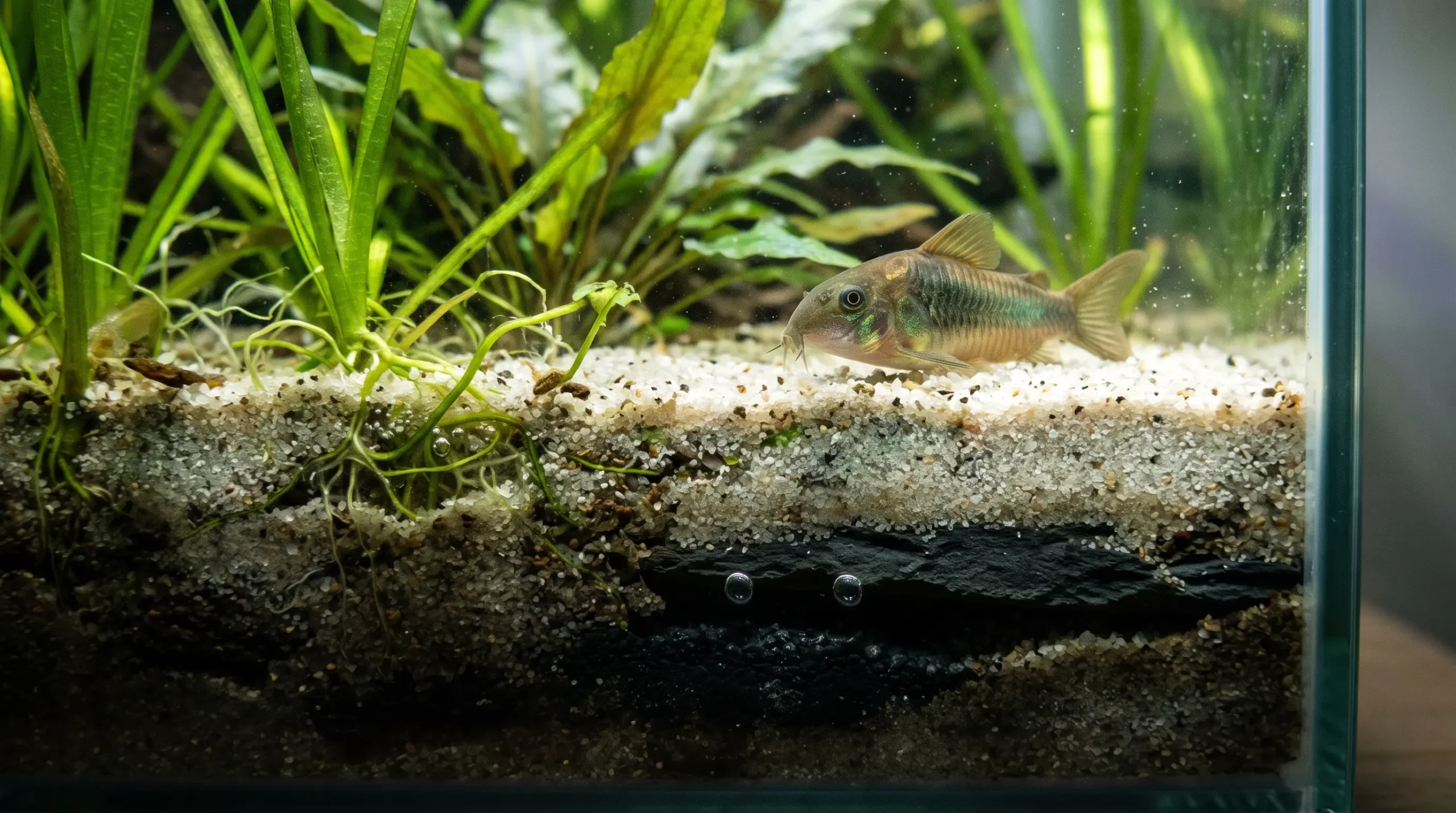
Few topics in modern aquatic husbandry generate as much persistent anxiety as sand substrate anaerobic pockets. When an aquarist prods an established aquarium sand bed during routine gravel vacuuming or planting and watches silvery gas bubbles erupt toward the surface, hobbyist forum lore immediately sounds the alarm for a lethal hydrogen sulfide event. Naturally, cultivators across all experience levels urgently question: are anaerobic gas pockets in aquarium sand dangerous to bottom-dwelling fish, ornamental dwarf shrimp, and delicate vascular plant roots?
Separating biological reality from persistent substrate mythology requires examining the fundamental biogeochemistry of deep sediment horizons. Pure, inert quartz or silica sand beds—even when layered to depths of three to five inches—cannot spontaneously generate toxic gas plumes without digestible organic electron donors and an absolute depletion of dissolved oxygen. In standard freshwater aquariums receiving balanced maintenance, rising bubbles consist predominantly of harmless trapped air from initial filling, metabolic carbon dioxide (CO2) produced by aerobic heterotrophs, or localized volatile organic acids.
However, dismissing substrate compaction entirely overlooks localized anoxic micro-environments where buried proteinaceous detritus, decaying plant crowns, or unmineralized soil underlays can stall interstitial porewater diffusion. Understanding how these reduced sediment zones truly function enables hobbyists to manage fine sand substrates safely while fostering pristine benthic health.
Table of Contents
Competitor Landscape and Content Gap Analysis
An evaluation of high-authority aquarium publications reveals a polarized and scientifically incomplete coverage of sand substrate anaerobic pockets. Existing hobbyist and commercial literature falls into two opposing camps, leaving major biochemical and toxicological gaps that this analysis resolves. The dominant alarmist narrative across traditional blogs and marine reef guides asserts that any fine sand bed exceeding two to three inches inevitably compacts, traps organic detritus, and generates lethal hydrogen sulfide (H2S) gas bubbles capable of annihilating livestock upon disturbance.
Simultaneously, these same guides claim that deep sand zones effortlessly reduce water-column nitrates (NO3–) into harmless nitrogen gas (N2). Such publications fail to explain the strict thermodynamic prerequisites required for biological sulfate reduction or why rising gas bubbles rarely transfer dissolved toxins into the bulk water column.
Conversely, contrarian empirical testing sites argue that anoxic or anaerobic conditions never occur inside home aquariums outside of the gastrointestinal tracts of fish, demonstrating through year-long tests of five-inch deep sand beds that neither anoxic denitrification nor hydrogen sulfide production takes place in standard setups. While this empirical perspective accurately exposes the inability of passive sand beds to denitrify bulk aquarium water, it overlooks localized micro-environments created when aquarists bury labile organic matter—such as uncomposted potting soil, decaying vascular root structures, or buried proteinaceous foods—beneath fine silica caps in the presence of sulfate fertilizers.
When investigating are anaerobic gas pockets in aquarium sand dangerous, establishing definitive topical authority requires bridging four critical content gaps absent from existing aquarium literature:
- Dissolved Oxygen Stratification: Mapping the quantitative five-stage dissolved oxygen gradient from aerobic porewater (2.0 to 8.0 ppm O2) down to obligate anaerobic horizons (< 0.08 ppm O2) where sulfate-reducing bacteria operate.
- Stoichiometric Iron Sulfide (FeS) Sequestration: Explaining why black discoloration in sand beds is actually an insoluble mackinawite mineral precipitate that locks away sulfide ions and protects aquatic fauna.
- pH-Dependent Aqueous Dissociation Kinetics (pKa1 = 7.04): Integrating U.S. Environmental Protection Agency (EPA) toxicological thresholds to demonstrate how water column pH governs the partition between lethal un-ionized H2S and comparatively benign bisulfide (HS–) ions.
- The Sulfate Fertilizer Trap: Exposing how commercial potassium and magnesium sulfate fertilizers fuel sulfide phytotoxicity in dirted and Walstad-style planted aquariums.
The Biogeochemistry of Sand Substrate Anaerobic Pockets
The Great Substrate Debate: Are Anaerobic Gas Pockets in Aquarium Sand Dangerous?
Few topics in aquatic husbandry provoke as much apprehension as sand substrate anaerobic pockets. When an aquarist prods a mature sand bed with aquascaping tweezers or a vacuum tube and observes large gas bubbles rising to the surface, conventional forum wisdom immediately diagnoses a catastrophic hydrogen sulfide outbreak. Consequently, novice and veteran cultivators alike frequently ask: are anaerobic gas pockets in aquarium sand dangerous to benthic fish, ornamental shrimp, and vascular plants?
The scientific reality requires separating pure mineral physics from organic microbial metabolism. Inert silica or quartz sand, even when layered to depths of three to five inches, cannot spontaneously generate toxic gas. Microorganisms require an electron donor in the form of digestible organic carbon alongside a specific sequence of terminal electron acceptors to respire. In an unfertilized, purely mineral sand bed receiving standard surface maintenance, rising bubbles consist predominantly of trapped atmospheric air from initial tank filling, harmless carbon dioxide (CO2) generated by aerobic heterotrophic respiration, or localized fermentation gases.
Even when substrate pockets emit a foul, sewage-like odor upon disturbance, chemical testing confirms that the smell typically originates from volatile organic acids, skatoles, and aerobic or hypoxic bacterial exudates rather than hydrogen sulfide. Aggressive dredging or sudden upheaval of mature sand beds releases trapped organic particulates into the water column, which rapidly triggers heterotrophic blooms that require a targeted protocol to fix aquarium water cloudy white bacterial blooms before dissolved oxygen plummets.
However, dismissing all benthic gas pockets as completely benign is equally flawed. When fine-grained sand compacts over trapped labile organics—such as decaying root crowns, buried fish waste, or unmineralized potting soil—interstitial porewater circulation stalls completely. Under these specific conditions, localized hypoxia and bacterial toxin accumulation can induce severe root necrosis, benthic gill irritation, and secondary heterotrophic bacterial blooms upon physical substrate disturbance.
Dissolved Oxygen Stratification and the Terminal Electron Acceptor Ladder
To understand how sand substrate anaerobic pockets evolve, the substrate bed must be analyzed as a vertical electrochemical gradient governed by Redox Potential (Eh) and interstitial porewater diffusion. Water flowing across the top of a sand bed carries dissolved oxygen (O2) through the upper millimeter-to-centimeter boundary layer via advective flow and molecular diffusion. As depth increases and fine grain geometries restrict hydraulic permeability, heterotrophic and autotrophic bacteria consume dissolved oxygen faster than downward diffusion can replenish it. Maintaining high dissolved oxygen in the upper sand horizon depends heavily on unimpeded atmospheric gas exchange at the air-water boundary, making it vital to install an aquarium biofilm surface skimmer to erase oily film that would otherwise depress system Oxidation-Reduction Potential (ORP).
Empirical sediment profiling divides a deep sand bed into five distinct biochemical horizons based on dissolved oxygen availability:
- Zone 1: Aerobic Horizon (2.0 to 8.0 ppm O2 | 0.0 to 1.5 in / 0 to 3.8 cm): Extends across the top one to two inches in well-circulated systems and supports aerobic heterotrophs. Within the oxygenated upper two inches of the substrate, pioneer ammonia-oxidizing bacteria and high-affinity Comammox Nitrospira drive the aquarium nitrogen cycle and biofiltration process, consuming bicarbonate alkalinity as they oxidize nitrogenous waste into nitrite (NO2–) and nitrate (NO3–). Zero toxic sulfides exist in this clean-toned sand horizon.
- Zone 2: Hypoxic Horizon (1.0 to 2.0 ppm O2 | 1.5 to 2.5 in / 3.8 to 6.4 cm): Oxygen diffusion slows sufficiently to halt obligate autotrophic nitrification while facultative heterotrophs continue mineralizing organic carbon into carbon dioxide (CO2). This transitional layer remains completely harmless to livestock.
- Zone 3: Hypoxic Fermentation Horizon (0.3 to 1.0 ppm O2 | 2.5 to 3.5 in / 6.4 to 8.9 cm): Facultative anaerobes switch to fermentative pathways, breaking down trapped complex detritus into short-chain volatile fatty acids (VFAs), organic aldehydes, and foul-smelling bacterial exudates. When aquarists disturb a neglected substrate and detect an odor resembling raw sewage or marsh gas, those volatile compounds originate from this fermentative horizon rather than hydrogen sulfide.
- Zone 4: Anoxic Horizon (0.08 to 0.3 ppm O2 | 3.5 to 4.5 in / 8.9 to 11.4 cm): Free molecular oxygen is virtually absent. Facultative bacteria strip oxygen atoms first from nitrate (NO3–) and nitrite (NO2–), and subsequently reduce manganese (Mn4+) and ferric iron (Fe3+) into dissolved ferrous iron (Fe2+), which primes the sand to chemically bind sulfur.
- Zone 5: Obligate Anaerobic Horizon (< 0.08 ppm O2 | > 4.5 in or Blocked Pocket): Only after dissolved oxygen plunges below 0.08 ppm and all interstitial nitrates, nitrites, and oxidized iron reserves are exhausted can obligate anaerobic sulfate-reducing bacteria utilize sulfate (SO42-) as a terminal electron acceptor. Even then, generated H2S is rapidly immobilized as black iron sulfide (FeS) precipitate. This thermodynamic hierarchy explains why sand substrate anaerobic pockets rarely produce dangerous free hydrogen sulfide in standard aquariums: as long as nitrate remains present in the interstitial porewater, redox potential stays poised well above the threshold required for sulfate reduction.
Debunking the Deep Sand Bed Denitrification Myth
For decades, marine and freshwater literature promoted the “Deep Sand Bed” (DSB) methodology, claiming that maintaining four to six inches of fine sand fosters anoxic bacterial guilds that convert water-column nitrates (NO3–) into nitrogen gas (N2), thereby eliminating the need for routine water exchanges. Controlled year-long experiments across multiple five-inch deep sand beds have thoroughly refuted this hypothesis, demonstrating zero measurable anoxic denitrification to nitrogen gas.
The failure of deep sand beds to denitrify aquarium water stems from a fundamental hydrodynamic paradox. Effective dissimilatory denitrification requires continuous advective transport of nitrate-rich water into an oxygen-free chamber containing abundant organic carbon, followed by the exhaust of the resulting nitrogen gas. In a fine sand bed, the very compaction and low hydraulic permeability that prevent oxygen from entering the lower layers simultaneously block nitrate molecules in the overlying water column from diffusing downward into the anoxic zone. Where nitrate reduction does occur in low-protein aquarium systems, it takes place via assimilatory denitrification—a process in which growing microbial biomass, fungi, and vascular plant roots incorporate nitrogen directly into cellular proteins—rather than anaerobic gas off-gassing.
Chemical Kinetics: Hydrogen Sulfide Toxicity vs. Iron Sulfide Buffering
pH-Dependent Dissociation (pKa1 = 7.04) and Teleost LC50 Thresholds
When true obligate anaerobic conditions develop—such as beneath a non-porous slab of slate rock pressing into organic soil, or around a buried decaying fish carcass in sulfate-rich water—sulfate-reducing bacteria produce hydrogen sulfide (H2S). In aquatic toxicology literature, hydrogen sulfide is classified alongside hydrogen cyanide as a potent mitochondrial poison that irreversibly binds to cytochrome c oxidase, rapidly arresting cellular respiration across aquatic fauna.
Just as total ammonia nitrogen (TAN) partitions between harmless ammonium (NH4+) and lethal un-ionized ammonia (NH3) based on pH and temperature, dissolved hydrogen sulfide is a weak diprotic acid governed by a primary dissociation equilibrium:
H₂S(aq) ⇌ H⁺ + HS⁻ (pKa₁ = 7.04 at 25 °C)
The physiological toxicity of sulfide solutions to freshwater fish depends overwhelmingly on ambient molecular H2S gas, which diffuses freely across branchial epithelia into blood capillaries, whereas the dissociated bisulfide ion (HS–) exhibits vastly lower direct toxicity. Because the pKa1 of hydrogen sulfide is 7.04 at 25°C, exactly 50% of total dissolved sulfide exists as toxic un-ionized H2S at neutral pH.
In an acidic planted aquarium operating at pH 6.0, 90% of total sulfide remains in the lethal un-ionized H2S gas phase. Because acidic water shifts 90% of dissolved sulfide into its lethal un-ionized gas form, aquarists must prevent biological acidification by applying the best low KH aquarium fix for water chemistry to keep carbonate buffering stable above 3 to 4 dKH. Conversely, in an alkaline rift-lake cichlid or marine aquarium at pH 8.0, 90% of the chemical dissociates into the comparatively benign HS– ion, leaving only 10% as molecular H2S.
Furthermore, aquatic toxicology benchmarks demonstrate that thermal elevation drastically accelerates sulfide mortality. In fathead minnows (Pimephales promelas), the 96-hour median lethal concentration (LC50) drops from 0.5800 mg/L H2S in cold water (6.5°C) down to 0.0367 mg/L at 20.0°C, and plunges to 0.0280 mg/L at tropical aquarium temperatures (25.0°C).
Across broader freshwater taxa, acute LC50 tolerances range from 0.003 mg/L in sensitive whitefish (Coregonus clupeaformis) to 3.0 mg/L in hardy mosquitofish (Gambusia affinis). Sublethal exposure to benthic toxins or hypoxic porewater plumes manifests rapidly in bottom-dwelling species, producing telltale behavioral anomalies detailed in this clinical breakdown of 10 symptoms of stress in freshwater fish, including surface piping and erratic substrate flashing. According to empirical aquatic toxicology benchmarks cited in comprehensive reviews on Hydrogen Sulfide aquatic toxicity and chemical kinetics, dissolved un-ionized hydrogen sulfide concentrations exceeding just 0.002 mg/L pose chronic hazards to freshwater teleosts and benthic invertebrates, with acute LC50 mortality intensifying sharply as water temperatures approach 25°C.
Despite these extreme micro-toxicity thresholds, rising gas bubbles from sand substrate anaerobic pockets rarely poison livestock in the water column due to two concurrent physicochemical safety barriers. First, hydrogen sulfide possesses a high Henry’s Law volatility constant, driving rapid mass escape from rising bubbles directly into ambient atmospheric room air before meaningful dissolution into the water column occurs.
Second, any trace H2S that does dissolve into oxygen-saturated bulk water undergoes rapid aerobic chemical and biological oxidation, reacting with dissolved oxygen (O2) and chemoautotrophic sulfur-oxidizing bacteria (such as Thiobacillus and Macromonas species) at the sediment-water interface to form harmless elemental sulfur (S0), thiosulfate (S2O32-), and sulfate (SO42-).
Why Aquarium Sand Turns Black: The Iron Sulfide (FeS) Safety Valve
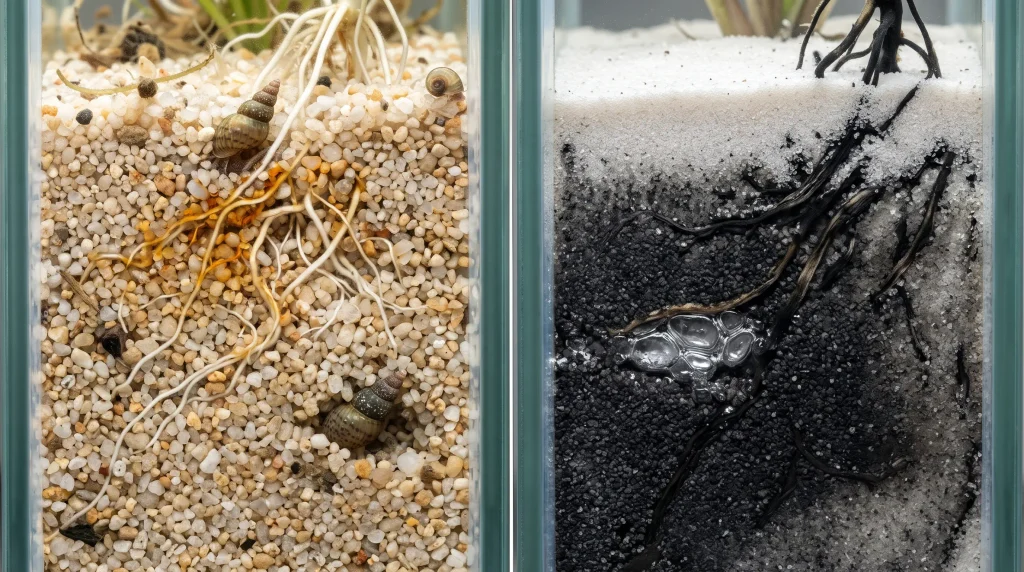
Visual comparison: healthy plant root development in aerated sand (left) versus black iron sulfide staining and sand substrate anaerobic pockets (right).A primary visual symptom that alarms aquarists inspecting the front glass pane of an aquarium is the appearance of dark gray or jet-black patches beneath the surface of the sand bed. While widely feared as volatile reservoirs of free poison, this black discoloration is actually solid iron sulfide (FeS)—specifically the tetragonal mineral mackinawite—which functions as an endogenous chemical safety valve.
In Zone 4 and Zone 5 of a reduced sediment bed, iron-reducing bacteria reduce insoluble ferric iron (Fe3+) into dissolved ferrous iron (Fe2+). When sulfate-reducing bacteria subsequently generate trace sulfide ions (H2S / HS–), the dissolved ferrous iron reacts instantaneously to precipitate insoluble black iron sulfide:
Fe2+(aq) + HS–(aq) → FeS(s, black precipitate) ↓ + H+
Rather than representing poisonous gas waiting to erupt, black sand patches prove that the substrate’s iron reserves have chemically bound and immobilized the sulfide into a non-volatile solid mineral. As long as iron remains available within the substrate matrix—which is abundant in clay soils, laterite, and iron-supplemented planted aquariums—free hydrogen sulfide cannot accumulate in the porewater. When black iron sulfide sand is later exposed to oxygenated water during light maintenance, it gradually re-oxidizes into harmless tan ferric oxyhydroxides and sulfate.
The Sulfate Fertilizer Trap in Capped Planted Substrates
If pure silica sand cannot spontaneously generate hydrogen sulfide and iron naturally immobilizes trace sulfides, specific management errors explain when sand substrate anaerobic pockets turn genuinely hazardous. As documented in microbiologist Diana Walstad’s Planted Substrate Ecology Framework, capping organic potting mixes with an overly thick sand layer blocks oxygen entry from overlying water, whereas soils containing excessive chemical sulfates actively generate root-killing hydrogen sulfide upon submergence.
When aquarists set up a dirted tank or Walstad-style aquarium using uncomposted potting mix capped with fine sand, two interacting factors determine whether the rhizosphere thrives or collapses. First, a fine sand cap exceeding 0.75 to 1.0 inch over rich organic soil severely restricts downward dissolved oxygen diffusion, as fine silica grains settle and compact, sealing the decomposing organic matter below.
Second, while standard tap water contains low sulfate levels that naturally limit sulfate reduction, potting soils pre-enriched with agricultural chemical fertilizers or tanks dosed heavily with sulfate-based general hardness (GH) boosters—such as potassium sulfate (K2SO4) and magnesium sulfate (MgSO4)—flood interstitial porewater with excess sulfate ions.
Under these sulfate-saturated, carbon-rich anaerobic conditions, biological sulfate reduction rapidly outpaces available iron binding capacity, accumulating free H2S within the root zone. Because hydrogen sulfide is a potent phytotoxin, it damages vascular plant roots upon contact, turning them black and triggering widespread root melt. To prevent this chemical cascade, Walstad methodology dictates capping organic potting mix with a thin sand layer of no more than 0.5 to 0.75 inch and utilizing calcium carbonate and magnesium carbonate mineral blocks rather than soluble sulfate salts to maintain general hardness.
| Diagnostic Parameter | Trapped Atmospheric Air | Aerobic / Fermentative CO2 & Organic Gas | Iron Sulfide (FeS) Sequestration Zone | Acute Hydrogen Sulfide (H2S) Pocket |
|---|---|---|---|---|
| Primary Gas / Compound | N2 (78%), O2 (21%), trace atmospheric gases. | Carbon dioxide (CO2), methane (CH4), trace volatile organic acids. | Solid mackinawite (FeS) mineral precipitate; bound non-volatile sulfur. | Un-ionized H2S gas and dissolved bisulfide (HS–) ions. |
| Dissolved Oxygen (O2) Horizon | 2.0 to 8.0 ppm (Aerobic Horizon) | 0.3 to 2.0 ppm (Hypoxic / Fermentative) | < 0.08 ppm (Anaerobic with Fe2+ buffer) | < 0.08 ppm (Obligate Anaerobic; Fe2+ depleted) |
| Olfactory Signature (Smell) | Completely odorless. | Earthy, musty, damp compost, or foul silage/sewage odor (volatile fatty acids). | Faint metallic or mild earthy scent; no sharp rotten-egg gas release. | Pungent, unmistakable, sharp “rotten egg” hydrogen sulfide stench. |
| Visual Substrate Appearance | Clean, uniform sand color; shiny silvery bubbles visible against the front glass pane. | Normal tan sand with organic mulm layer; healthy tan or pale white root structures. | Distinct dark gray or jet-black staining on sand grains; localized charcoal streaks against glass. | Blackened, liquefying necrotic plant roots; white filamentous Beggiatoa bacterial mats. |
| Biological Impact on Fauna |
✓
Zero Toxicity
Completely safe for fish & shrimp. | Harmless in Bubbles Massive stirring of thick mulm can trigger secondary bacterial blooms. |
✓
Safe While Undisturbed
Solid FeS successfully locks sulfur away from porewater. |
✕
Highly Toxic
Lethal to vascular roots; severe gill irritation and hypoxia if violently dredged. |
| Recommended Remediation | Gently stir top 0.5 in of sand after initial tank filling to vent trapped atmospheric air. | Hover vacuum 0.5 in above surface to lift mulm; avoid deep burying of dry fish foods. | Leave deep layers undisturbed; iron sulfide gradually oxidizes back to tan ferric oxide if exposed to O2. | Siphon localized black pocket directly out into a waste bucket; execute 30%–50% water change; run fresh activated carbon. |
Botanical Root Ecology, Radial Oxygen Loss, and Bioturbation
The most effective defense against sand substrate anaerobic pockets is biological engineering rather than aggressive mechanical stirring. In nature, aquatic macrophytes—such as Echinodorus (Amazon Swords), Vallisneria, and Cryptocoryne species—evolved specialized spongy tissues with continuous internal air channels called aerenchyma. Through a physiological mechanism known as Radial Oxygen Loss (ROL), healthy vascular plants transport photosynthetically generated oxygen from their leaves down into their root tips, leaking molecular O2 into the surrounding rhizosphere. This oxygen halo oxidizes toxic ferrous iron (Fe2+) and sulfide (H2S) directly at the root surface, maintaining a positive redox potential (Eh) even within fine substrates.
However, a destructive feedback loop occurs when heavy root-feeders are planted into overly deep, unfertilized, compacted silica sand under weak lighting. Selecting ultra-fine, completely inert silica sand frequently suffocates delicate vascular root crowns and triggers hypoxic plant melt, a primary failure mode highlighted in the FishWaterLog best nano fish for 5 gallon tank expert guide.
Deprived of photosynthetically active radiation (PAR) and essential root nutrients, the plant cannot sustain Radial Oxygen Loss. The compacted sand suffocates the root crown, initiating massive hypoxic root melt. As the subterranean root biomass decays, it injects a surge of labile organic carbon directly into the oxygen-starved sand bed, fueling heterotrophic bacterial proliferation and secondary toxic pockets. When interstitial porewater circulation stalls and cation exchange sites become depleted, cultivators must systematically recharge old aquarium soil using deep-burial root tabs followed by an immediate 30% to 50% water exchange.
Key Prevention Protocols for Healthy Sand Beds
- Grain Size and Bed Depth Calibration: Selecting medium-grade quartz or pool filter sand (0.5 to 1.5 mm grain diameter) rather than ultra-fine sugar sand (< 0.2 mm) prevents mechanical interlocking, while limiting inert sand depth to 1.5 to 2.5 inches (or 0.5 to 0.75 inches when capping organic potting soil) preserves interstitial oxygen diffusion. Because a deep sand bed displaces 15% to 25% of gross tank capacity, aquarists should input exact substrate dimensions into the aquarium calculator and parametric log to calculate net working water volume before dosing conditioners or fertilizers.
- Benthic Bioturbator Deployment: Introducing burrowing invertebrates—specifically Malaysian Trumpet Snails (Melanoides tuberculata), Lumbriculus blackworms, or marine Nassarius snails—alongside gentle sand-sifting teleosts like Corydoras catfish continuously turns over the upper substrate horizon without rupturing deep anoxic zones.
- Hardscape Dead-Zone Prevention: Avoiding the placement of flat, non-porous slabs of slate or dense timber directly onto deep sand beds containing organic matter prevents localized anoxic seals; elevating heavy hardscape on hidden subsurface supports or coarse lava rock bags maintains interstitial water movement beneath the footprint.
- Surface-Only Siphoning Execution: Hovering the gravel vacuum 0.5 inches above the sand interface in a swirling motion during weekly water exchanges lifts settled flocculent detritus without dredging buried anaerobic layers into the water column.
- Sulfate Input Restriction in Dirted Tanks: Substituting sulfate-heavy remineralizing salts with carbonate and chloride mineral formulations in sand-capped soil aquariums starves sulfate-reducing bacteria of their required terminal electron acceptor.
Conclusion
The widespread apprehension surrounding sand substrate anaerobic pockets stems from conflating harmless fermentative carbon dioxide (CO2) bubbles and protective iron sulfide precipitates with acute hydrogen sulfide poisoning. Empirical sediment chemistry confirms that pure, inert quartz sand beds neither drive water-column denitrification nor release catastrophic clouds of toxic gas. Obligate biological sulfate reduction requires dissolved oxygen to drop below 0.08 ppm alongside the complete exhaustion of interstitial nitrates (NO3–) and ferric iron (Fe3+).
True sulfide phytotoxicity remains confined to mismanaged setups where rich organic matter is sealed beneath a compacted fine-sand cap exceeding one inch in the presence of heavy chemical sulfate fertilizers and acidic water conditions (pKa1 = 7.04). By maintaining proper bed depth (1.5 to 2.5 inches for inert sand, or 0.5 to 0.75 inches over organic soil), encouraging botanical Radial Oxygen Loss, deploying benthic bioturbators like Malaysian Trumpet Snails, and practicing hovering surface siphoning, aquarists can maintain clean, pristine sand beds with zero toxicological risk.
Frequently Asked Questions (FAQs)
Are anaerobic gas pockets in aquarium sand dangerous to fish?
When hobbyists ask are anaerobic gas pockets in aquarium sand dangerous, the short answer for standard aquariums is no. The vast majority of gas bubbles rising from sand beds consist of harmless trapped atmospheric air or metabolic carbon dioxide (CO2) generated by heterotrophic bacteria. Even if trace hydrogen sulfide (H2S) forms, it quickly escapes into the air above the water due to high volatility, while any dissolved fraction is rapidly oxidized into harmless sulfate by dissolved oxygen and beneficial bacteria at the sediment interface. Severe risks only develop if a heavily loaded, decomposing anaerobic pocket is aggressively dug up in an acidic, unoxygenated tank.
Why does aquarium sand turn black underneath the surface?
Black discoloration visible against the glass inside an established sand bed is caused by the precipitation of solid iron sulfide (FeS), specifically the mineral mackinawite. When low-oxygen bacteria reduce iron and trace sulfates simultaneously, dissolved ferrous iron (Fe2+) instantly binds with sulfide ions, creating an insoluble black coating across individual sand grains. This chemical reaction acts as an essential built-in safety valve, locking away potentially toxic sulfides into an inert, non-volatile solid matrix that cannot poison fish or shrimp.
Should aquarists stir or poke deep sand beds during maintenance?
Cultivators should only disturb the top 0.25 to 0.5 inches of the aerobic sand layer to sweep away surface mulm and disrupt benthic algae. Deep sand beds exceeding 2.0 to 2.5 inches—especially sand-capped potting soils in Walstad tanks—should never be forcefully plowed or stirred. Deep dredging ruptures vascular root systems, dislodges beneficial bacterial zones, and releases trapped interstitial ammonia and phosphates directly into the water column, frequently inducing stubborn cloudy bacterial blooms.
What is the ideal depth for an aquarium sand substrate?
For an unplanted or epiphyte-focused aquarium using inert quartz sand, a clean depth of 1.0 to 1.5 inches provides adequate stability while maximizing interstitial porewater oxygen diffusion. In planted aquariums featuring heavy root-feeders sustained by root tabs, a bed depth of 2.0 to 2.5 inches offers ample anchorage without severe compaction. If using sand as a protective top cap over organic potting soil, maintain a thin cap of just 0.5 to 0.75 inches so dissolved oxygen can readily diffuse downward into the biological rhizosphere.
How should an aquarist fix a sand bed that smells like rotten eggs?
If an unmistakable rotten-egg odor (signaling hydrogen sulfide) is detected during maintenance, stop stirring or prodding the substrate immediately. Lower a narrow siphon hose directly over the localized dark zone to vacuum out the black sand and decaying organic pocket straight into a waste bucket. Perform an immediate 30% to 50% partial water change using dechlorinated, well-aerated water, place fresh activated carbon into the filter to capture dissolved organic compounds, and verify that carbonate hardness (KH) and pH remain stable above neutral to prevent toxic acid-driven H2S speciation.
