

In the discipline of advanced aquatic ecosystem management, achieving absolute chemical, biological, and environmental stability remains the paramount objective. Historically, monitoring nitrogenous compounds, thermal gradients, and potential hydrogen (pH) constituted the baseline of water quality management. However, the critical limiting factor for cellular respiration in any closed ecosystem is dissolved oxygen (DO). Integrating an advanced aquarium dissolved oxygen meter elevates freshwater management from reactive observation into proactive, real-time telemetry.
For decades, aquarists relied on chemical drop tests or infrequent spot-checks that provided only delayed snapshots of saturation levels. Such discrete testing protocols fail to detect rapid shifts that drive livestock losses. While pH or ammonia fluctuate over days, an acute oxygen crash causes suffocation within minutes, offering zero biological buffer. Deploying a dedicated continuous dissolved oxygen monitoring aquarium setup is essential for real-time gas exchange kinetics tracking and total hypoxia prevention.
Modern telemetry powered by a luminescent optical sensor maintains freshwater habitats strictly within safe physiological parameters. By tracking circadian cycles and accounting for biological oxygen demand, automated systems pinpoint dangerous drops before anoxic thresholds occur. This data-driven framework transforms botanical aquaria and closed aquaculture into an exact science.
Table of Contents
The Thermodynamic Physics of Gas Exchange Kinetics
To fully leverage the capabilities of an aquarium dissolved oxygen meter, an exhaustive understanding of gas exchange kinetics is required. Oxygen enters a freshwater column through two primary pathways: atmospheric diffusion at the air-water interface and biochemical photosynthesis driven by submerged aquatic flora.
The solubility of atmospheric oxygen in water is fundamentally governed by Henry’s Law, which states that dissolved gas concentration is directly proportional to its atmospheric partial pressure above the liquid phase. However, the physical capacity of freshwater to hold dissolved oxygen is inversely correlated with water temperature.
Converting raw partial pressure telemetry into true dissolved oxygen concentration requires rigorous thermodynamic algorithms, explicitly derived from the foundational Benson and Krause (1984) equations and subsequent Garcia and Gordon (1992, 1993) limnological solubility fittings.
In addition to thermal gradients, ionic strength directly suppresses gas solubility via the salting-out effect. In hard-water planted setups, tanks undergoing therapeutic salt baths, or high-TDS aquatic environments, telemetry controllers must apply automated conductivity compensation (calibrated in µS/cm or ppt salinity) to prevent overestimating true dissolved oxygen saturation.
Freshwater DO Saturation and Thermal Dynamics
Cold water retains significantly higher concentrations of dissolved gases, whereas tropical freshwater systems operate at elevated thermal baselines with depressed saturation ceilings. Deploying a high-precision dissolved oxygen sensor is vital to track how thermal shifts compound hypoxic risks:
| Temperature (°C) | Maximum DO Saturation in Freshwater (mg/L at Sea Level) | Risk Factor for Tropical Species |
|---|---|---|
| 15.0°C | 10.08 mg/L | Low |
| 20.0°C | 9.09 mg/L | Minimal |
| 25.0°C | 8.26 mg/L | Moderate |
| 30.0°C | 7.56 mg/L | High (Requires continuous monitoring) |
| 35.0°C | 6.95 mg/L | Critical (Severe Hypoxia Risk) |
As temperatures rise, maximum saturation drops while aquatic metabolic rates surge, creating severe biological strain.
Surface Agitation and Fluid Turbulence Mechanics
Gas transfer efficiency relies heavily on boundary layer disruption. Without active fluid movement, the surface layer reaches rapid equilibrium with ambient air, blocking oxygen transfer to lower strata:
- Boundary Layer Bottlenecks: Stagnant water columns restrict diffusion to the uppermost millimeter, leading to lethal benthic hypoxia.
- Engineered Mechanical Turbulence: Spray bars, wavemakers, and aeration stones physically agitate the surface to drive steady gas exchange kinetics.
- Degassing and Ingress: Surface turbulence forces oxygen-depleted bottom water upward for rapid CO2 off-gassing and continuous oxygen ingress.
- Stratification Prevention: Mechanical disruption prevents chemical and thermal layering, ensuring uniform readings on your aquarium dissolved oxygen meter.
Continuous telemetry tracking via an optical probe ensures these thermodynamic constraints are monitored in real time, preventing sudden biological oxygen crashes. For a rigorous, peer-reviewed deep dive into the underlying thermodynamic physics of atmospheric gas solubility and hydrologic oxygen transfer rates, researchers should consult the extensive environmental databases maintained by the USGS Water Science School.
Quantifying Biological Oxygen Demand in Closed Ecosystems
Within any complex biological system, aggregate oxygen consumption must be carefully quantified and actively managed. This core metric is scientifically designated as biological oxygen demand (BOD)—the total mass of dissolved oxygen required by aerobic microorganisms to effectively decompose organic matter within the water column, combined with the baseline physiological respiratory requirements of the macrofauna (fish, invertebrates, and mollusks) inhabiting the ecosystem.
Deploying an aquarium dissolved oxygen meter provides the baseline telemetry necessary to quantify these dynamic metabolic shifts before an unmanaged biological load triggers lethal hypoxia.
The stoichiometric oxygen demand of autotrophic biofiltration is exceptionally rigorous: the complete oxidation of 1 mg of ammonia-nitrogen (NH4+-N) into nitrate requires precisely 4.57 mg of dissolved oxygen (comprising 3.43 mg O2 for the conversion to nitrite by Nitrosomonas and an additional 1.14 mg O2 for the subsequent oxidation to nitrate by Nitrobacter). The microbial growth rate (μ) across dual substrates is governed by Michaelis-Menten kinetics:
μ = μmax * [ S_NH4+ / (K_NH4+ + S_NH4+) ] * [ DO / (K_DO + DO) ]
When dissolved oxygen levels remain above 2.0 to 3.0 mg/L, nitrification kinetics operate as a zero-order reaction with respect to oxygen, where ammonia availability dictates the oxidation rate. However, if dissolved oxygen drops below the critical 2.0 mg/L threshold, the kinetics shift into a first-order reaction regarding oxygen. At this point, oxygen becomes the absolute rate-limiting factor, causing ammonia oxidation to stall rapidly and risking a catastrophic biofilter crash.
Drivers of Elevated Biological Oxygen Demand
In a closed freshwater environment, the biological oxygen demand is exceptionally dynamic and never static:
- Exogenous Organic Loading: The introduction of exogenous organic matter—such as high-protein commercial feeds, decaying botanical matter, or deceased organisms—triggers an immediate, exponential proliferation of heterotrophic bacterial colonies. As these bacteria enzymatically break down the detritus, they consume vast quantities of dissolved oxygen from the surrounding water.
- Aerobic Nitrification Demands: Furthermore, the foundational nitrogen cycle—specifically the oxidation of highly toxic ammonia into nitrite, and subsequently into nitrate by nitrifying bacteria such as Nitrosomonas and Nitrobacter species—is an obligate aerobic process governed by complex nitrifying bacterial kinetics.
- Macrofaunal Cellular Respiration: Stocking density directly elevates systemic respiratory requirements, compounding the base oxygen draw of the biofilter.
Nitrification Crashes and DO Thresholds
A sudden reduction in dissolved oxygen not only threatens the survival of the macrofauna but can actively stall or completely crash the biological filtration matrix. If the DO level falls below the critical operational threshold required by nitrifying bacteria, the ecosystem experiences an immediate accumulation of toxic ammonia, exponentially compounding the physiological stress on the inhabitants.
To maintain a stable ecosystem, understanding the delicate balance of these chemical markers is imperative; therefore, integrating regular assessments into routine parameter testing ensures that the biological oxygen demand never exceeds the physical oxygenation capacity of the system.
Diagnostic Interventions via Continuous DO Telemetry
Continuous monitoring empowers the aquarist to observe sudden BOD spikes in real time using a continuous dissolved oxygen monitoring aquarium setup:
- Trend Identification: If telemetry indicates a sustained downward trend in baseline oxygen saturation despite consistent aeration, it serves as a diagnostic indicator of excessive organic loading.
- Targeted Waste Reduction: This provides the requisite data to stage an intervention—such as reducing feeding regimes, conducting deep substrate vacuuming, or increasing mechanical filtration throughput—long before the biochemical load precipitates a catastrophic failure.
- Automated Hypoxia Preemption: Addressing sudden chemical imbalances is vastly more manageable when proactive systems alert the practitioner well before issues necessitate emergency interventions, such as complex ammonia spike management protocols.
The Paradox: Nighttime Dissolved Oxygen Drop Planted Tank
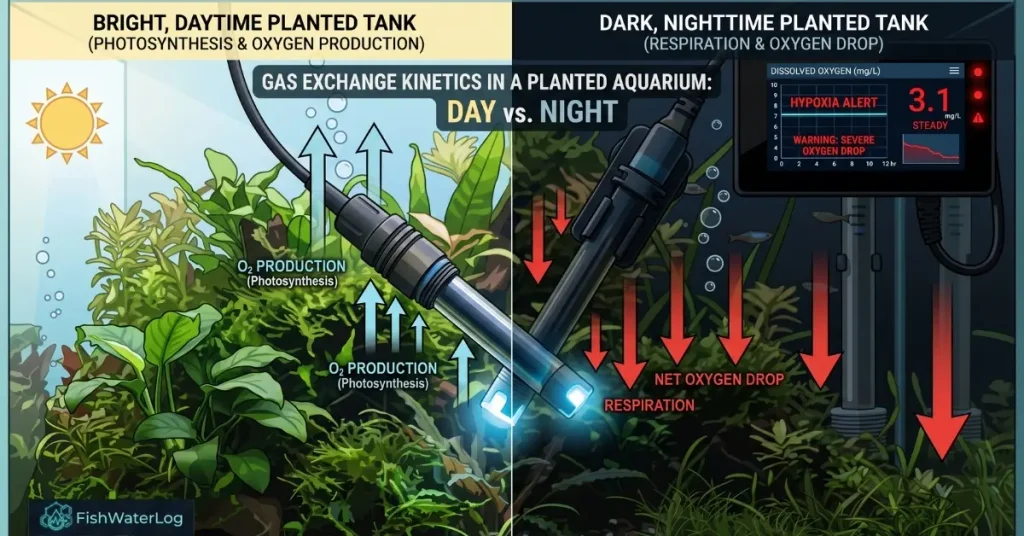
A critical environmental phenomenon—often overlooked in superficial aquariology literature, representing a significant knowledge gap—is the severe nighttime dissolved oxygen drop planted tank ecosystems routinely experience. Heavily planted freshwater aquaria are frequently misunderstood by novices as self-sustaining, hyper-oxygenated environments that are immune to hypoxic events. While it is true that during the photoperiod (daylight hours), submerged aquatic vegetation engages in the Calvin cycle, rapidly sequestering carbon dioxide and liberating massive volumes of oxygen as a metabolic byproduct, the physiological realities of the ecosystem invert drastically when the lights turn off.
Mitochondrial Respiration and Nocturnal Phase Shifts
When the artificial lighting systems power down, the light-dependent reactions of photosynthesis cease instantaneously. However, the cellular respiration of the plants continues unabated. Mitochondria within the plant cells must continuously consume oxygen and excrete carbon dioxide to generate adenosine triphosphate (ATP) for ongoing cellular maintenance and growth. Consequently, as dusk falls over the aquarium, the dense aquatic flora transitions from being the primary source of dissolved oxygen to becoming one of the most significant contributors to the total biological oxygen demand.
Biome-Wide Respiratory Stress and Nocturnal Troughs
During this nocturnal cycle, the entire biome is placed under extreme respiratory stress:
- Systemic DO Consumption: The flora, macrofauna, heterotrophic decomposers, and nitrifying bacteria all simultaneously draw from a finite, rapidly diminishing pool of dissolved oxygen.
- Predawn Troughs: Environmental data conclusively demonstrates that the absolute lowest levels of dissolved oxygen consistently occur in the early hours of the morning, precisely before the photoperiod recommences.
- High-Tech CO2 Compounding: In tanks with supplemental carbon dioxide injection, the cessation of photosynthesis combined with ongoing plant respiration drives dangerous CO2 accumulation at night, suppressing gas exchange rates and causing steep pH crashes.
- Acute Hypoxia Indicators: Without proactive management, extreme nocturnal depletion causes surface gasping, compromised immune responses, or unexplained mass mortality events.
Why Spot Testing Fails vs. Continuous Telemetry
This ecological dynamic proves why traditional chemical drop tests—virtually always performed during daylight hours when oxygen levels peak—provide a dangerous false sense of security. Deploying a dedicated continuous dissolved oxygen monitoring aquarium system via digital telemetry is the only verifiable scientific method to track nocturnal drops in real time. It guarantees that your engineered gas exchange kinetics and an aquarium dissolved oxygen meter remain capable of sustaining the ecosystem through the most perilous hours of the dark cycle.
Legacy Measurement: Galvanic and Polarographic Electrochemical Sensors
To fully appreciate the modern capabilities of an aquarium dissolved oxygen meter, one must analyze the technological evolution of the hardware utilized to quantify dissolved oxygen. Historically, the water quality industry standard relied exclusively on electrochemical sensors, specifically categorized as polarographic (Clark-type) and galvanic probes.
Electrochemical Sensor Operating Principles
Both polarographic and galvanic DO sensors utilize two reactive metal electrodes: an anode and a cathode. These electrodes are immersed in a specialized chemical electrolyte solution housed inside the sensor casing. An extremely thin, oxygen-permeable polytetrafluoroethylene (PTFE) or Teflon membrane separates the internal anode and cathode structures from the measured aquarium water column.
As dissolved oxygen diffuses across this permeable barrier, it is chemically reduced at the cathode, generating a small electrical signal that is translated into an active DO concentration reading. The primary difference lies in their power dynamics: polarographic sensors require an external polarizing voltage with a warm-up period of up to 15 minutes, whereas galvanic sensors utilize dissimilar metals (typically zinc or lead anodes with silver cathodes) to generate an autonomous electrical potential.
Master Your Tank Parameters & Prevent Spikes
Download our scientifically formulated 2-page water chemistry matrix, emergency deviation protocols, and biosecurity checklist.
📥 Download Free Printable PDF
Fundamental Limitations in Closed Aquatic Telemetry
Despite their historical adoption, traditional electrochemical sensors present severe operational challenges when tasked with long-term continuous monitoring in freshwater tanks:
- Oxygen Consumption and Stagnant Dead Zones: The chemical reduction reaction actively consumes oxygen molecules directly from the membrane surface. In low-flow environments, the probe rapidly depletes local oxygen, generating falsely depressed readings that fail to reflect systemic levels.
- Strict Fluid Flow Dependency: To deliver reliable data, electrochemical probes require constant, vigorous water velocity across the membrane face to prevent localized anoxic dead zones.
- Electrolyte Depletion and Anode Degradation: Continuous chemical reactions degrade the anode over time and exhaust internal liquid electrolytes, causing severe, unavoidable sensor drift.
- High Maintenance and Recalibration Overheads: Maintaining legacy electrochemical probes demands frequent membrane replacements, handling hazardous chemical electrolytes, and performing continuous recalibrations.
In biologically active closed ecosystems, the intensive labor and consumable costs required to maintain galvanic probes make upgrading to a solid-state dissolved oxygen sensor essential for reliable telemetry.
The Luminescent Optical Sensor Revolution
In stark contrast to the limitations of legacy electrochemistry, modern aquatic telemetry relies almost exclusively on the luminescent optical sensor, representing a paradigm shift in environmental measurement technology. Upgrading an aquarium dissolved oxygen meter to optical DO technology entirely circumvents consumable chemicals, relying instead on the highly precise quantum principle of fluorescence quenching.
The Physics of Luminescent Fluorescence Quenching
An optical dissolved oxygen sensor operates through advanced photonic interactions within an engineered sensing matrix:
- Luminescent Matrix Composition: The sensor features a replaceable cap coated with an oxygen-sensitive luminescent dye, typically composed of an organometallic ruthenium or porphyrin complex immobilized in a permeable sol-gel matrix.
- Excitation via Blue LED: The internal optics emit a precise pulse of blue light from a light-emitting diode (LED), exciting the ground-state electrons within the luminescent dye to higher energy orbitals.
The mathematical relationship governing collisional quenching is defined by the Stern-Volmer equation:
I0 / I = τ0 / τ = 1 + K_SV * [O2]
In this equation, I0 and I denote luminescence intensity in the absence and presence of oxygen, τ0 and τ represent the corresponding luminescence decay lifetimes, K_SV is the Stern-Volmer quenching constant, and [O2] is the dissolved oxygen concentration. Rather than tracking raw light intensity (I)—which degrades over time due to fluorophore photobleaching and excitation LED aging—modern optical DO telemetry nodes utilize single-frequency phase-shift fluorometry to measure the luminescence decay lifetime (τ). Because lifetime decay is an intrinsic physical property that remains unaffected by signal attenuation, this phase-shift measurement eliminates localized oxygen consumption, delivering drift-resistant telemetry with zero fluid-flow dependency.
- Luminescent Emission: As these electrons naturally decay back to their ground state, they emit a signature red luminescent signal.
- Dynamic Energy Quenching: Dissolved oxygen molecules diffusing across the cap absorb this excitation energy via non-radiative collisions, directly quenching the red luminescence.
- Phase-Shift Lifetime Detection: An integrated photodiode measures the phase shift (decay lifetime) of the luminescent return, which is strictly inversely proportional to the partial pressure of dissolved oxygen in the water column.
Operational Advantages in Continuous Aquatic Telemetry
Because luminescence measurement relies strictly on photonic physics rather than chemical reduction, it introduces decisive operational benefits for closed aquarium setups:
- Zero Oxygen Consumption: The optical sensing mechanism consumes no dissolved oxygen during measurement, eliminating localized anoxic sampling artifacts.
- Absolute Flow Independence: The probe functions with pinpoint precision in completely stagnant water, low-flow planted thickets, or turbulent filtration raceways without requiring minimum flow velocities.
- Exceptional Long-Term Baseline Stability: With no consumable liquid electrolytes or fragile Teflon membranes, optical probes resist sensor drift and require minimal recalibration.
- Corrosion-Resistant Industrial Builds: Advanced optical telemetry probes encased in titanium or marine-grade stainless steel remain impervious to fouling in freshwater, brackish, and marine setups.
Furthermore, practitioners requiring detailed engineering specifications regarding precision telemetry instruments can learn more about the advanced research and sensor development driving aquatic monitoring protocols at the National Oceanic and Atmospheric Administration (NOAA).
By shifting to an advanced optical dissolved oxygen probe, the system entirely bypasses standard chemical reduction processes. The probe measures phase-shift photoluminescence lifetimes, making it the premier choice for zero-maintenance continuous telemetry in dense botanical layouts where water flow is restricted.
Technical Comparison: Electrochemical vs. Luminescent Optical Measurement
To systematically evaluate the advantages of upgrading to modern sensor architectures for continuous telemetry, a rigorous comparative analysis of their operational metrics is essential. Deploying an aquarium dissolved oxygen meter equipped with an advanced luminescent optical sensor eliminates the mechanical failure points and drift inherent to legacy electrochemical probes.
The following breakdown delineates the functional differences between traditional galvanic electrochemical cells and modern optical sensing arrays in closed freshwater setups:
| Operational Metric | Galvanic Electrochemical Sensor | Luminescent Optical Sensor |
|---|---|---|
| Fundamental Measurement Principle | Chemical oxygen reduction (Anode/Cathode) | Optical fluorescence quenching (Phase Shift) |
| Systemic Oxygen Consumption | Actively consumes surrounding oxygen | Zero oxygen consumption |
| Fluid Flow Dependency | Highly dependent (Requires constant fluid velocity) | Completely independent (Accurate in stagnant water) |
| Routine Maintenance Requirements | Extremely high (Frequent electrolyte/membrane changes) | Exceptionally low (Annual or bi-annual cap replacement) |
| Baseline Sensor Drift | Severe (Requires weekly manual calibration) | Negligible (Stable for multiple months) |
| Response Time Dynamics (T90) | Moderate to Slow | Highly rapid (< 60 seconds) |
| Operational Warm-up Period | Required upon powering (up to 15 minutes) | Instantaneous data acquisition upon startup |
| Interference from Trace Gases | Susceptible to H2S, CO2, and ammonia interference | Immune to common aquatic gas interference |
Why Optical Technology Excels in Continuous Monitoring
- Flow Independence in Planted Aquaria: Unlike galvanic probes that generate false hypoxemia readings in zero-flow micro-zones, optical probes provide precise measurements regardless of localized water movement.
- Long-Term Calibration Integrity: The absence of sacrificial anodes and degrading electrolyte solutions prevents continuous baseline drift during long monitoring cycles.
- Instantaneous Automation Response: Immediate startup times and rapid T90 response kinetics enable controllers to trigger aerators or skimmers the instant an acute oxygen crash begins.
The empirical superiority of the luminescent optical sensor makes it the unequivocal choice for critical hypoxia prevention and uninterrupted freshwater telemetry across botanical displays and closed aquaculture facilities.
Strategic Data Assignment and Telemetry Integration
Deploying an aquarium dissolved oxygen meter for absolute hypoxia prevention requires far more than simply submerging a probe into the water column. Proper implementation demands strategic data assignment and meticulous sensor placement to ensure your continuous telemetry accurately captures the aggregate biochemical state of the entire ecosystem.
Optimal Sensor Placement Strategies
Improper probe positioning creates skewed data streams that misrepresent water quality parameters:
- Avoiding Hyper-Oxygenated Micro-Zones: Placing a luminescent optical sensor directly above an active air stone or inside a filter return produces artificially inflated saturation readings. This localized hyper-oxygenation masks hazardous anoxic dead zones elsewhere in the tank, providing a dangerous false positive of system stability.
- Preventing Dense Canopy False Alarms: Burying the probe deep within dense botanical thickets yields localized readings far below the systemic average, triggering premature alarms during the nighttime dissolved oxygen drop planted tank phase.
- Ideal Placement Zones: Position the sensor in an area of moderate, representative fluid circulation—such as the primary intake chamber of an external sump or a mid-level zone along the main aquarium glass. This guarantees that incoming telemetry reflects true baseline biological oxygen demand.
Industrial Protocols and Longitudinal Trend Analysis
Modern optical sensors, such as the WTW FDO series or Aqualabo OPTOD, interface seamlessly with digital telemetry controllers via universal industrial protocols like Modbus RS485 or SDI-12. High-frequency logging plots real-time DO saturation curves against elapsed time, unlocking critical diagnostic capabilities:
- Community Respiration Tracking: Longitudinal trend analysis allows aquarists to measure the precise amplitude and frequency of the diurnal oxygen wave to calculate dark-cycle respiration rates.
- Early Warning Diagnostics: A nocturnal trough that drifts downward over consecutive weeks serves as an early indicator of organic detritus accumulation, declining biofilter throughput, or biomass overstocking.
- Systemic Ecosystem Stability: Continuous empirical logging provides the granular insights needed to safeguard sensitive biotope community dynamics in closed, high-density aquatic environments.
To ensure all monitoring components operate harmoniously, cross-reference your telemetry architecture against a comprehensive Freshwater Aquarium Checklist: Equipment & Testing Audit.
Edge Telemetry Node: Hardware and ESPHome Configuration
Building an autonomous dissolved oxygen monitoring node requires coupling industrial-grade sensor circuits, such as the Atlas Scientific EZO-DO embedded circuit, with microcontrollers like the ESP32. While UART communication works for single-probe spot checks, multi-parameter nodes tracking DO, pH, and ORP require switching the EZO circuit to the I2C protocol, enabling multiple sensors to daisy-chain across shared Serial Data (SDA) and Serial Clock (SCL) lines.
To prevent database bloat in logging platforms like Home Assistant, the node firmware must manage data velocity at the hardware edge using sliding window median filters. Below is the standard ESPHome YAML configuration for an I2C-connected DO sensor:
Integrating your hardware edge node as a native ESPHome dissolved oxygen sensor allows you to compile data dynamically using simple YAML scripts. By applying median sliding window filters on the I2C bus, you can log stable O2 levels straight to Home Assistant without database state bloat.
| Firmware Parameter | ESPHome Configuration | Impact on Ecosystem Telemetry |
|---|---|---|
update_interval | 1s | Determines the raw polling frequency of the I2C bus to provide high temporal resolution of localized water chemistry. |
window_size | 15 | Collects raw measurements into a memory buffer to smooth out transient noise or micro-bubbles hitting the sensor membrane. |
send_every | 30 | Transmits processed median data to Home Assistant every 30 iterations, drastically reducing database bloat. |
accuracy_decimals | 2 | Standardizes the floating-point output across the API (e.g., 6.45 mg/L) to match limnological reporting standards. |
Precision Maintenance: Optical DO Probe Calibration Freshwater Protocols
While luminescent optical sensors are vastly superior to their galvanic predecessors in terms of baseline signal stability, they are not entirely immune to physical entropy and gradual degradation. The specialized luminescent dye embedded within the sensor cap experiences continuous photobleaching from the excitation LED, alongside prolonged exposure to aquatic biofilms, fluctuating pH levels, and general organic fouling. Over extended operational windows, the intensity of the fluorescence quenching response slowly diminishes, leading to slight, incremental inaccuracies in reported telemetry.
Atmospheric Water-Saturated Air Calibration Standards
To counteract physical degradation, rigorous optical DO probe calibration freshwater routines must be integrated into your preventative maintenance schedule. While legacy galvanic units demand weekly recalibrations, an optical aquarium dissolved oxygen meter reliably holds calibration integrity for 2 to 6 months depending on systemic bio-load:
- Single-Point Atmospheric Calibration: Because the partial pressure of atmospheric oxygen is a predictable constant governed by barometric pressure and altitude, optical probes achieve high-precision calibration in water-saturated air (100% relative humidity).
- Biofilm Removal and Prep: Remove the probe from the water column, gently rinse away surface biofilms using deionized water, and inspect the sensing cap for physical scoring.
- Moist Chamber Stabilization: Place the probe inside a specialized calibration sleeve containing a moist sponge, allowing the internal thermistor to equilibrate to ambient air temperature without desiccating the luminescent matrix.
- Barometric Table Referencing: The digital telemetry controller cross-references the optical phase-shift return against onboard barometric compensation tables, instantaneously zeroing out baseline drift.
Consumable Cap Replacements and Fouling Remediation
In setups prone to hard-water calcium carbonate scaling or heavy bacterial bio-slimes, clean the sensing cap using a mild, non-abrasive acidic solution. However, luminescent sensing caps are consumable hardware components:
- 12–24 Month Replacement Cycles: Commercial and lab-grade optical sensor caps require total replacement every 12 to 24 months to maintain measurement accuracy within strict $\pm2\%$ full-scale tolerances.
- Preventing Telemetry Blindspots: Neglecting scheduled recalibration skews nocturnal trough data, leaving closed ecosystems vulnerable during critical dark-cycle respiration spikes.
When equipment calibration drifts unchecked, undetected oxygen deficits can stall biofiltration colonies, triggering cascading chemical imbalances that require intensive remediation like having to Fix a Nitrogen Cycle Crash in Aquariums.
Automation, Probes & Dosing for Complete Hypoxia Prevention
The ultimate synthesis of continuous dissolved oxygen monitoring and environmental control networks forms the zenith of advanced aquatic management. Passive data collection is merely the preliminary phase; deploying an aquarium dissolved oxygen meter reaches its full operational potential when seamlessly integrated into closed-loop automation, probes, and dosing networks designed expressly for autonomous hypoxia prevention.
Threshold Logic Gates and Buffer Configuration
Modern telemetry controllers can be programmed with precise logic gates and conditional parameters keyed to real-time dissolved oxygen saturation thresholds:
- Target Safety Boundaries: For a densely planted freshwater biotope, an aquatic engineer might designate 5.5 mg/L as the absolute physiological safety limit for livestock.
- Automated Buffer Activation: The controller is calibrated to trigger at a 5.8 mg/L buffer threshold, launching corrective protocols before levels dip into hazardous hypoxia zones during the nighttime dissolved oxygen drop planted tank cycle.
Tier 1 Intervention: Dynamic Gas Exchange Modulation
The primary automated response manipulates the ecosystem’s physical gas exchange kinetics to force atmospheric oxygen into solution without manual intervention:
- Surface Boundary Agitation: Digital relays fire instantly to power secondary high-volume air pumps, maximizing aquarium air pump efficiency, actuating return-line venturi valves, or engaging high-throughput surface skimmers.
- Nocturnal Gas Balancing: Aggressive surface disturbance rapidly drives oxygen ingress while off-gassing excess respiratory carbon dioxide.
- Surgical Photoperiod Efficiency: Because aeration triggers strictly via live data rather than static mechanical timers, it eliminates excessive turbulence during daytime lighting hours, preserving vital injected CO2 needed for plant photosynthesis.
Tier 2 Intervention: Autonomous Pure O2 and Compound Dosing
In high-density aquaculture tanks, commercial holding raceways, or ultra-sensitive botanical displays, secondary automated fail-safes provide emergency life support:
- Pure Oxygen Injection: Solenoid arrays linked to pressurized O2 cylinders inject micro-bubbles directly into reactor chambers to halt steep oxygen drops.
- Emergency Chemical Dosing: Metering pumps administer calculated volumes of stabilized liquid oxygenating compounds if DO levels continue downward trends.
- Systemic Biome Insulation: Closed-loop telemetry insulates the ecosystem against sudden organic loading, mechanical filtration crashes, or thermal solubility reductions, transforming the aquarium into a self-correcting biological machine.
Maintaining strict chemical boundaries ensures you fulfill the core water management protocols detailed in the aquarium water parameters precision directory.
Conclusion
The modern management of complex freshwater ecosystems necessitates a complete departure from rudimentary, reactive testing in favor of continuous, high-precision data acquisition. The strategic integration of an aquarium dissolved oxygen meter—specifically a system utilizing an advanced luminescent optical sensor—represents the definitive methodology for accurately tracking the biological oxygen demand of a closed aquatic ecosystem. By cultivating a deep understanding of the thermodynamic intricacies governing gas exchange kinetics and actively managing the severe dangers posed by the nighttime dissolved oxygen drop planted tank environments routinely face, aquarists can implement automated telemetry to preempt catastrophic crashes long before livestock is compromised.
Ultimately, deploying continuous dissolved oxygen monitoring aquarium systems alongside stringent optical DO probe calibration freshwater schedules provides the automated life-support infrastructure required for absolute hypoxia prevention and sustained biological stability across the entire aquarium biome.
Frequently Asked Questions
What is the ideal DO level for freshwater ecosystems?
Most freshwater flora and fauna thrive optimally at dissolved oxygen concentrations between 5.0 and 8.0 mg/L, though absolute minimum physiological requirements can vary significantly by species morphology and temperature.
Why is continuous dissolved oxygen monitoring preferred over chemical drop tests?
Chemical drop tests provide an isolated, instantaneous snapshot that cannot capture rapid environmental fluctuations or severe nocturnal depletions. Continuous telemetry offers uninterrupted real-time data streams essential for longitudinal trend observation and triggering automated life-support systems.
How often should optical DO probe calibration be performed in a freshwater setup?
While vastly more stable than legacy galvanic sensors, luminescent optical sensors should undergo an atmospheric calibration verification every 2 to 6 months to account for biological matrix fouling and minor phase-shift drift. The physical sensing caps must be replaced every 1 to 2 years.
Can low DO levels negatively affect the nitrogen cycle in a planted aquarium?
Absolutely. Nitrifying bacteria (Nitrosomonas, Nitrobacter) are obligate aerobes. A severe drop in dissolved oxygen will immediately inhibit their metabolic function, potentially leading to a complete cessation of the nitrogen cycle and a subsequent, lethal accumulation of toxic ammonia.
How do aquatic plants actively contribute to hypoxia at night?
In the absence of photosynthetic light, the Calvin cycle ceases, but cellular mitochondrial respiration continues. The plants actively absorb oxygen from the water column and release carbon dioxide to survive the dark cycle, drastically increasing the system’s biological oxygen demand and lowering the overall DO concentration precisely when the fish need it most.
Master Your Tank Parameters & Prevent Spikes
Download our scientifically formulated 2-page water chemistry matrix, emergency deviation protocols, and biosecurity checklist.
📥 Download Free Printable PDF

6 thoughts on “Aquarium Dissolved Oxygen Meter: Freshwater DO Telemetry”