

The cultivation of high-technology freshwater planted aquariums has evolved significantly from rudimentary substrate fertilization into a highly sophisticated discipline resembling chemical engineering. In systems characterized by high-intensity photosynthetically active radiation (PAR) and pressurized carbon dioxide injection, aquatic flora metabolize macronutrients and micronutrients at an exponential rate. In high-growth systems with pressurized dissolved carbon, balancing nutrient delivery alongside verified saturation via an aquarium co2 drop checker guide prevents photosynthetic bottlenecks. Relying on manual fertilization protocols introduces an unacceptable degree of human error and biochemical inconsistency.
When an aquarist doses nutrients manually, the water column experiences severe concentration spikes immediately following the dose, followed by a rapid depletion trough as plants consume the available minerals. These violent peaks and valleys in the nutrient profile serve as the primary biological triggers for aggressive algal proliferation, destabilizing the entire ecosystem.
To achieve the absolute chemical stability required by delicate and demanding botanical species, the implementation of a comprehensive aquarium peristaltic dosing pump setup has transitioned from a luxury to a foundational structural necessity. Moving away from manual labor toward an automated micro dosing planted tank schedule eliminates the inconsistency of human intervention, providing a steady, reliable, and mathematically calculated influx of life-sustaining minerals. Deploying a high-precision stepper motor doser transforms the static glass aquarium into a dynamic, automated bioreactor. In this environment, daily nutrient telemetry and precision mechanics govern the ecosystem’s baseline stability, ensuring that aquatic plants remain in a state of continuous, uninhibited growth—aligning directly with target ranges cataloged in our Aquarium Water Parameters Directory.
The transition to automated dosing fundamentally alters the aquarist’s role from a daily laborer to a systems manager. Instead of measuring powders and liquids daily, the operator formulates highly concentrated master solutions—such as those required for estimative index macro dosing—on a monthly basis, delegating the physical delivery of these chemicals to mechanical apparatuses. This shift requires a deep understanding of fluid dynamics, polymer science, and inorganic chemistry.
Hardware failsafes like peristaltic pump tubing backflow prevention must be engineered from the start, while recurring protocols for calibrating aquarium peristaltic dosing pumps prevent volumetric drift. Furthermore, isolating trace elements prevents issues like photolytic chelated iron degradation within fluid lines. Mastering the hardware and the chemical interactions within the fluid reservoirs is paramount to achieving long-term ecological equilibrium.
Table of Contents
Mechanical Architecture of Peristaltic Fluid Transfer
Building a precision aquarium peristaltic dosing pump setup requires an understanding of how positive displacement and mechanical occlusion interact with fluid dynamics.
Positive Displacement and Roller Dynamics
A peristaltic pump operates on the fundamental engineering principle of positive displacement. The mechanical assembly contains an elastomeric conduit fitted inside a rigid, circular pump housing. A central rotor equipped with multiple rollers compresses the flexible line against the track. As the rotor turns, the physical occlusion point advances, driving trapped fluid forward. As the roller disengages, the polymer’s elastic restitution creates a localized vacuum that draws fresh solution from the reservoir.
This mechanism isolates the fluid stream from metallic components, gears, and motor seals, eliminating corrosion and chemical cross-contamination from saline solutions. The mechanical roller profile directly governs delivery dynamics:
- Two-Roller Assemblies: Maximize polymer lifespan by minimizing cyclic fatigue, but introduce a pulsatile, intermittent delivery profile.
- Three- and Four-Roller Assemblies: Provide a linear, continuous flow profile that prevents hydraulic pressure spikes within micro-delivery lines, though the higher compression rate accelerates mechanical wear.
- Hydraulic Seal Integrity: Sustained roller occlusion acts as a physical pinch valve, providing basic line isolation against gravitational forward-siphoning.
The Necessity of the Stepper Motor Doser
When designing an automated micro dosing planted tank schedule, the motor architecture determines the absolute floor of volumetric resolution. Entry-level hardware universally relies on brushed or brushless Direct Current (DC) motors. These units approximate liquid volumes using run-time durations, introducing significant operational drawbacks:
- Voltage and Viscosity Susceptibility: DC motors run at variable speeds when subjected to minor supply voltage drops or head-height resistance.
- Thermal Drift: Motor coil heating during sequential cycles alters internal friction, expanding volumetric delivery error margins to between ±5.0% and ±10.0%.
- Micro-Dosing Inaccuracy: Timed activations under two seconds suffer from inertial lag, making fractional milliliter delivery impossible to replicate consistently.
Overcoming these physical limitations requires an industrial-grade stepper motor doser. Instead of continuous unmonitored rotation, a stepper motor divides a 360-degree cycle into hundreds of discrete, magnetically locked steps.
The microcontroller drives an exact rotational step count rather than an estimated runtime, tightening volumetric tolerances to between ±0.1% and ±0.5%. This mechanical resolution is vital for high-demand estimative index macro dosing protocols and nano-aquariums, where an over-dose of merely 0.5 mL of trace elements can lead to toxicity in sensitive dwarf shrimp and invertebrates. Regular routines for calibrating aquarium peristaltic dosing pumps verify this mechanical displacement, providing stable baseline data for automated daily nutrient telemetry systems.
Elastomer Science and Fluid Conduit Integrity
Maintaining structural fluid integrity in a high-precision aquarium peristaltic dosing pump setup depends on the physical chemistry of the flexible conduit. Because peristaltic displacement relies entirely on mechanical deformation, selecting the proper elastomer is the primary line of defense against catastrophic failure and volumetric drift.
Polymer Degradation and Spallation Mechanics
The continuous mechanical stress placed on the polymer through relentless cycles of occlusion and restitution eventually leads to structural fatigue. Over time, this fatigue induces spallation—a process where microscopic particles of the inner tube wall shear off directly into the fertilizer stream. As internal walls degrade and lose their memory, volumetric displacement drops unpredictably, eventually causing line ruptures.
- Platinum-Cured Silicone: Standard in budget units; visually transparent and flexible, but possesses a limited operational lifespan of 50 to 250 hours before fatigue induces delivery inaccuracies.
- PharMed BPT (Biocompatible Peristaltic Tubing): A specialized thermoplastic elastomer offering over 1,000 hours of continuous service life. For aquarists seeking industrial-grade pump components and chemically resistant elastomeric tubing that defies severe mechanical degradation, you can review extensive technical material specifications by visiting the official catalog at Cole-Parmer.
- Photolytic Protection: Unlike clear silicone, the opaque formulation of PharMed BPT shields sensitive micronutrients from direct light exposure, mitigating premature chelated iron degradation inside the feed lines.
Conduit longevity is governed mathematically by the occlusion ratio (the outer diameter minus the roller gap, divided by twice the wall thickness). An optimal ratio sits strictly between 1.0 and 1.2:
- Under-Occlusion (<1.0): Roller pinch is insufficient, allowing pressurized fluid to slip backward across the head, destroying baseline accuracy and corrupting automated daily nutrient telemetry.
- Over-Occlusion (>1.2): Generates extreme mechanical shear forces, accelerating polymer spallation and destroying a 1,000-hour rated tube in fewer than 50 hours of active rotation.
Peristaltic Pump Tubing Backflow Prevention Physics
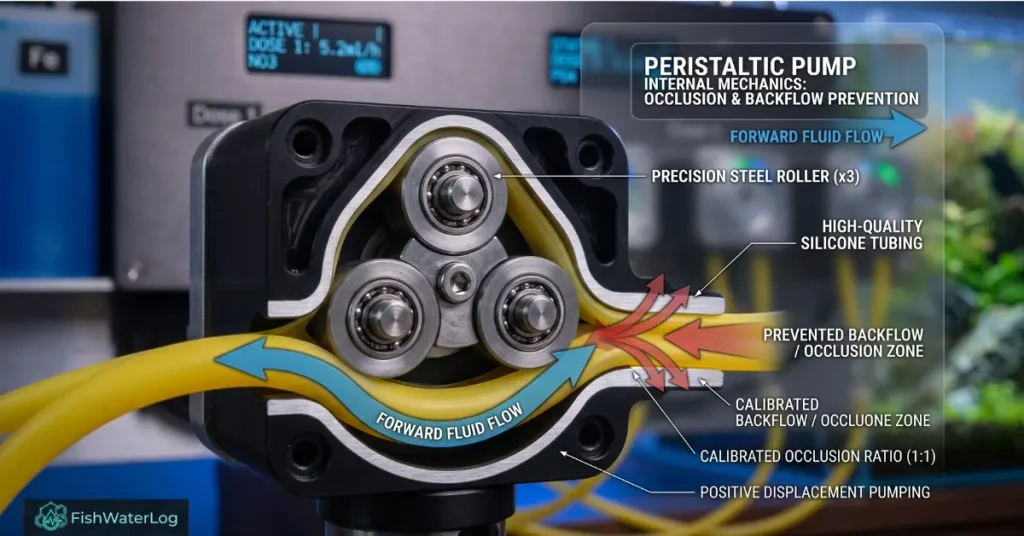
Internal cross-section of a tri-roller peristaltic pump head demonstrating positive displacement occlusion and peristaltic pump tubing backflow prevention.A catastrophic failure vector in automated nutrient delivery is the unintentional formation of a hydraulic siphon. If the pump module sits below the aquarium water surface, or if reservoirs sit higher than the discharge output, worn tubing or resting rollers can trigger a gravitational siphon. This failure mode either dumps concentrated agricultural salts into the tank—crashing delicate fauna—or siphons display water back into the fertilizer jugs, flooding the cabinet.
Engineering fail-safe peristaltic pump tubing backflow prevention requires specific physical plumbing protocols:
- The Physical Air Gap (Siphon Break): The most mathematically absolute failsafe. Terminating rigid acrylic discharge lines in free air above the maximum tank waterline prevents atmospheric vacuum formation, rendering back-siphoning physically impossible.
- Diaphragm Check Valves: If sub-surface injection into a pressurized filter return line is required, install medical-grade, fluoropolymer check valves immediately downstream of the stepper motor doser head to arrest reverse flow mechanically.
- Drift & Occlusion Verification: Routinely calibrating aquarium peristaltic dosing pumps ensures the rollers maintain sufficient compression to seal the line at rest, preserving the schedule’s structural integrity during high-demand estimative index macro dosing runs.
When sub-surface delivery mandates mechanical barrier integration, deploy low-cracking-pressure elastomeric duckbill or diaphragm check valves to prevent imposing destructive backpressure across low-torque stepper motors. Always maintain a strict physical elevation hierarchy: dosing containers and pump heads must sit below the terminal discharge line, and nozzle tips must terminate above the water line with a physical air gap to eliminate continuous forward-siphon risks.
The Calculus of Calibration and Drift Mitigation
Procuring the most expensive, highly engineered stepper motor doser is practically meaningless without implementing rigorous, recurring calibration protocols. In a high-precision aquarium peristaltic dosing pump setup, the physical discrepancy between the volume firmware assumes it is dispensing and the actual physical volume pushed through the lines represents the primary catalyst for automated ecosystem failure.
Calibrating Aquarium Peristaltic Dosing Pumps
The ongoing discipline of calibrating aquarium peristaltic dosing pumps establishes the baseline volumetric flow rate of a specific polymer conduit under real-world hydraulic conditions. When fresh tubing is installed, it undergoes an initial mechanical break-in phase. Over the first several days of operation, cyclic compression from the rollers causes the inner diameter of the tube to stretch and flatten microscopically.
This mechanical deformation dictates that a single 360-degree rotation of the pump head will physically displace less fluid on day thirty than it did on day one. Before initiating gravimetric calibration runs, purge micro-airlocks via continuous manual priming until discharge is laminar, and calibrate at the exact operational vertical head height to account for gravitational resistance.
Operational Drivers of Tubing Drift and Volumetric Degradation
- Elastomer Fatigue & Creep: Continuous roller compression flattens the conduit, permanently reducing the internal lumen volume and stroke displacement per revolution.
- Run-Time Drift Timing: Initial polymer stretching occurs rapidly during the first 48 hours, requiring an immediate post-break-in calibration to reset baseline delivery.
- Starvation in High-Demand Systems: Uncorrected flow decay throws off an automated micro dosing planted tank schedule, causing slow, insidious nutrient starvation in tanks running estimative index macro dosing regimens.
Due to progressive elastomeric fatigue and tubing compression set, execute an initial volumetric calibration 48 hours post-installation (after mechanical break-in), followed by mandatory gravimetric verification every 30 to 60 days.
Gravimetric vs. Volumetric Baseline Establishment
Most hobbyists rely on volumetric calibration by running the unit for sixty seconds, discharging fluid into a graduated cylinder, and visually estimating the meniscus. While acceptable for coarse bulk additions, visual assessment introduces substantial reading error via parallax distortion and liquid surface tension along cylinder walls.
For precision systems that interface with daily nutrient telemetry, gravimetric baseline calibration is mandatory. This technique utilizes a high-precision digital balance to weigh the net liquid discharge.
Key Protocols for Precision Gravimetric Verification
- Mass-to-Volume Anchoring: Uses the physical constant of pure water (1.00 g/mL at 20°C) alongside the specific gravity of concentrated agricultural salts to eliminate visual meniscus error. When preparing concentrated fertilizer stock solutions, source water must be purged of initial tds creep in aquarium ro di lines to prevent unmeasured mineral baseline shifts.
- Micro-Resolution Output: Enables firmware logic to lock in delivery accuracy down to 0.01 mL, protecting sensitive fauna from localized trace-metal toxicity.
- Hydraulic Head Standardization: Preserves calibration integrity by locking container placement, line length, and vertical lift alongside verified peristaltic pump tubing backflow prevention failsafes.
Always perform volumetric calibration using pure Reverse Osmosis Deionized (RO/DI) water rather than concentrated fertilizer solutions; variable specific gravity and chemical viscosity skew precision baseline readings while introducing needless chemical waste.
Nutrient Methodologies and Precipitation Prevention
Automated hardware serves merely as the physical delivery mechanism; the ultimate efficacy of any aquarium peristaltic dosing pump setup relies entirely on the underlying biochemical regimen it is programmed to execute. Planted aquarium nutrition is fundamentally divided into two categories: macronutrients (Nitrogen, Phosphorus, Potassium—NPK), which form the bulk of plant biomass, and micronutrients (Iron, Manganese, Zinc, Copper, Boron, Molybdenum), which act as crucial metabolic catalysts for photosynthesis and cellular respiration.
Estimative Index Macro Dosing Dynamics
The most prominent and aggressive nutritional methodology utilized in high-growth environments is estimative index macro dosing, a framework pioneered by aquatic botanist Tom Barr. The core philosophy of the Estimative Index (EI) is to intentionally provide a non-limiting, surplus supply of nutrients directly to the water column. By ensuring that aquatic flora are never bottlenecked by Liebig’s Law of the Minimum, growth rates are pushed to their biological maximums. This hyper-accelerated growth allows plants to consume all available light energy and injected carbon dioxide, effectively outcompeting nuisance algae for critical resources. To dive deeper into the theoretical biological foundations of unrestricted plant growth and compare non-limiting saturation against lean substrate methods, review the dosing benchmarks detailed by The 2Hr Aquarist.
Because estimative index macro dosing requires the continuous addition of substantial quantities of chemical salts throughout the week, it heavily relies on a mandatory 50% weekly water change to “reset” the system, mathematically preventing the toxic accumulation of unused compounds over time. To automate this, the aquarist dissolves dry agricultural salts (such as Potassium Nitrate, Monopotassium Phosphate, and Potassium Sulfate) into known volumes of distilled or RO water. The IoT controller is then programmed to divide the weekly target into smaller, micro-doses, maintaining a steady baseline without initiating osmotic shock. Always use a highly accurate water parameter calculator to mathematically determine the exact milliliter chemical requirements for your total water volume before programming your doser’s microcontroller.
Planted Aquarium Nutrient Dosing Targets Comparison
| Nutrient Target | Estimative Index (EI) | Lean Dosing (ADA) | PPS-Pro (High Light) |
|---|---|---|---|
| Nitrate (NO₃) | 15.0 – 30.0 ppm weekly | 1.5 – 6.0 ppm weekly | 7.0 – 14.0 ppm weekly |
| Phosphate (PO₄) | 2.0 – 6.0 ppm weekly | 1.4 – 4.0 ppm weekly | 0.7 – 1.4 ppm weekly |
| Potassium (K) | 20.0 – 30.0 ppm weekly | 20.0 – 24.0 ppm weekly | 9.3 – 18.6 ppm weekly |
| Magnesium (Mg) | 5.0 – 10.0 ppm weekly | Substrate dependent | 0.7 – 1.4 ppm weekly |
| Iron (Fe) | 0.5 – 1.0 ppm weekly | 0.03 – 0.06 ppm weekly | 0.35 – 0.70 ppm weekly |
Lean Substrate Methodologies and PPS-Pro
Conversely, systems architected around organically rich, active soil substrates (such as ADA Aqua Soil) often employ lean dosing methodologies. The lean approach intentionally minimizes water column nutrients, biochemically forcing plants to develop extensive root networks to extract sustenance directly from the substrate. Lean dosing targets drastically lower parameters (e.g., limiting NO3 to 1.5–6 ppm weekly).
- Precision Hardware Demands: A precision stepper motor doser is vital for lean dosing, as daily delivery volumes often represent fractions of a milliliter that standard DC motors cannot reliably deliver.
- Perpetual Preservation (PPS-Pro): PPS-Pro seeks a functional middle ground, supplying just enough daily nutrients to match active plant consumption without necessitating large 50% weekly water resets.
- Volumetric Drift Safeguards: Routinely calibrating aquarium peristaltic dosing pumps ensures these micro-volumes do not degrade over time, while peristaltic pump tubing backflow prevention blocks reverse siphoning into high-concentration bottles.
Chemical Separation of Macros and Micros
A cardinal rule of aquatic inorganic chemistry that automated systems must strictly enforce is the absolute temporal separation of macronutrients and micronutrients. Specifically, when Phosphorus (sourced from Monopotassium Phosphate) and Iron (sourced from trace element mixtures) mix in concentrated aqueous solutions, they undergo a rapid, irreversible reaction forming Iron Phosphate. This compound is a highly insoluble, rust-colored precipitate that falls out of solution, rendering iron biologically unavailable for foliar uptake.
- Alternating Daily Schedules: A properly architected automated micro dosing planted tank schedule must operate on alternating days. The controller doses macros on Mondays, Wednesdays, and Fridays, while discharging micros on Tuesdays, Thursdays, and Saturdays.
- Intra-Day Temporal Buffering: If high nutrient uptake demands daily delivery of both solutions, firmware must maintain a strict 6-to-8 hour temporal buffer—such as macros at dawn and micros at dusk. This ensures the circulation filter thoroughly dilutes the first solution before the reactive second compound enters the column.
- Telemetry and Degradation Monitoring: Integrating daily nutrient telemetry tracks conductivity build-up, while using opaque lines and bottles protects sensitive trace solutions against photolytic chelated iron degradation before discharge.
Cross-Disciplinary Fluid Mechanics Note: While this guide focuses on freshwater planted bioreactors and the classic phosphate-iron precipitation bottleneck, identical fluid displacement mechanics apply to marine reef systems. In reef environments, automated dosing mitigates abiotic calcium carbonate precipitation (Ca2+ + CO3(2-) ⇌ CaCO3) by temporally separating concentrated calcium chloride and alkaline sodium carbonate buffers. Across both freshwater and saltwater ecosystems, positive displacement integrity, anti-siphon physical air gaps, and temporal spacing remain the fundamental engineering baselines.
Bio-availability and Chelated Iron Degradation
A significant oversight in mainstream aquascaping literature is the nuanced chemical behavior of iron within an oxygen-saturated aquatic environment. Free ferrous iron (Fe²⁺) and ferric iron (Fe³⁺) are unstable when suspended in oxygenated water with a pH exceeding 5.5. Within hours, free iron rapidly oxidizes—effectively rusting—and settles into the substrate where foliar absorption through plant foliage becomes impossible.
To prevent rapid oxidation, fertilizer formulations bond raw metal ions within a synthetic organic molecule known as a chelate. The chelate acts as a protective molecular claw, shielding the iron ion from dissolved oxygen and holding it in a soluble state until flora can actively assimilate it. However, the physical stability of these chelated complexes is strictly governed by ambient environmental variables, primarily pH dynamics and photon exposure.
Stability Constants of Synthetic Chelates
The phenomenon of chelated iron degradation occurs when the chelating ligand breaks down prematurely in the water column, dropping iron into an insoluble oxidized state before flora can assimilate it. Selecting a specific chelating agent requires scientifically matching it to the water column’s baseline pH, as different ligands exhibit vastly different stability constants:
- Fe-EDTA: Chemically stable strictly below pH 6.5, making it suitable for acidic, soft-water blackwater tanks, but it remains highly susceptible to photolytic destruction.
- Fe-DTPA: Remains chemically active up to pH 7.5 with moderate optical resistance, serving as the reliable workhorse ligand for standard pressurized CO₂-injected planted tanks.
- Fe-EDDHA: Retains full stability up to pH 9.0 even under intense irradiation, making it ideal for alkaline hard-water or African cichlid planted systems.
- Ferrous Gluconate: Exhibits a broad pH tolerance but relies on weak organic bonds that break down within hours, making it strictly suited for supplemental daily micro-doses rather than static reservoir storage.
Synthetic Iron Chelate Performance Matrix
| Chelate Molecule | Effective pH Range | Optical Stability | Optimal Application |
|---|---|---|---|
| Fe-EDTA | Stable below pH 6.5 | Highly susceptible to photolysis | Acidic, blackwater biotope tanks |
| Fe-DTPA | Stable up to pH 7.5 | Moderate optical resistance | Standard CO₂-injected planted aquariums |
| Fe-EDDHA | Stable up to pH 9.0 | Highly stable under intense PAR | Alkaline African cichlid planted setups |
| Ferrous Gluconate | Broad range (weak bond) | Rapid breakdown (hours) | Supplemental daily micro-dosing pulses |
Using an EDTA-based iron supplement in water with a pH of 7.2 triggers chelated iron degradation almost immediately upon discharge. This chemical dissociation induces severe iron chlorosis, manifesting as bleached, pale yellow new leaves while older growth remains green due to iron’s immobility across botanical vascular systems.
Photolysis and the Necessity of Optical Shielding
The secondary vector driving ligand collapse is photolysis. Synthetic molecules like Fe-EDTA and Fe-DTPA decompose when exposed to ultraviolet radiation and high-intensity Photosynthetically Active Radiation (PAR). Placing transparent reservoir bottles near high-output lighting drives photon cleavage of the chelate bonds, producing insoluble ferric hydroxide sludge at the container base.
Protecting an automated micro dosing planted tank schedule from photolysis requires specific hardware safeguards:
- Opaque Storage Reservoirs: Store all concentrated micronutrient stocks in tinted, light-impervious containers to prevent photon penetration.
- PharMed BPT Fluid Conduits: Upgrading clear silicone delivery lines to opaque PharMed BPT lines prevents in-line photodegradation along runs exposed to open cabinet lighting.
- Mechanical Flow Isolation: Pairing shielded lines with reliable peristaltic pump tubing backflow prevention ensures ambient aquarium water cannot dilute or oxidize reservoir stocks.
Faunal Interactions and Gill Uptake Pathways
Preserving iron solubility impacts more than plant cellular metabolism; it directly influences aquatic fauna. Freshwater species, such as the rainbow trout (Oncorhynchus mykiss), actively assimilate bioavailable, waterborne iron directly across their branchial gill epithelia to support metabolic performance and hemoglobin synthesis.
When trace fertilizers drop out of solution due to improper pH buffering or photochemical oxidation, the nutrient becomes unavailable to both plants and fish. Maintaining steady solubility via a calibrated aquarium peristaltic dosing pump setup powered by a stepper motor doser ensures constant bioavailability across the ecosystem. Synchronizing this hardware with daily nutrient telemetry and routine routines for calibrating aquarium peristaltic dosing pumps safeguards the nutrient baseline required during intensive estimative index macro dosing protocols.
Next-Generation IoT Telemetry and Microcontroller Logic
The pinnacle of modern aquatic technology is the seamless fusion of precision mechanical hardware with the Internet of Things (IoT). Transitioning from rudimentary programmable timers to dynamic, logic-based microcontroller architectures creates a true closed-loop aquarium peristaltic dosing pump setup where physical additions are governed entirely by real-time chemical parameters.
Constructing an Automated Micro Dosing Planted Tank Schedule
A modern automated micro dosing planted tank schedule extends far beyond static time-of-day execution. Advanced ecosystems utilize open-source platforms like Home Assistant deployed on local hardware (such as a Raspberry Pi or Proxmox LXC) to orchestrate complex automation routines.
Microcontroller boards such as the NodeMCU ESP8266 or ESP32, flashed with custom ESPHome firmware, act as specialized automation hubs interfacing directly with motor drivers:
- Environmental Feedback Loops: If optical infrared sensors detect an evaporative water drop, the controller halts fertilizer additions to prevent solute hyper-concentration and osmotic shock.
- Ultra-Low Volume Control: Driving a precision stepper motor doser enables fractional-milliliter delivery pulses tailored for lean-dosing setups or nano-aquascapes.
- Chemical Protection: Timed delivery sequences separate macro salts from iron sources, preventing ligand breakdown and premature chelated iron degradation within the water column.
Implementing Daily Nutrient Telemetry via ESP8266
Implementing daily nutrient telemetry requires the continuous empirical logging of physical and chemical water parameters to trigger automated mechanical responses. Utilizing isolated laboratory-grade OEM sensing circuits—such as Atlas Scientific EZO circuits for pH, Electrical Conductivity (EC), Dissolved Oxygen (DO), and Oxidation-Reduction Potential (ORP)—allows microcontrollers to stream high-resolution biochemical data every few seconds via the lightweight MQTT protocol. By interfacing microcontrollers with lab-grade circuits for continuous EC and executing strict freshwater orp probe calibration, the automation platform monitors real-time organic load alongside macro salt accumulation.
Real-time EC and TDS telemetry proves indispensable during high-demand estimative index macro dosing regimens:
- Solute Accumulation Tracking: Adding dissolved agricultural salts causes electrical conductivity to climb predictably; logging this rise eliminates guesswork regarding plant uptake rates.
- Automated Safety Cascades: If conductivity breaches a critical ceiling, Home Assistant instantly suspends the dosing schedule, pushes a smartphone notification, or engages motorized ball valves to execute a safety water reset.
- Hydraulic and Hardware Verification: Sensor data reveals micro-siphoning anomalies, confirming that peristaltic pump tubing backflow prevention systems and physical air breaks are functioning properly.
Fail-Safe Firmware Architecture and System Redundancy
When automating critical life-support systems, software and hardware redundancies are non-negotiable:
- Hardware Watchdog Timers: Embedded watchdog routines autonomously restart the ESP8266 or ESP32 if firmware execution freezes or wireless network connectivity drops.
- Hardcoded Runtime Ceilings: Stepper motor driver logic must encode maximum run-time cutoffs directly into local firmware, ensuring power to the pump cuts off even if a remote “stop” packet fails.
- Volumetric Recalibration Tracking: Scheduled prompts for calibrating aquarium peristaltic dosing pumps ensure flow-rate accuracy remains synchronized with firmware telemetry models despite elastomeric tubing wear.
For non-custom builds, commercial architectures like Neptune Systems Apex, GHL Profilux, or AC Infinity UIS enable similar closed-loop telemetry, translating digital pulses into automated daily micro-fraction doses.
Conclusion
Integrating an advanced aquarium peristaltic dosing pump setup represents the cornerstone of modern aquatic ecosystem logging, transitioning closed aquatic biotopes from labor-intensive manual guesswork into proactive, precision-engineered chemical management. Moving away from subjective manual fertilization toward an automated micro dosing planted tank schedule establishes absolute parameter stability within the water column, preventing the volatile nutrient spikes and troughs that trigger severe nuisance algae blooms. Sustaining this ecological equilibrium requires deliberate hardware engineering, beginning with the selection of a precision stepper motor doser to achieve sub-milliliter mechanical resolution across both nano-aquascapes and high-volume displays. Mechanical reliability demands uncompromising failsafe integration, utilizing dedicated peristaltic pump tubing backflow prevention alongside physical air gaps to eliminate destructive siphon hazards.
Furthermore, fluid dynamic accuracy must be maintained through the recurring discipline of calibrating aquarium peristaltic dosing pumps using gravimetric baselines, compensating for microscopic polymer deformation and flow drift over extended operational cycles. When this mechanical precision is fused with biochemical awareness—balancing the aggressive parameters of estimative index macro dosing, temporally separating conflicting elements, and shielding trace reservoirs against photolytic chelated iron degradation—aquatic flora achieve uninhibited foliar development while preserving vital branchial absorption pathways for livestock. Coupled with real-time daily nutrient telemetry and open-source smart logic controllers, automated dosing delivers an uncompromising, resilient blueprint for long-term planted aquarium success.
At FishWaterLog, our methodologies are rooted in systematic aquatic science research and longitudinal telemetry testing. For more on our empirical validation protocols and water quality standards, visit our About Us page.
Frequently Asked Questions
Why is calibrating aquarium peristaltic dosing pumps repeatedly necessary?
As the elastomeric tubing inside the pump head is continuously compressed by the rollers, it undergoes microscopic mechanical stretching and flattening (spallation). This physical degradation alters the internal diameter of the tube over time, meaning the pump will push slightly less fluid per rotation after 30 days of use. Regular gravimetric calibration corrects this drift and synchronizes the physical output with the software’s telemetry logic.
Is an automated micro dosing planted tank schedule required for the Estimative Index?
While it is technically possible to execute EI dosing manually, the methodology requires the daily or alternate-day addition of highly concentrated NPK and trace elements. Manual administration introduces a high risk of human error, forgetfulness, and volumetric inaccuracy. Automation ensures the non-limiting nutrient baseline required by EI is maintained perfectly, eliminating the peaks and valleys that trigger algae blooms.
What is the most effective method for peristaltic pump tubing backflow prevention?
The most mathematically absolute method to prevent a catastrophic back-siphon is implementing a physical air gap, ensuring the termination point of the rigid acrylic dosing tube never makes contact with the aquarium’s water surface. In specialized setups requiring sub-surface nutrient injection, medical-grade synthetic rubber check valves must be installed on every fluid delivery line to mechanically block reverse flow.
Why are my red stem plants turning pale despite automated iron dosing?
This is a classic morphological symptom of severe iron chlorosis, which is almost always caused by unseen chelated iron degradation. If your aquarium’s water pH exceeds 6.8 and your automated doser is dispensing an Fe-EDTA based fertilizer, the iron chelate is chemically breaking down and precipitating into an insoluble solid before the plants can absorb it. Additionally, if your liquid reservoir is clear and exposed to ambient room lighting, UV photolysis is actively destroying the chelate bonds. Resolve this by switching to an opaque reservoir and utilizing an Fe-DTPA based iron supplement.
How does daily nutrient telemetry improve the dosing process?
Telemetry replaces subjective visual observation with hard, empirical data. By utilizing continuous electrical conductivity (EC) and pH monitoring through microcontrollers like the ESP8266 and EZO circuits, the system tracks exactly how rapidly the aquatic flora is depleting the available nutrients. This allows the aquarist—or the smart-home logic controller itself—to mathematically refine the dosing schedule in real-time, halting nutrient additions if salt buildup becomes excessive.
