

The transition from a low-technology aquatic environment to a high-intensity planted ecosystem fundamentally shifts the limiting factors of biological growth. Aquatic flora rely entirely on the surrounding water column to supply the necessary elements for photosynthesis. While intense illumination provides the photonic energy required to split water molecules, the subsequent dark reactions—specifically the Calvin-Benson cycle—demand a continuous, high-volume influx of inorganic carbon to synthesize glucose and other essential structural carbohydrates.
Understanding the fundamental role of dissolved carbon dioxide is the cornerstone of advanced aquatic horticulture. While low-energy setups can rely on ambient diffusion, supplemental co2 for aquarium plants is the single most effective way to stimulate robust cellular growth, drive intense pearling, and competitively outpace opportunistic algae outbreaks.
In the vast majority of aquatic plants, carbon fixation is mediated by the enzyme Ribulose-1,5-bisphosphate carboxylase-oxygenase, commonly known as RuBisCO. An inherent evolutionary flaw in RuBisCO is its dual affinity: it can bind with either carbon dioxide or oxygen. In a densely planted aquarium under high illumination, photosynthetic activity rapidly saturates the water with dissolved oxygen. If the concentration of dissolved carbon dioxide is not artificially elevated to compensate, RuBisCO will preferentially bind with oxygen in a wasteful process known as photorespiration. This process consumes energy, halts structural growth, and ultimately leads to the necrotic decay of the plant mass.
Atmospheric diffusion alone can only provide a baseline of 2 to 3 parts per million (ppm) of dissolved CO2 in a standard aquarium. To competitively outpace photorespiration and sustain high-energy species, hobbyists rely on pressurized CO2 injection to achieve an optimal CO2 dissolved ppm aquarium target between 30 and 45 ppm. However, managing this influx requires navigating the complex planted tank CO2 pH KH relationship. A failure to accurately calibrate these parameters risks severe CO2 toxicity in fish or biochemical stagnation, making an authoritative aquarium CO2 drop checker guide an indispensable operational blueprint for learning how to read CO2 drop checker color using a standardized DIY 4 dKH solution for drop checker monitoring.
Principles of Aqueous Thermodynamics and Gas Exchange
To successfully implement carbon supplementation, one must comprehend the physical chemistry governing the dissolution of gases in a liquid medium. When pressurized CO2 gas is injected into an aquarium, its behavior is dictated by Henry’s Law, which states that the solubility of a gas in a liquid is directly proportional to the partial pressure of that gas above the liquid, assuming a constant temperature.
However, carbon dioxide is uniquely reactive compared to atmospheric oxygen or nitrogen. When CO2 dissolves into water, a small but critical fraction of the dissolved gas molecules (approximately 0.1% to 0.2%) reacts chemically with the water molecules to form carbonic acid (H2CO3):
CO2(aq) + H2O(l) <-> H2CO3(aq)
Carbonic acid is a weak, volatile acid. Once formed, it immediately seeks thermodynamic equilibrium by dissociating into a bicarbonate ion (HCO3-) and a free hydrogen ion (H+):
H2CO3(aq) <-> H+(aq) + HCO3-(aq)
It is the liberation of these free hydrogen ions that directly drives down the pH of the aquarium water. Thus, the injection of CO2 is not merely the addition of a nutrient; it is an active acidification of the environment. The rate at which the pH falls, and the depth to which it plunges, are entirely dependent on the pre-existing chemical buffering capacity of the water column. To ensure foundational water chemistry is optimal before beginning CO2 injection, aquarists must establish a rigorous testing protocol; consult a comprehensive Freshwater Aquarium Checklist: Equipment & Testing Audit to verify baseline equipment accuracy.
The Planted Tank CO2 pH KH Relationship
The buffering capacity of an aquarium—specifically its ability to absorb free hydrogen ions and resist rapid pH fluctuations—is quantified as Carbonate Hardness (KH), also referred to as alkalinity. The interaction between injected carbon, resulting carbonic acid, and systemic buffering bicarbonates forms the foundation of the planted tank CO2 pH KH relationship.
In water possessing a high KH (e.g., 10 dKH or greater), there is an abundance of dissolved bicarbonate and carbonate ions. When carbonic acid dissociates and releases hydrogen ions, these abundant buffering agents immediately bind with the free H+ ions, preventing them from significantly lowering the overall pH. The result is that massive quantities of CO2 can be dissolved into the water column with only a minimal, barely perceptible drop in pH.
Conversely, in an environment with very low KH (e.g., 0 to 2 dKH), the water lacks sufficient bicarbonate reserves. The buffering capacity is rapidly exhausted. Once the minimal buffers are consumed, every subsequent molecule introduced via pressurized CO2 injection produces free hydrogen ions that dramatically and precipitously crash the pH, rapidly elevating the risk of CO2 toxicity in fish. Understanding this inverse dynamic is vital because a calibrated aquarium CO2 drop checker isolates this chemical reaction from tank water variables, allowing aquarists to monitor the exact CO2 dissolved ppm aquarium level.
Maintaining specific KH and general hardness bounds is not only relevant for plant growth but is also critical for the osmoregulation of specialized livestock; for detailed parameters regarding sensitive fauna, review our Cherry Shrimp Water Parameters: GH, KH & TDS Tank Care Guide. Furthermore, the type of soil utilized in the system will dictate natural buffering tendencies; an active aquasoil will artificially strip KH from the water, a dynamic deeply explored in our Substrate for Planted Tanks: Sand vs Gravel Guide. To ensure reliable visual telemetry, mastering how to read CO2 drop checker color with a properly mixed DIY 4 dKH solution for drop checker housings remains essential.
Mathematical Modeling: The Henderson-Hasselbalch Equation
The empirical foundation for deducing the exact CO2 dissolved ppm aquarium concentration from pH and KH variables is the Henderson-Hasselbalch equation. This formula is utilized in biochemistry to determine the pH of a buffer solution based on the acid dissociation constant (pKa) and the ratio of the concentrations of the conjugate base and the weak acid. The empirical foundation for deducing dissolved CO2 from pH and KH variables is the Henderson-Hasselbalch equation. For the underlying mathematical derivation, reference the LibreTexts Chemistry Guide on Henderson-Hasselbalch Buffer Approximation.
The standard form of the equation is expressed as:
pH = pKa + log10([A-] / [HA])
When applied specifically to the carbonate buffering system of a freshwater planted aquarium at standard operating temperatures (approximately 25°C), the equation is adapted to reflect the specific equilibrium of carbonic acid:
pH = pKa + log10([HCO3-] / [CO2])
The pKa of carbonic acid is generally accepted to be 6.35. Because the equation utilizes a base-10 logarithm, the relationship between pH, KH, and CO2 is non-linear. This mathematical reality dictates both digital pH probe calibration and how to read CO2 drop checker color accurately when assessing carbon saturation.
Logarithmic Scaling and the “Baseline Paradox”
A widespread oversimplification in the aquascaping community is the strict rule that a 1.0 drop in pH always guarantees 30 ppm of dissolved CO2. Because the scale is logarithmic, a 1.0 pH drop represents exactly a tenfold (10x) increase in dissolved carbon dioxide from the initial, pre-injection starting point.
This dynamic introduces what advanced horticulturists refer to as the baseline paradox, proving that the final concentration depends entirely on the natural, degassed baseline of the aquarium water:
- If an aquarium is heavily stocked with fish and possesses a large, respiring biological filter, its natural degassed CO2 concentration might sit at 3.0 ppm. A tenfold increase (a 1.0 pH drop) will yield an optimal 30 ppm of CO2.
- However, if an aquarium is sparsely populated and heavily agitated, its natural baseline might only be 0.6 ppm. A tenfold increase (a 1.0 pH drop) will only yield 6 ppm of dissolved CO2—a level grossly insufficient for demanding plants.
To achieve a true 30 ppm in the second scenario, the aquarist would need to target a much larger pH drop, potentially 1.4 or higher, emphasizing why relying solely on uncalibrated charts can disrupt the planted tank CO2 pH KH relationship.
The 26 Percent Rule
Further dissecting the logarithmic scale reveals granular data for fine-tuning pressurized CO2 injection. Every single 0.1 increment drop in pH corresponds mathematically to an approximate 26% increase in the concentration of dissolved CO2 (10^0.1 ≈ 1.2589).
If an aquarist measures a starting baseline and calculates that a 1.0 pH drop provides 30 ppm, pushing the system further requires careful calculation. Dropping the pH to 1.1 below baseline increases the CO2 by another 26%, yielding roughly 38 ppm. A drop of 1.2 pH below baseline yields roughly 48 ppm. This exponential curve highlights how incredibly sensitive the system becomes at higher injection rates; a microscopic twist of the needle valve can easily push a safe 35 ppm environment into a toxic 50+ ppm death zone. Consult an aquarium calculator to cross-reference your specific KH/pH values before adjusting flow rates. Using a certified DIY 4 dKH solution provides the necessary buffer isolation to verify these shifts safely.
Drop Checker Architecture and Indicator Chemistry
To safely monitor gas levels without relying on continuous, complex mathematical estimations, installing a dedicated aquarium co2 checker is the most reliable choice. This glass device functions as an isolated chemical reactor, establishing a direct air-water interface that isolates the indicator chemistry from volatile tank buffers.
To bypass the complex mathematics of individual aquarium baselines, the aquarium CO2 drop checker was engineered as a standardized reference instrument. It utilizes the Henderson-Hasselbalch equation internally, providing a closed-loop system isolated from fluctuating tank water variables.
Mechanics of the Air-Water Interface
The drop checker is essentially an inverted glass bell housing an indicator fluid. The critical design element is the physical air gap that separates the internal fluid from the external aquarium water.
When the concentration of dissolved carbon dioxide in the aquarium rises via pressurized CO2 injection, the gas exerts partial pressure and diffuses across the water column, exiting the water and entering the air pocket within the drop checker. Once in the air pocket, the gaseous CO2 diffuses downward into the internal indicator liquid. This double-diffusion process ensures that only volatile gases can cross the barrier. Tannins, humic acids, liquid fertilizers, phosphate buffers, and proprietary soil compounds present in the aquarium water cannot cross the air gap. Consequently, the pH of the indicator fluid changes solely and exclusively in response to carbon dioxide.
However, this architecture introduces a kinetic limitation. The diffusion of gas through water, into the air, and back into a separate volume of water requires time. A standard drop checker exhibits a latency period of 60 to 90 minutes. It is not a real-time monitor; it is a historical record of what the CO2 dissolved ppm aquarium concentration was over an hour ago. For this reason, the device should be mounted low in the water column—at least below the 50% line—to prevent surface oxygen exchange from falsely raising the internal reading.
Invert the glass drop checker and inject approximately 1.5 to 2.0 mL of the calibrated 4 dKH reagent directly into the bulb reservoir using a sterile syringe or pipette. Slowly rotate the unit upright so the fluid pools entirely in the hemispherical bulb. Verify that the downward-facing neck remains completely free of trapped liquid to preserve the uninterrupted air-water exchange interface.
Bromothymol Blue Halochromism
The visual accuracy of your telemetry depends entirely on the chemical composition of the co2 indicator fluid housed within the glass bulb. Using a pre-mixed solution of laboratory-grade bromothymol blue and a precise 4 dKH standard ensures that the colorimetric shifts align perfectly with safe carbon thresholds.
The visual telemetry of the instrument relies on Bromothymol blue (3′,3″-dibromothymolsulfonephthalein), a highly specific halochromic chemical indicator. Bromothymol blue is selected because its pKa (approximately 7.10) and its visual transition range perfectly align with the target pH generated by optimal carbon levels in a calibrated DIY 4 dKH solution for drop checker reservoirs.
The indicator acts as a weak acid in solution, changing its molecular structure based on the concentration of surrounding hydrogen ions:
- In alkaline or neutral environments (pH > 7.1), the molecule is deprotonated, reflecting deep blue light.
- In highly acidic environments (pH < 6.0), the molecule is heavily protonated, shifting its absorption spectrum so that it reflects bright yellow light—a warning signal of potential CO2 toxicity in fish.
- In the narrow transition zone (pH 6.2 to 7.0), the solution contains a balanced mixture of both protonated and deprotonated molecules, visually blending into distinct green hues. Mastering how to read CO2 drop checker color within this narrow window ensures the planted tank CO2 pH KH relationship remains perfectly balanced.
How to Read CO2 Drop Checker Color Accurately
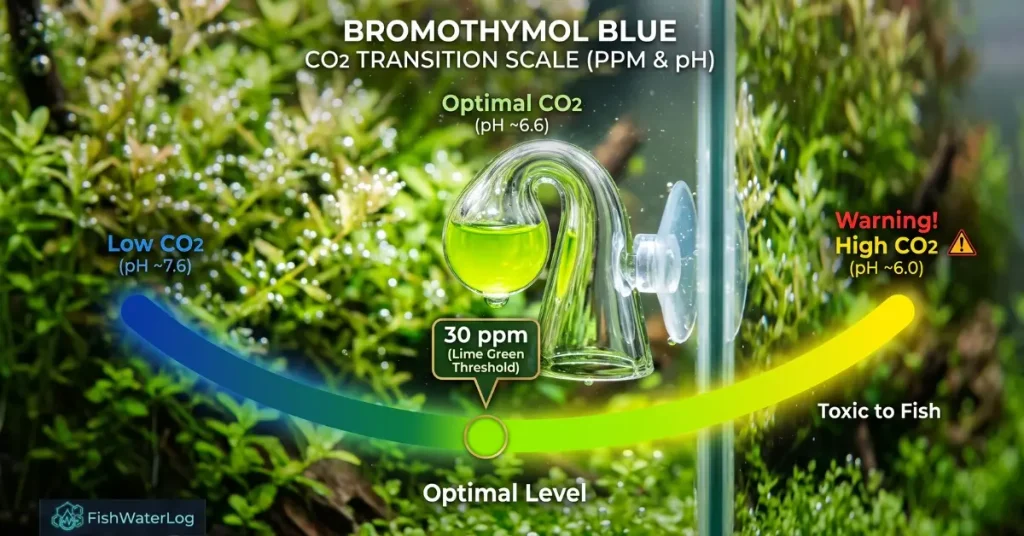
Misinterpreting the subtle nuances of bromothymol blue halochromism is a pervasive diagnostic failure that triggers either chlorotic plant stunting or accidental livestock mortality. Mastering how to read CO2 drop checker color requires discarding overly simplified hobbyist dogma and understanding exact chromatic calibration.
The Fallacy of “Green Equals 30 ppm”
One of the most persistent and damaging myths in the aquatic hobby is the blanket statement that any green hue in an aquarium CO2 drop checker indicates a perfect 30 ppm concentration. In reality, bromothymol blue begins its spectral shift from blue to dark green at remarkably low saturation levels. It requires merely 10 to 15 ppm of dissolved carbon dioxide to turn the indicator solution a discernible shade of green.
For low-energy setups cultivating shade-tolerant flora (such as Anubias, Java Fern, or Cryptocoryne species), 15 ppm (dark forest green) is often sufficient to maintain baseline growth. However, for high-energy aquascapes utilizing intense PAR and demanding carpeting plants, 15 ppm will cause a severe metabolic bottleneck, triggering rampant algae outbreaks and necrotic leaf melt. In these specialized setups, the ideal target is 30 to 35 ppm, which corresponds strictly to a vivid lime green or apple green hue. Discerning the minute visual difference between forest green (15–20 ppm) and lime green (30–35 ppm) is essential, especially under high-CRI RGB fixtures that can alter human color perception.
Standard Colorimetric Shifts Reference Table
To accurately calibrate pressurized CO2 injection and maintain the delicate planted tank CO2 pH KH relationship, aquarists must reference the precise colorimetric spectrum below, assuming the device is loaded with a laboratory-standard DIY 4 dKH solution for drop checker analysis:
Tracking these distinct colorimetric shifts ensures the tank achieves an optimal CO2 dissolved ppm aquarium baseline while actively shielding delicate fauna from fatal CO2 toxicity in fish.
Formulating the DIY 4 dKH Solution for Drop Checker
The entire mathematical premise of the aquarium CO2 drop checker hinges upon the internal fluid maintaining an exact, unyielding carbonate hardness of 4.0 degrees (4 dKH). If this baseline variable shifts, the Henderson-Hasselbalch equation yields false data, impairing your ability to monitor the true planted tank CO2 pH KH relationship.
The Danger of Utilizing Aquarium Water
A catastrophic error frequently committed by novices is mixing raw aquarium water with the bromothymol blue reagent inside the drop checker. Aquarium water is a complex chemical soup. It contains phosphates from fish waste and fertilizers, humic and fulvic acids leaching from driftwood, and proprietary buffering agents released by commercial aquasoils.
All of these compounds act as weak acids or bases, artificially altering the buffering capacity of the water. A drop checker filled with tank water might test at 4 dKH, but its actual resistance to pH drops will be entirely skewed by non-carbonate buffers. This completely invalidates the mathematical relationship, resulting in a device that might display green even when the water is fatally saturated with 60 ppm of CO2 from uncalibrated pressurized CO2 injection, triggering acute CO2 toxicity in fish. To achieve clinical accuracy, the reference fluid must be synthesized in isolation using laboratory protocols.
Gravimetric Preparation Protocols
Creating a DIY 4 dKH solution for drop checker applications requires sterile equipment, high-purity solute, and gravimetric precision. The procedure relies on a two-phase serial dilution, as measuring the microscopic fraction of a gram of sodium bicarbonate required for a single liter of 4 dKH water exceeds the resolution of standard digital scales.
- Phase 1: Concentrated Stock Formulation
- Utilizing a digital analytical balance, measure exactly 6.00 grams of pure Sodium Bicarbonate (NaHCO3). Ensure the reagent is pure and lacks commercial anti-caking agents.
- Transfer the 6.00 grams of solute into a sterilized 1-liter volumetric flask.
- Fill the flask to the graduation mark with exactly 1.00 liter of highly purified Distilled or Deionized (DI) water (0 TDS). Do not use reverse osmosis water unless it is guaranteed to have zero residual mineral content.
- Agitate the solution vigorously until all solute is homogenized. This produces an extremely concentrated alkaline stock solution.
- Phase 2: Final Target Dilution
- Extract exactly 10.0 milliliters of the Phase 1 concentrated stock solution using a precision laboratory pipette.
- Transfer this 10.0 mL into a separate, empty 1-liter volumetric flask.
- Fill this second flask to the 1.00-liter graduation mark with fresh distilled water.
- Thoroughly mix the solution. This final volume now possesses a mathematically precise carbonate hardness of 4.0 dKH.
- Phase 3: Reagent Integration
- Extract a 5.0 mL sample of the Phase 2 solution and subject it to a high-precision chemical titration test. It is vital that this precision is verified for water parameter bounds management. If the test deviates from exactly 4 dKH, discard the batch and recalibrate the gravimetric measurements.
- Once confirmed, transfer a working volume to a sterile dropper bottle. Add liquid Bromothymol Blue reagent drop-wise until the solution achieves a deep, translucent blue hue. The fluid is now ready for deployment to measure exact CO2 dissolved ppm aquarium targets and reliably evaluate how to read CO2 drop checker color.
The chemical integrity of bromothymol blue within the drop checker gradually degrades due to prolonged exposure to light and continuous gas-phase diffusion. Replace the indicator solution every 4 to 6 weeks during routine water changes. Discard the aged fluid, rinse the glass bulb with distilled water (never tap or soapy water), and reload with fresh 4 dKH solution to maintain colorimetric accuracy.
Advanced Calibration: The Relative pH Drop Method
Due to the inherent 60 to 90-minute kinetic latency of an aquarium CO2 drop checker, elite aquascapers rely on it primarily as a continuous secondary monitor. The primary diagnostic benchmark for precisely calibrating pressurized CO2 injection is the Relative pH Drop Method. This clinical technique measures real-time active pH suppression in the water column to deduce exact carbon saturation.
Degassing Protocols and Baseline Measurement
The Relative pH Drop Method requires establishing a fully degassed baseline pH, initiating carbon injection, and measuring the differential at peak saturation:
- Establishing the Baseline: Determine the true pH of the aquarium water absent any dissolved carbon dioxide. Extract a water sample from the aquarium. While traditional hobby advice suggests letting the sample sit open for 24 to 48 hours, kinetic thermodynamic modeling proves that vigorously agitating a half-filled, sealed container for three continuous minutes rapidly strips out exogenous CO2, establishing an instantaneous, reliable atmospheric equilibrium. Record this degassed pH using a calibrated digital meter.
- Determining Peak Saturation: Program the CO2 solenoid to activate 2 to 3 hours prior to the main photoperiod. Directly measure the tank water’s pH immediately before the aquarium lights turn on, capturing peak saturation before plant photosynthesis begins consuming inorganic carbon.
- Calculating the Target Drop: Subtract the peak saturation pH from the degassed baseline. In systems maintaining moderate alkalinity (1 to 10 dKH), achieving a full 1.0 pH drop guarantees an optimal CO2 dissolved ppm aquarium concentration within the 30 to 35 ppm range. Pushing the differential to a 1.2 or 1.4 drop elevates carbon availability beyond 40 ppm for high-demand carpeting species, provided livestock is closely monitored for signs of respiratory distress.
Ensure your aquarium water maintenance includes verifying these metrics on a bi-weekly basis, as organic load and filter maturation can naturally alter the baseline pH over time.
Overcoming Ultra-Low Carbonate Environments
While the standard 1.0 pH drop rule is mathematically robust across standard parameters, it fails in ultra-soft water regimes. In environments measuring between 0 and 1 dKH—frequently maintained for specialized Caridina shrimp or delicate soft-water flora—the carbonate buffer is virtually nonexistent.
Because the planted tank CO2 pH KH relationship curves non-linearly at near-zero carbonate levels, a 1.0 pH drop in ultra-soft water yields insufficient carbon availability. Achieving a target 25 to 30 ppm concentration in a 0–1 dKH environment often requires a relative drop of 1.4 to 1.6 pH. In these delicate conditions, cross-verifying colorimetric indicators with a freshly prepared DIY 4 dKH solution for drop checker units is critical, ensuring hobbyists know how to read CO2 drop checker color accurately to prevent inadvertent CO2 toxicity in fish.
Pressurized CO2 Injection Dynamics and Hardware Optimization
Deploying a high-precision aquarium co2 setup requires more than just a quality regulator and needle valve. The physical efficiency of gas diffusion, the placement of your ceramic diffuser, and the continuous circulation of the water column collectively dictate how effectively carbon enters solution before escaping into ambient air.
Producing accurate chemical reagents is futile if the physical diffusion of the gas is inefficient. The hardware utilized to introduce inorganic carbon into the aquatic ecosystem directly dictates the thermodynamic stability of the environment and the reliability of your telemetry.
Diffuser Placement and Micro-Bubble Suspension
The primary objective of a CO2 diffuser is to shear the gas delivered via pressurized CO2 injection into microscopic bubbles, drastically increasing the surface-area-to-volume ratio. This enhanced surface area facilitates rapid dissolution into the water column before buoyant bubbles can breach the surface and escape into ambient air.
Strategic placement of the diffuser is critical. It must be situated deep within the water column—ideally in the lower third of the tank—directly in the path of the primary filter outflow or downwelling circular current. This directional flow forces micro-bubbles to remain in continuous suspension, extending their dwell time and ensuring they thoroughly bathe the benthic plant mass.
Similarly, positioning the aquarium CO2 drop checker requires spatial precision:
- If mounted too close to the surface, the indicator fluid reads falsely low due to atmospheric off-gassing at the water-air interface.
- If mounted directly above or adjacent to the diffuser, rising micro-bubbles will enter the inverted glass chamber, bypass water column equilibrium entirely, and artificially crash the internal pH, producing a false bright yellow hue.
- Mount the device approximately one to two inches above the substrate in an area of moderate, indirect flow to measure the true ambient CO2 dissolved ppm aquarium concentration.
Active planted ecosystems develop microscopic bacterial biofilms and dust algae across glass surfaces over time. If a biofilm coats the inner lip of the drop checker’s entry funnel, it impedes gaseous transfer across the air gap, artificially increasing kinetic latency beyond 90 minutes. Clean the entry funnel monthly with a dedicated soft nylon brush during routine maintenance.
The Inadequacy of Bubble Counters
A prominent misconception in aquascaping is the reliance on “bubbles per second” (BPS) as a definitive measurement of carbon saturation. A bubble counter is useful solely for establishing mechanical repeatability on a specific needle valve; it is scientifically useless for determining dissolved carbon levels.
The physical volume of an individual bubble fluctuates significantly based on ambient room temperature, fluid viscosity within the counter chamber (water vs. mineral oil), internal tubing diameter, and regulator working pressure. Three bubbles per second on a wide-bore counter can deliver twice the gaseous volume of three bubbles per second on a standard setup. Furthermore, bubble counters cannot account for diffuser dissolution efficiency, surface agitation dynamics, or the metabolic consumption rate of the plant biomass.
To protect livestock from lethal CO2 toxicity in fish and maintain the optimal planted tank CO2 pH KH relationship, bubble counts must only serve as mechanical reference markers. True biological calibration must be verified by knowing how to read CO2 drop checker color paired with a certified DIY 4 dKH solution for drop checker units and relative pH drop telemetry.
Pathology of CO2 Toxicity in Fish (Hypercapnia)
While dense aquatic flora necessitates elevated carbon levels, the fauna occupying the ecosystem is highly susceptible to carbon dioxide poisoning. The operational boundary between a thriving high-energy aquascape and a lethal aquatic environment is exceedingly narrow, making an understanding of CO2 toxicity in fish non-negotiable for anyone operating pressurized CO2 injection.
The Bohr and Root Effects in Teleost Respiration
In freshwater teleost fish, the physiological trigger for respiration is not a lack of ambient dissolved oxygen, but rather the accumulation of metabolic carbon dioxide within their own vascular system. In a balanced environment, the partial pressure of CO2 in the fish’s bloodstream is higher than in the surrounding water, allowing the gas to passively diffuse outward across the delicate gill lamellae.
However, when ambient CO2 dissolved ppm aquarium levels are artificially elevated beyond 40 to 50 ppm, the partial pressure gradient reverses. Carbon dioxide ceases to exit the gills and instead begins accumulating inside the bloodstream, inducing a pathological state known as hypercapnia.
Hypercapnia triggers rapid respiratory acidosis, precipitously crashing the pH of the fish’s blood. This physiological acidification unleashes two catastrophic biochemical responses:
- The Bohr Effect: As blood acidity increases, hemoglobin loses its binding affinity for oxygen molecules, preventing efficient cellular respiration.
- The Root Effect: Unique to certain teleost fish, this response actively reduces the total oxygen-carrying capacity of hemoglobin, regardless of surrounding oxygen levels.
Consequently, even if the aquarium water is 100% saturated with dissolved oxygen from vigorous plant pearling, livestock will physically suffocate. Their acidified hemoglobin is rendered chemically incapable of transporting oxygen to vital organs. Observable symptoms include severe lethargy, loss of equilibrium (erratic corkscrew swimming caused by neurological acidosis), and rapid gasping at the surface. If your aquarium CO2 drop checker loaded with a DIY 4 dKH solution for drop checker reservoirs shifts to bright yellow, toxicity is imminent.
Preventative Surface Agitation Models
Mitigating the risk of hypercapnia requires a holistic approach to gas exchange telemetry. A pervasive mistake among beginner hobbyists is minimizing filter surface agitation under the false assumption that rippling water “wastes” injected gas.
While surface agitation accelerates the off-gassing of excess carbon dioxide, it provides an indispensable biological safety net. Vigorous surface ripples create a controlled pressure-release valve for excess CO2 while driving massive atmospheric oxygen dissolution into the water column.
This dual-exchange mechanism is especially vital at night. When the photoperiod concludes, plant photosynthesis stops and oxygen production halts immediately. Both flora and fauna continue nocturnal respiration, consuming oxygen and liberating massive amounts of organic CO2. If surface agitation is inadequate, this nocturnal biological load compounds with residual injected gas, triggering a severe nocturnal pH crash and destabilizing the delicate planted tank CO2 pH KH relationship. Maintaining clean, active surface agitation ensures thermodynamic equilibrium, allowing you to sustain target 30 to 35 ppm daylight concentrations safely while mastering how to read CO2 drop checker color with absolute confidence.
Conclusion
The successful execution of high-technology aquascaping relies far less on aesthetic intuition than it does on rigorous applied chemistry. An aquarium drop checker is not merely a manual for matching colors on a chart; it represents an exploration of aqueous thermodynamics, the Henderson-Hasselbalch equation, and the delicate physiological balance between flora and fauna.
By demanding gravimetric precision in formulating the 4 dKH reference fluid, accounting for the kinetic lag of gas diffusion, and implementing the Relative pH Drop Method, the advanced aquarist eliminates guesswork. Navigating the carbonate buffering system with analytical rigor ensures that the aquatic environment remains saturated with the vital carbon needed to outpace photorespiration, while permanently establishing the physical boundaries necessary to protect aquatic livestock. Mastery of these metrics elevates the planted aquarium from a volatile experiment into a stable, self-sustaining ecosystem. For foundational scientific context on aqueous buffering and hydrogen ion dynamics, reference the USGS Water Science Guide on pH and Aquatic Chemistry.
Frequently Asked Questions
Key technical and troubleshooting protocols for aquarium carbon telemetry

3 thoughts on “Aquarium CO2 Drop Checker Guide: Read Colors & Setup 4 dKH”