
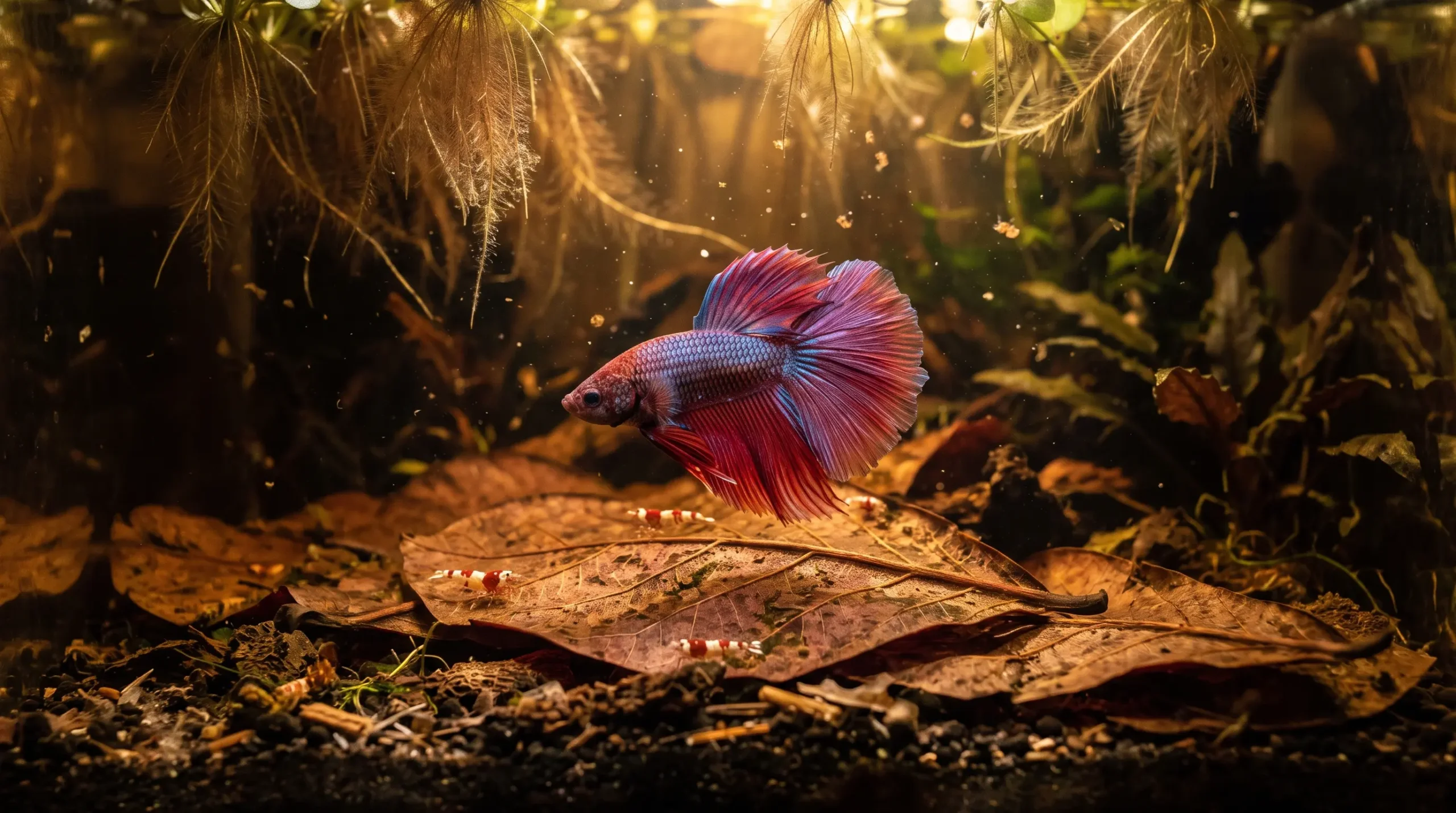
Understanding every indian almond leaves aquarium benefit transforms how freshwater aquarists manage water chemistry, fish immunity, and natural biotope health. Harvested from the tropical Terminalia catappa tree, these dried botanicals do far more than tint clear tap water into a warm, amber blackwater aquarium. As the foliage submerges, it releases bioactive tannins and humic acids alongside potent polyphenols that actively soothe stressed livestock, suppress fungal egg rot, and support beneficial grazing microflora.
While hobbyist forums frequently offer vague rules of thumb, mastering how to use catappa leaves in freshwater tank environments requires precision. Whether you are fine-tuning betta fish water parameters, cultivating nutrient-rich cherry shrimp biofilm, or lowering aquarium pH naturally without triggering an acid crash, improper dosing or active chemical filtration can neutralize your results. Below, we break down the clinical extraction kinetics, exact catappa leaf dosage protocols, and toxicological safety limits needed to unlock the full therapeutic potential of these botanicals.
Table of Contents
Beyond Hobbyist Myths: The Real Science Behind Indian Almond Leaves
While mainstream aquarium publications consistently highlight basic surface observations—such as brown water tinting or leaf litter aesthetics—they routinely overlook the peer-reviewed biochemical mechanisms that govern every indian almond leaves aquarium benefit. To master how to use catappa leaves in freshwater tank ecosystems safely, aquarists must look past generic rules of thumb and examine how Terminalia catappa interacts with water chemistry and fish physiology at a cellular level.
Limitations of Standard Commercial Aquarium Guides
Most commercial vendor guides provide only generalized husbandry advice, leaving critical parametric gaps for serious freshwater keepers:
- Generic Tannin Claims: Existing guides state that dried foliage releases brown tannins and supports a blackwater aquarium, without identifying the specific antimicrobial compounds responsible for disease resistance.
- Broad Dosing Ranges: Standard instructions advise adding one leaf per 5 to 20 gallons and replacing it every four to eight weeks—ignoring tank alkalinity, water temperature, and actual catappa leaf dosage precision.
- Unverified Safety Myths: Many commercial blogs claim it is impossible to overdose botanicals, overlooking documented gill precipitation thresholds in sensitive fish.
Clinical Biochemistry & Aquaculture Data Gaps
Analytical chromatography and veterinary aquaculture trials fill these blind spots with measurable, repeatable data for optimizing betta fish water parameters and dwarf shrimp habitats:
- Quantified Polyphenol & Flavonoid Potency: Dried Terminalia catappa extracts yield 208.72 mg GAE/g of total phenolics (led by punicalagin, corilagin, and chebulagic acid) and 35.77 mg QE/g of flavonoids (quercetin, kaempferol, and rutin), with zero toxic saponins or steroids.
- Selective Biofilter-Safe Antibacterial Action: Through iron-chelating siderophore competition, tannins and humic acids rupture cell membranes in pathogenic bacteria (Aeromonas hydrophila, Aeromonas veronii, and Pseudomonas aeruginosa) while sparing beneficial nitrifying biofilter bacteria (Rhodococcus rhodochrous and Bacillus oceanisediminis).
- Precision 80°C Thermal Extraction & 72-Hour Kinetics: Steeping leaves at exactly 80°C maximizes peaks of antimicrobial gallic and ellagic acids without stripping slow-release properties, while standard soaking reaches 96.6% tannin saturation within 72 hours (13.60 mg/mL at Day 3 vs. 14.08 mg/mL at Day 7).
- Leaf Senescence & Maturity Grading: Naturally fallen red-brown leaves contain significantly higher antioxidant concentrations—achieving 100% fungal inhibition at 20% extract dilution—compared to prematurely harvested yellow or green foliage, while forming superior cherry shrimp biofilm as they decompose.
- Documented Toxicological Ceilings (LC50): Veterinary bioassays on guppies, carp, and Betta splendens establish 96-hour median lethal concentrations between 5.6 and 7.0 mg/mL, where excessive tannin-protein binding coats gill filaments and impairs respiration when lowering aquarium pH naturally too aggressively.
Biochemical Profile and Core Indian Almond Leaves Aquarium Benefit
Phytochemical Constituents of Terminalia catappa
The primary indian almond leaves aquarium benefit originates from the dense secondary metabolite profile of Terminalia catappa Linn., a large deciduous tropical tree in the family Combretaceae native to tropical Asia. As its broad, leathery leaves undergo biannual senescence and detach naturally from the branch, chlorophyll degrades and leaves behind a concentrated matrix of hydrolyzable tannins, phenolic acids, triterpenoids (such as ursolic acid), phytosterols, and flavonoids.
When submerged in a closed freshwater ecosystem, water-soluble polyphenols leach across the leaf cuticle into the water column, transforming clear municipal water into an amber-tinted, bioactive medium that replicates tropical Southeast Asian and Amazonian blackwater aquarium habitats:
- Dominant Hydrolyzable Polyphenols: Punicalagin, punicalin, corilagin, chebulagic acid, geraniin, and terflavins A and B drive therapeutic antimicrobial and antioxidant activity.
- Quantified Phenolic & Flavonoid Density: Dried ethanolic extracts of brown Terminalia catappa leaves contain 208.72 mg GAE/g of total phenolics and 35.77 mg QE/g of total flavonoids (quercetin, kaempferol, vitexin, and rutin), with zero toxic alkaloids or saponins.
- Dose-Dependent Antibacterial Potency: Disc-diffusion assays confirm antibacterial inhibition zones expanding from 1.73 mm (at 30% dilution) to 9.06 mm (at 90% dilution) against Gram-positive Staphylococcus aureus, and from 1.83 mm to 6.50 mm against Gram-negative Pseudomonas aeruginosa.
Selective Antibacterial Action and Siderophore Iron Chelation
In ornamental aquaculture, opportunistic Gram-negative bacteria—most notably Aeromonas hydrophila, Aeromonas veronii, Aeromonas caviae, and Pseudomonas aeruginosa—trigger hemorrhagic septicemia, dermal ulceration, tail rot, and fin necrosis. The tannins and humic acids leached from Indian almond leaves neutralize these pathogens through a dual biophysical mechanism: polyphenolic hydroxyl groups bind dissolved metal ions to act as competitive siderophores that starve bacteria of essential iron cofactors, while direct phenolic contact destabilizes the outer lipopolysaccharide membrane of Aeromonas cells, causing cell wall lysis and cytoplasmic leakage. Controlled disc-diffusion assays published in the National Center for Biotechnology Information (NCBI) confirm that dried Terminalia catappa brown leaf extracts contain 208.72 mg/g of total phenolics that actively inhibit pathogenic Gram-negative and Gram-positive bacteria.
Crucially for closed aquarium filtration, laboratory evaluations confirm that Terminalia catappa extracts deliver selective antimicrobial protection without crashing biological filtration:
- 72-Hour Aqueous Extraction Kinetics: Total leached tannin levels rise from 4.02 mg/mL at 24 hours to 13.60 mg/mL at 72 hours (96.6% of total saturation) before plateauing at 14.08 mg/mL on Day 7.
- Safe Therapeutic Margins (MIC vs. LC50): Dilute therapeutic concentrations between 0.50 and 2.00 mg/mL achieve the Minimum Inhibitory Concentration (MIC) required to suppress Aeromonas hydrophila (0.50–1.50 mg/mL), Pasteurella pneumotropica (0.80 mg/mL), and Photobacterium damsela or Enterococcus faecalis (1.00 mg/mL)—staying well below the 96-hour acute toxicity limits (LC50 of 5.60 to 7.00 mg/mL) for ornamental fishes.
- Beneficial Biofilter Preservation: Botanical leachates exhibit markedly weaker inhibition toward beneficial nitrifying bacteria such as Rhodococcus rhodochrous and Bacillus oceanisediminis, ensuring uninterrupted ammonia and nitrite oxidation. When managing active outbreaks alongside botanical conditioning, cross-reference symptoms using established fish diseases clinical protocols to determine when severe systemic infections require dedicated fish quarantine tank treatment.
Antifungal Efficacy Against Saprolegnia and Egg Mortality
Fungal colonization by water molds of the genus Saprolegnia (Saprolegnia parasitica and Saprolegnia diclina), alongside Candida spp. and Rhizopus oligosporus, is a leading cause of egg mortality during ornamental fish spawning and secondary infections on abraded skin. Breeders of labyrinth fishes (Betta splendens, Osphronemus gouramy), South American dwarf cichlids, Corydoras catfishes, and kuhli loaches rely on Catappa foliage to protect newly deposited roe.
Bioactive flavonoids such as quercetin and kaempferol cross-link with fungal cell wall proteins to inhibit hyphal germination on the outer egg membrane (chorion). Controlled hatchery trials on gourami eggs and carp seeds—alongside ectoparasite studies targeting Trichodina and goldfish gill flukes (Gyrodactylus and Dactylogyrus)—demonstrate that Terminalia catappa extracts significantly boost hatching rates, eliminate external protozoans, and harden dermal scales in juvenile fish. As the submerged leaves soften, they also cultivate nutrient-dense cherry shrimp biofilm and infusoria that nourish newly hatched fry and dwarf shrimp.
Hematological Enhancement and Osmotic Stress Reduction
Beyond external pathogen suppression, mastering how to use catappa leaves in freshwater tank setups induces measurable physiological improvements inside the fish’s bloodstream and digestive tract while stabilizing betta fish water parameters:
- Enhanced Blood & Oxygen Transport: Hematological studies on Betta splendens and catfish (Heterobranchus longifilis) exposed to aqueous almond leaf extracts document elevated total serum protein, increased red blood cell (erythrocyte) counts, and higher mean corpuscular volume (MCV) and hemoglobin (MCH), boosting oxygen delivery and innate immunity.
- Antioxidant Organ & Gill Protection: Waterborne Catappa antioxidants specifically ellagic acid and corilagin—mitigate oxidative cellular stress, preserve intestinal villi width and crypt architecture for nutrient absorption, and regulate branchial acetylcholinesterase and lysozyme enzyme activity.
- Cortisol Reduction & Natural Coloration: Visually, the warm amber tint diffuses harsh overhead aquarium lighting while gently lowering aquarium pH naturally at a calibrated catappa leaf dosage, reducing cortisol-driven skittishness, symptoms of stress in freshwater fish, and stimulating vibrant chromatophore expansion in shy species such as rasboras, tetras, and discus.
Water Chemistry Dynamics and Parametric Buffering
Humic Acid Chelation and Carbonate Hardness (KH) Interaction
When Terminalia catappa leaves decompose in freshwater, they release botanical tannins and humic acids alongside fulvic acids. Humic acids function as natural organic chelators that bind divalent cations—specifically calcium (Ca2+) and magnesium (Mg2+)—as well as toxic heavy metal ions, thereby softening the water, protecting post-larval shrimp from metal toxicity, and reducing General Hardness (GH).
Simultaneously, these weak organic acids dissociate to release free hydrogen ions (H+), which react directly with the dissolved bicarbonate anions (HCO3–) that make up your aquarium’s Carbonate Hardness (KH):
H+ + HCO3– → H2O + CO2
Because carbonate alkalinity acts as an active chemical buffer that neutralizes acids, the exact pH shift triggered by Indian almond leaves depends entirely on your source water’s baseline KH:
- Hard, Alkaline Tap or Groundwater (7 to 11 dKH): Adding two or three Catappa leaves imparts a golden amber tint and delivers full antibacterial benefits, but the strong bicarbonate reserve neutralizes the weak organic acids before any measurable pH drop occurs.
- Soft-Water & Remineralized RO Systems (< 2 dKH): In low-TDS blackwater aquarium setups with minimal alkalinity, organic acids rapidly consume the remaining bicarbonate buffer and drive pH downward—requiring careful monitoring to prevent a sudden acid stall.
Aquarists utilizing botanicals in soft-water setups should implement a low KH aquarium fix strategy to balance natural acid leaching against carbonate depletion, and consult technical protocols on how to lower aquarium GH in freshwater tanks when conditioning mineral-rich tap water for sensitive species.
Ammonia Toxicity Mitigation via pKa Equilibrium Shifts
One of the most consequential second-order aspects of every indian almond leaves aquarium benefit—and a primary reason breeders rely on lowering aquarium pH naturally—involves the thermodynamic equilibrium of Total Ammonia Nitrogen (TAN). In aquarium water, fish waste exists in a pH- and temperature-dependent balance between non-toxic ionized ammonium (NH4+) and highly toxic un-ionized free ammonia (NH3), governed by the acid dissociation constant (pKa = 9.246 at 25°C).
Mastering how to use catappa leaves in freshwater tank environments with a calibrated catappa leaf dosage provides a critical biochemical safety net:
- Dramatic Reduction in Toxic NH3: When Catappa organic acids gently guide aquarium pH downward from 7.5 into a slightly acidic 6.5–7.0 range—ideal for maintaining stable betta fish water parameters—the un-ionized mole fraction (f) of toxic NH3 drops sharply.
- Biological Filter Buffer: At pH 7.0 and 25°C, only 0.57% of total ammonia exists in the lethal free ammonia (NH3) form, protecting fish and grazing invertebrates on cherry shrimp biofilm during minor biofilter fluctuations.
To track how botanical additions alter acid-base equilibria in real time, input your weekly titration measurements into our interactive aquarium calculator and parametric log and verify species-specific safety thresholds inside the aquarium water parameters precision directory.
How to Use Catappa Leaves in Freshwater Tank Setups
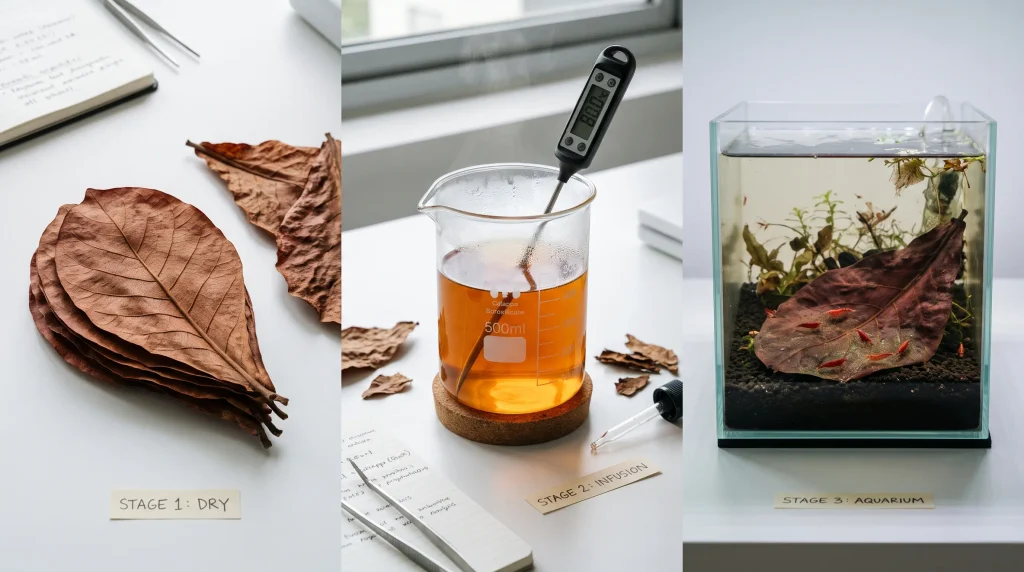
Mastering how to use catappa leaves in freshwater tank environments requires selecting properly senesced foliage, choosing an extraction method aligned with your aesthetic and clinical goals, and calibrating catappa leaf dosage to net working water volume.
Leaf Maturity and Color Selection Science
Not all Indian almond leaves offer equal phytochemical density. As Terminalia catappa leaves age on the branch prior to biannual shedding, their pigmentation transitions through distinct biochemical stages:
- Light & Dark Green Foliage (Young to Mature): Prematurely plucked green leaves contain high chlorophyll and soluble proteins that yield cloudy water and elevate organic nitrogen loads.
- Yellow Foliage (Early Senescence): Partially degraded chlorophyll with incomplete polyphenol concentration.
- Deep Reddish-Brown Foliage (Late Autumn Senescence): Laboratory assays analyzing phenol and antioxidant concentrations across all pigmentation stages confirm that naturally fallen red-brown leaves possess the highest density of antimicrobial phenolics and produce a crystal-clear amber extract.
To maximize water quality and therapeutic potency, hobbyists should exclusively source sun-dried, pesticide-free red-to-brown Grade A+ leaves collected after natural detachment.
Preparation Methods: Direct Immersion vs. 80°C Thermal Extraction
Aquarists can deploy Catappa leaves using three distinct preparation protocols depending on whether the objective is sustained biofilm cultivation, rapid pathogen treatment, or clear-water conditioning:
- 1. Direct Immersion Protocol (Sustained Release & Leaf Litter): Rinse dried leaves briefly under dechlorinated tap water to remove surface dust and place them directly into the aquarium. Whole leaves initially float for 48 to 72 hours while water saturates their fibrous vascular tissue before sinking to the substrate. This preserves 100% of water-soluble tannins inside the tank, releasing peak concentrations over the first 3 to 7 days and gradually decomposing over 4 to 8 weeks. To accelerate sinking without losing tannins, pin the leaf stem beneath hardscape rocks or driftwood, or crumble dried leaves into smaller fragments.
- 2. Precision 80°C Thermal Extraction (Concentrated Blackwater Tea): When you want the therapeutic and water-softening benefits of lowering aquarium pH naturally without visible decomposing leaf litter on the substrate, preparing a concentrated aqueous extract via 80°C thermal extraction is superior to direct leaf placement. While some hobbyist guides suggest boiling leaves at 100°C for 10 minutes, chromatographic analysis demonstrates that steeping 3 grams of dried leaves (approximately 2 to 2.5 medium leaves) per 1 liter of water at 80°C for 10 to 15 minutes produces the highest analytical peaks of antimicrobial gallic acid, ellagic acid, and total phenols. Cool the dark liquor to room temperature, strain through fine filter paper, and dose incrementally over 2 to 3 days while monitoring pH.
- 3. Pre-Soaked Biofilm Substrate Protocol (Low-Tint Grazing): For aquascapes where heavy brown water staining is undesirable but benthic invertebrates require leaf litter for grazing, submerge the leaves in a separate bucket of dechlorinated water for 48 to 72 hours prior to tank introduction. This removes 96.6% of soluble tannins while leaving a waterlogged cellulose substrate ready for immediate cherry shrimp biofilm colonization.
Volumetric Catappa Leaf Dosage Protocols
Because natural leaves vary in length from 10 cm to 25 cm (4 to 10 inches), precision dosing requires calibrating leaf count and dry mass to the aquarium’s net working water volume. When conditioning specialized setups for labyrinth fishes, align leaf dosing with target betta fish water parameters to maintain stable temperature, pH, and hardness envelopes, and pair botanical care with weekly cherry shrimp water parameters verification in invertebrate tanks:
- Standard Leaf Sizing Benchmark: 15 to 20 cm (6 to 8 inches) Grade A+ red-brown dried Terminalia catappa leaf (~1.4 to 3.5 g dry weight).
- Baseline Therapeutic Tannin Target: 0.50 to 1.50 mg/mL aqueous extract equivalent for antibacterial prophylaxis.
- Maximum Safe Concentration Ceiling: Keep total extract concentration below 5.60 mg/mL to prevent gill precipitation.
- Optimal Thermal Steep Temperature: 80°C for 10 to 15 minutes in dechlorinated or reverse osmosis water.
- Routine Water Change Schedule: 15% to 30% weekly volumetric replacement to prevent organic accumulation.
| Aquarium System Application | Standard Leaf Dosage (15–20 cm / 6–8 in) | Dry Mass / Extract Equivalent | Replacement & Maintenance Cycle | Primary Biological & Chemical Objective |
|---|---|---|---|---|
| General Community Freshwater | 1 Medium Leaf per 40–75 L (10–20 US Gal) | ~1.5–3.5 g per 50 L | Replace every 4–6 weeks; maintain 20–30% weekly water changes | Mild humic acid metal chelation, stress reduction, and trace antioxidant support |
| Everyday Betta & Gourami Display | 1–2 Leaves per 15–20 L (4–5 US Gal) | ~3.5–7.0 g per 20 L | Replace every 3–4 weeks as leaf skeletonizes | Replicates Southeast Asian habitat, prevents fin rot, and enhances scale hardness |
| Betta & Soft-Water Spawning Tank | 1 Leaf per 20 L (Standard) up to 10 pcs per 15 L (Intensive Conditioning) | 0.5–1.5 mg/mL Tannin Concentration | Introduce 72 hours prior to spawning; remove after fry swim freely | Provides bubble-nest anchor, inhibits Saprolegnia egg fungus, and suppresses Aeromonas |
| Fry-Rearing & Grow-Out System | 1 Leaf per 40 L (10 US Gal) | ~3.5 g per 40 L | Add a second leaf when holes appear in the first leaf (4–8 weeks) | Cultivates infusoria and microbial biofilm as first food for newly hatched fry |
| Caridina & Neocaridina Shrimp Tank | 1 Pre-soaked or Raw Leaf per 20–40 L (5–10 US Gal) | ~2.0–3.5 g per 30 L | Leave decomposing skeleton intact until fully consumed by shrimp | Supplies saprophytic fungal/bacterial cherry shrimp biofilm without copper toxicity |
| Concentrated Blackwater Extract | 2.5 Leaves (3 g) steeped at 80°C in 1 L (1 US Quart) water | Dose 10–50 mL extract per 20 L tank water over 2–3 days | Re-dose proportionally during weekly water changes | Instant tannin delivery and pH buffering without leaf litter aesthetics |
Chemical Filtration Conflicts and Biofilm Cultivation
A frequent operational error when introducing botanicals involves leaving chemical filtration media inside the filter canister or hang-on-back chamber. High-porosity adsorbents—specifically activated carbon and synthetic organic scavenging resins such as Seachem Purigen—rapidly strip dissolved tannins and humic acids along with antimicrobial flavonoids directly out of the water column, neutralizing every indian almond leaves aquarium benefit. Always remove activated carbon and Purigen prior to dosing Catappa leaves or liquid extracts, relying instead on mechanical sponge filtration and biological ceramic media.
Once submerged in a chemical-free blackwater aquarium, the epidermal tissue of the Catappa leaf is colonized within days by saprophytic fungi, benign bacteria, and microscopic infusoria. This mucilaginous cherry shrimp biofilm layer converts indigestible plant lignin and cellulose into a high-protein, lipid-rich grazing matrix that significantly boosts juvenile survival rates in Caridina cantonensis and Neocaridina dwarf shrimp, ornamental snails, and bottom-dwelling Corydoras fry. Rather than vacuuming away skeletonized leaves during routine maintenance, breeders should introduce a fresh leaf as soon as perforations appear in older decomposing foliage to sustain continuous microbial colonization and antioxidant polyphenol release documented in PubMed Central.
Overdosing Risks, Gill Precipitation, and Clinical Thresholds
While hobbyist literature frequently asserts that Indian almond leaves cannot be overdosed, controlled veterinary toxicology studies demonstrate clear upper safety boundaries. Maintaining a calibrated catappa leaf dosage is essential to capture every indian almond leaves aquarium benefit without triggering acute branchial distress.
Acute Toxicity Thresholds (LC50) & Gill Precipitation Mechanism
Static bioassays conducted on ornamental guppies, fancy carp, and Betta splendens using concentrated 3-day aqueous Terminalia catappa extracts establish clear lethal limits:
- 96-Hour Median Lethal Concentrations (LC50): Acute toxicity occurs at 5.6 mg/mL for guppies, 5.8 mg/mL for fancy carp, and 7.0 mg/mL for Betta splendens.
- 72-Hour LC50 Benchmarks: Recorded at 5.8 mg/mL (guppies), 5.9 mg/mL (fancy carp), and 7.6 mg/mL (Betta splendens).
- Branchial Gill Precipitation: Clinical necropsy of fish exposed to lethal botanical overdoses reveals heavy solid precipitates adhering directly to the gill lamellae. At excessive concentrations, astringent tannins cross-link with mucoproteins on the branchial epithelium, coagulating the protective gill mucus coat and causing respiratory asphyxiation and ionoregulatory failure.
Clinical Safety Protocols for Home Aquariums
To prevent gill irritation, osmotic shock, and dissolved oxygen depletion when lowering aquarium pH naturally in a blackwater aquarium, follow these strict operational limits:
- Single-Dose Leaf Ceiling: Never introduce more than 1 medium leaf per 15 liters (4 gallons) at a single time in unconditioned display tanks.
- Gradual Liquid Extract Acclimation: Dose concentrated aqueous extracts incrementally over 48 to 72 hours so fish branchial ionocytes can adapt safely to shifting pH, conductivity, and betta fish water parameters.
- Preventing Nocturnal Hypoxia: Heterotrophic microbes breaking down cellulose leaf litter consume dissolved oxygen (DO) and release carbon dioxide (CO2). Heavily botanical-stocked tanks require continuous gentle surface agitation or sponge filter aeration to prevent nocturnal hypoxia and fish gasping at the water surface.
- Avoid Alcohol-Based Tinctures: Never dose homemade ethanolic or methanolic leaf extracts directly into occupied aquariums or fish feed without complete solvent evaporation. Aquaculture trials on Heterobranchus longifilis show that 1.0% dietary alcohol extracts dropped survival to 51.67%, whereas 1.0% aqueous (water) extracts achieved a 95.0% survival rate.
Conclusion
The scientific evidence confirms that the indian almond leaves aquarium benefit extends far beyond decorative amber water tinting. Through the controlled leaching of hydrolyzable tannins (punicalagin, corilagin, and chebulagic acid), tannins and humic acids, and flavonoid glycosides, Terminalia catappa leaves act as a multifaceted phytotherapeutic agent in freshwater husbandry.
At therapeutic concentrations of 0.5 to 2.0 mg/mL, aqueous Catappa leachates inhibit pathogenic Aeromonas, Pseudomonas, and Saprolegnia species via iron-chelating siderophore competition and membrane lysis while sparing essential nitrifying bio-filters. By mastering how to use catappa leaves in freshwater tank setups—pairing mature red-brown leaf selection or 80°C thermal extraction with active carbonate hardness (KH) monitoring, healthy cherry shrimp biofilm succession, and the removal of activated carbon filtration—aquarists can safely harness botanical water chemistry to elevate fish immunity, breeding success, and ecosystem stability.
Frequently Asked Questions (FAQs)
How long does it take for Indian almond leaves to sink and release tannins?
Dried Indian almond leaves typically float on the water surface for 48 to 72 hours before becoming fully waterlogged and sinking to the aquarium substrate. Quantitative extraction assays demonstrate that tannin leaching begins immediately upon submersion, reaching 4.02 mg/mL after 24 hours and achieving 13.60 mg/mL (96.6% of total extractable tannin capacity) by Day 3.
Do Catappa leaves harm beneficial nitrifying bacteria in the aquarium filter?
No, standard aquarium dosages of Catappa leaves do not harm the biological filter. Controlled microbiological assays published in 2026 demonstrate that Terminalia catappa leaf extracts exhibit selective antibacterial activity—strongly rupturing the cell membranes of pathogenic Aeromonas caviae and Aeromonas veronii while showing minimal inhibitory impact on beneficial nitrifying bacteria such as Rhodococcus rhodochrous and Bacillus oceanisediminis.
Should aquarists boil Indian almond leaves before adding them to a freshwater tank?
Boiling Indian almond leaves at 100°C and discarding the water is counterproductive if the goal is water conditioning, as it strips out the beneficial water-soluble tannins and flavonoids. However, if you want to create a concentrated liquid blackwater extract, steeping the leaves in clean water at 80°C for 10 to 15 minutes maximizes the extraction of antimicrobial gallic acid, ellagic acid, and phenols, which can then be cooled and dosed directly into the tank. Conversely, if the leaves are intended solely as a low-tint food source for dwarf shrimp, soaking or briefly boiling them and discarding the dark liquid removes excess staining while softening the leaf tissue for grazing.
Why did adding Indian almond leaves not lower the aquarium pH?
Indian almond leaves release weak organic humic and tannic acids that only lower pH after depleting the water’s Carbonate Hardness (KH) buffer. In aquariums with moderate-to-high alkalinity (above 4 to 6 dKH), dissolved bicarbonate ions (HCO3–) instantly neutralize the hydrogen protons released by the leaves, preventing any measurable drop in pH while still retaining the antibacterial and stress-relieving benefits of the tannins.
Can activated carbon or Seachem Purigen be used with Indian almond leaves?
No. Chemical filtration media such as activated carbon and Seachem Purigen actively adsorb organic compounds and will rapidly strip tannins, humic acids, and therapeutic phytochemicals from the water column. Remove all chemical filtration resins before introducing Indian almond leaves; conversely, if a tank becomes overly tinted or overdosed, adding fresh activated carbon or Purigen alongside a 20–30% water change will quickly clear the water.
How often should decomposing Catappa leaves be replaced in a fish tank?
In a purely ornamental fish tank, replace Indian almond leaves every 3 to 4 weeks once the active tannins have leached out and the leaf structure begins to fragment. In dwarf shrimp, snail, or fry-rearing tanks, leave the decomposing leaf skeleton in the tank until it is completely consumed by detritivores (typically 4 to 8 weeks), and introduce a fresh replacement leaf as soon as holes begin forming in the previous leaf.

1 thought on “Indian Almond Leaves Aquarium Benefit: Pro Freshwater Guide”