
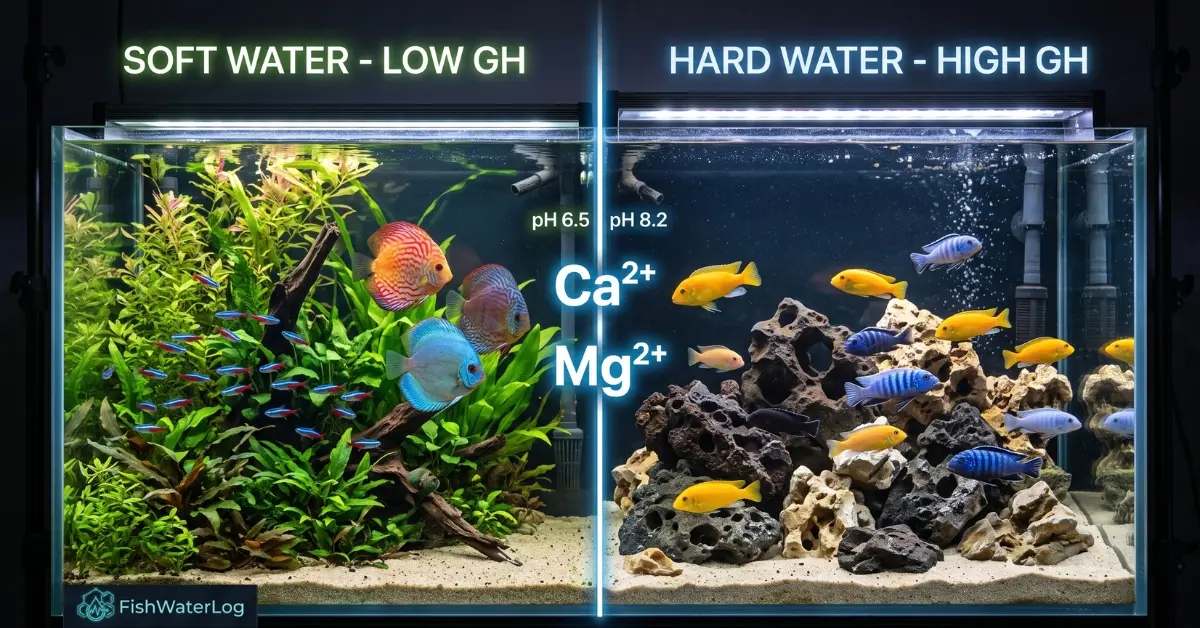
Water chemistry serves as the invisible biological foundation of every successful closed aquatic habitat, dictating cellular health, enzyme function, and systemic stability. Among the core parameters monitored by aquarists, Aquarium GH stands out as a primary biochemical driver because it quantifies the aggregate concentration of dissolved multivalent cations—predominantly calcium (Ca²⁺) and magnesium (Mg²⁺).
When managing sensitive soft water fish species such as Discus, wild-caught tetras, or dwarf cichlids, maintaining proper mineral balance is essential to prevent chronic metabolic fatigue and support cellular osmoregulation. Mastering how to lower GH in freshwater aquarium systems requires moving beyond unpredictable chemical additives toward methodical dilution and active substrate buffering, establishing an environment where aquatic life can thrive over a natural lifespan.
The Chemical Architecture of Aquatic Ecosystems
In captive aquatic life-support systems, dissolved minerals constitute the foundational architecture that governs biological stability and cellular homeostasis. While aquarists frequently focus on macroscopic variables like water clarity, Aquarium GH represents a far more fundamental chemical metric. Unlike Carbonate Hardness (KH), which primarily measures acid-neutralizing buffering capacity, General Hardness explicitly quantifies the cumulative mass of multivalent metallic cations in the water column—most notably dissolved calcium (Ca²⁺) and magnesium (Mg²⁺). When housing specialized soft water fish, learning how to lower GH in freshwater aquarium layouts is vital to prevent osmotic distress and sustain an accurate, life-supporting mineral balance.
According to baseline data published by the USGS Water Science School on water hardness, regional groundwater percolation dissolves heavy deposits of limestone and dolomite, yielding hard tap water across more than 85% of municipal supplies.
Permanent Hardness vs. Temporary Buffers
In practical aquatic chemistry, General Hardness is characterized as “permanent hardness”. Unlike temporary hardness associated with carbonate anions—which can precipitate out of solution via thermal boiling—the sulfates and chlorides that bind calcium and magnesium cannot be disrupted or stripped through simple boiling or basic mechanical filtration. Consequently, utilizing basic chemical dechlorinators, boiling, or simple water degassing has zero impact on dissolved divalent cation concentrations.
- Geological Origin: Tap water mineral concentrations derive from regional groundwater percolation through subterranean limestone (calcium carbonate) and dolomite (calcium magnesium carbonate) deposits, yielding heavily mineralized municipal supplies in excess of 85% of regional tap lines.
- Evaporative Concentration: Pure water molecules (H2O) evaporate continuously from the water surface, but heavy calcium and magnesium salts remain behind in the water column. “Topping off” an aquarium with standard tap water compounds this baseline, progressively concentrating multivalent ions and driving parameters far beyond tolerable levels for soft-water fauna.
- Physiological Impact: High concentrations of unbound divalent cations continuously interact with branchial membranes, placing severe evolutionary demands on teleost osmoregulation and forcing the continuous expenditure of metabolic energy.
The Biological Imperative: Osmoregulation in Freshwater Teleosts
The fundamental necessity of maintaining proper mineral balance within closed aquatic environments lies in the physiological mechanism of teleost osmoregulation. Osmoregulation represents the continuous, energy-demanding biological process through which aquatic fauna maintain internal fluid and electrolyte equilibrium across semi-permeable membranes (primarily the gills, dermal layers, and gastrointestinal tract) relative to the ambient water column.
Freshwater teleost fishes and macro-invertebrates are obligate hyperosmotic regulators. Because their internal bodily fluids maintain a significantly higher ionic concentration than the surrounding freshwater, thermodynamic laws of diffusion force water to move continuously into their bodies through branchial epithelia, while vital internal salts constantly leak outward into the water column. To prevent cellular lysis and internal dilution, teleosts must constantly excrete large quantities of dilute urine while utilizing active transport mechanisms to absorb trace minerals from the external environment.
Cellular Mechanisms: Ionocytes, ATP, and Calcium Channels
The extraction of essential divalent cations is executed by specialized branchial cells known as ionocytes (historically termed mitochondria-rich cells or chloride cells). These cells are densely populated across the primary and secondary lamellar epithelium of teleost gills.
- Epithelial Channel Entry: Transepithelial mineral uptake begins with the passive influx of calcium across the apical cell membrane through specialized, non-voltage-gated epithelial calcium channels, identified functionally as TRPV6 or ECaC (epithelial calcium channel).
- Basolateral Extrusion: Once inside the ionocyte, the extrusion of cations across the basolateral membrane into the bloodstream is actively driven by high-affinity Ca2+-ATPase pumps and Na+/Ca2+ exchanger networks.
- Metabolic Cost: This active transport chain relies on adenosine triphosphate (ATP) generated via oxidative phosphorylation within the dense mitochondrial matrix of the ionocytes. Under baseline conditions, approximately 90% of cellular oxygen consumption in these tissues is dedicated strictly to sustaining ATP output for ion transport.
As documented in peer-reviewed physiological research on teleost ion transport and osmoregulation, freshwater teleosts operate as hyperosmotic regulators, relying on high-density branchial ionocytes to extract vital divalent cations against a steep concentration gradient.
Pathophysiological Consequences of Incompatible Aquarium GH
When evolutionary soft water fish species—such as wild Discus (Symphysodon spp.), Cardinal Tetras (Paracheirodon axelrodi), or Chocolate Gouramis (Sphaerichthys osphromenoides)—are placed into an environment with excessive Aquarium GH, their finely tuned physiological pathways experience acute disruption. Understanding how to lower GH in freshwater aquarium habitats directly prevents these three severe failure modes:
- Metabolic Exhaustion: The excessive concentration gradient of ambient calcium and magnesium forces branchial ionocytes and renal tubules to expend vast reserves of cellular ATP to regulate mineral influx. This continuous metabolic diversion robs the organism of energy required for somatic growth, tissue repair, and immune defense.
- Renal Calcinosis and Osmotic Collapse: Chronic exposure to elevated divalent ions leads to the precipitation of insoluble calcium salts within renal tubules, culminating in progressive nephrocalcinosis, kidney failure, and early mortality. Sudden parameter shifts compound this damage, inducing acute cellular dehydration or osmotic shock.
- Invertebrate Ecdysis Failure: In freshwater crustaceans (such as Caridina and Neocaridina shrimp), inappropriate General Hardness prevents normal exoskeleton formation. Excessively high calcium causes rigid, inflexible cuticles that crack fatally during molting (ecdysis), whereas deficient mineral levels prevent post-molt hardening, leaving specimens defenseless against predation and bacterial infection.
Gap Analysis: The Calcium-to-Magnesium Ratio
A prevalent misconception in aquariculture is treating Aquarium GH as a single, uniform measurement. Standard test kits provide a cumulative value for divalent cations, obscuring the precise biological proportions of dissolved calcium (Ca2+) and magnesium (Mg2+). In natural waterways and closed biotope environments, establishing the proper mineral balance requires maintaining an optimal 3:1 Calcium-to-Magnesium ratio. Understanding this specific stoichiometric relationship is fundamental when learning how to lower GH in freshwater aquarium setups safely.
- Magnesium as an Enzymatic Co-Factor: Magnesium is essential for activating more than 300 enzymatic pathways and directly governs how teleost ionocytes metabolize and integrate calcium during branchial osmoregulation. Without adequate dissolved magnesium, calcium cannot be biologically absorbed and may precipitate out of solution.
- Physiological Dangers of Cation Imbalance: An excess of calcium relative to magnesium causes severe exoskeleton rigidity in freshwater shrimp, leading to fatal molting failures. Conversely, disproportionately high magnesium concentrations impair neural transmission and induce systemic muscular lethargy in soft water fish.
- Limitation of Blind Dilution: Lowering General Hardness without measuring individual cation ratios can leave the aquatic habitat deficient in critical magnesium, destabilizing biological systems even when the overall GH reading appears optimal on a testing chart.
The Fallacy of Chemical Water Softeners
Aquarists often resort to domestic water-softening appliances or commercial “softening pillows” containing sodium-based ion-exchange resins to reduce water hardness. While these resin beds effectively lower the measurable degrees of General Hardness, they create a severe physiological hazard for freshwater organisms.
As hard tap water flows through a sodium-form resin, the active matrix binds divalent calcium and magnesium ions while simultaneously releasing monovalent sodium (Na+) or potassium (K+) ions into the water column. This substitution introduces critical biological issues:
- Masked Salinity and High TDS: Because standard liquid drop-titration tests only measure multivalent cations (calcium and magnesium), the resulting test indicates a low GH. However, the Total Dissolved Solids (TDS) and electrical conductivity remain unchanged or even increase due to displaced sodium ions.
- Severe Hyperosmotic Stress: Evolutionary soft water fish possess branchial ionocytes specialized for low-salinity, mineral-deficient environments. Flooding their habitat with high concentrations of dissolved sodium alters the ambient osmotic pressure, inducing hyperosmotic stress and progressive renal damage.
- Safe Remediation Rule: Lowering mineral hardness must always be achieved through physical extraction and volumetric dilution, never through chemical sodium substitution.
Protocols for Mineral Reduction
Establishing a stable, low-hardness aquatic environment requires methodical intervention rather than rapid chemical adjustments. Sudden drops in multivalent ion concentrations trigger acute osmotic shock, meaning any reduction in Aquarium GH must be executed gradually over multiple water exchanges. Understanding how to lower GH in freshwater aquarium ecosystems safely relies on physical extraction, volumetric dilution, and natural biological filtration.
Reverse Osmosis (RO) and Deionized (DI) Water Blending
The most precise, reproducible method for reducing General Hardness is blending source water with Reverse Osmosis (RO) or Deionized (DI) water. An RO system utilizes a semi-permeable membrane under pressure to strip 95% to 99% of dissolved multivalent cations. However, to prevent premature membrane degradation and sudden mineral surges, monitor your system against TDS creep in aquarium RO/DI systems before blending replacement water.
- The Pure RO Risk: Because pure RO water is entirely devoid of dissolved minerals, utilizing 100% un-remineralized RO water creates an extreme osmotic gradient that causes teleost cells to lose vital internal electrolytes. RO effluent must always be blended with tap water or reconstituted with targeted mineral salts to preserve the 3:1 Calcium-to-Magnesium mineral balance.
- Blending Calculus: To achieve a target hardness, aquarists calculate a direct volumetric ratio. For example, if municipal tap water measures 12 dGH and the target environment requires 6 dGH for delicate soft water fish, blending 50% tap water with 50% pure RO water achieves the desired parameter.
- Top-Off Protocol: Evaporated water consists purely of $H_2O$, leaving dissolved calcium and magnesium behind. All evaporation top-offs must be conducted strictly with pure RO or distilled water to prevent cumulative mineral creep and osmoregulatory distress.
Active Filtration via Sphagnum Peat Moss
For biotope setups, filtering water through organic sphagnum peat moss provides a functional botanical method to manage hardness. Peat moss acts as a natural, weak ion-exchange resin, binding divalent calcium and magnesium ions while slowly releasing humic, fulvic, and tannic acids into the water column.
- Biochemical Conditioning: This natural exchange lowers GH and pH simultaneously, creating the amber-tinted blackwater parameters favored by Amazonian and Southeast Asian teleosts.
- Monitoring KH Exhaustion: Because peat moss actively consumes Carbonate Hardness (KH), aquarists must monitor buffering capacity closely to avoid an unexpected pH crash. The rate of mineral absorption varies depending on the botanical density of the peat, necessitating routine liquid titration testing.
This natural filtration process simultaneously lowers GH and pH while releasing beneficial humic compounds; explore our clinical guide on botanical tannins in freshwater aquariums to safely harness fulvic acids without inducing severe pH instability.
Dilution with Distilled or Rainwater
Distilled water, produced via thermal vaporization, provides a mineral-free alternative to RO water and functions via the same volumetric dilution principles. Natural rainwater also exhibits negligible hardness; however, atmospheric precipitation frequently absorbs airborne industrial pollutants, nitrates, and sulfur compounds. If utilizing rainwater, it must be harvested in non-industrial rural regions and passed through activated carbon media before tank introduction.
Substrate Science: Cation Exchange Capacity (CEC)
Modern planted aquaria leverage active substrates (aquasoils) to manage water chemistry from the bottom up. Manufactured from kiln-fired volcanic clays and organic humates, active substrates possess a high Cation Exchange Capacity (CEC).
- Electrostatic Mineral Trapping: The microscopic clay lattices within aquasoil carry an inherent negative electrical charge. As hard water flows across the substrate bed, the soil actively attracts and binds positively charged calcium (Ca2+) and magnesium (Mg2+) ions, physically pulling them out of the water column and softening the habitat for soft water fish.
- Benthic Nutrient Banking: Bound cations remain locked within the substrate matrix, where plant root hairs secrete hydrogen ions (H+) to exchange and absorb the trapped calcium and magnesium directly into their vascular systems for structural growth.
- Buffering Lifespan & Cycling Precaution: The CEC capacity of active soil is finite. Constant exposure to hard tap water saturates the soil’s binding sites within 6 to 12 months, whereas pairing aquasoil with RO-diluted water preserves its active softening capacity for 24 to 36 months. Additionally, freshly unsealed aquasoils leach initial surges of ammonium (NH4+), requiring frequent water changes during the initial cycling weeks.
Unlike completely inert silica sand or basic gravel, choosing the right substrate for planted tanks ensures your benthic layer provides high cation exchange capacity to actively pull excess hardness cations out of the water column.
Measuring and Monitoring General Hardness
Precision telemetry is fundamental when adjusting water parameters, as attempting to alter Aquarium GH without analytical verification risks severe osmotic destabilization. Relying on seasonal municipal water reports is inadequate; municipal treatment alterations and aquifer shifts create constant baseline fluctuations. Understanding how to lower GH in freshwater aquarium setups safely requires distinguishing between true divalent cation testing and broad electrical conductivity metrics.
Liquid Titration vs. The TDS Fallacy
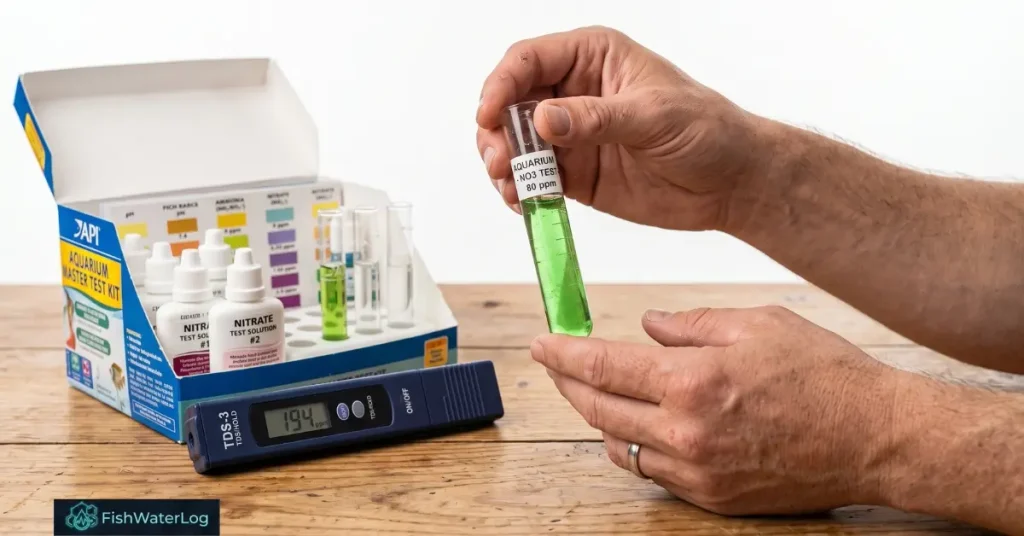
Liquid drop-titration assays represent the laboratory standard for tracking General Hardness in home aquaria. These test kits employ chelating agents and colorimetric indicators that bind selectively to dissolved calcium and magnesium ions. As drops are introduced into a measured 5 mL sample vial, a sharp color transition (typically shifting from orange to green) marks the exact titration endpoint, with each drop representing one German degree of hardness (1 dGH).
Conversely, many aquarists mistakenly rely on Total Dissolved Solids (TDS) pens to estimate mineral hardness. A TDS meter measures electrical conductivity rather than specific multivalent cations:
- Conductivity Interference: A TDS pen measures all charged ions indiscriminately—including sodium, potassium, chlorides, nitrates, phosphates, and organic acids leached from driftwood or botanicals.
- False Telemetry: If an aquarist employs a sodium-based water softener or doses potassium-based plant fertilizers, the TDS reading may exceed 300 ppm while the actual calcium and magnesium available for teleost osmoregulation remains at zero. While TDS meters are valuable for verifying reverse osmosis membrane rejection rates, liquid titration is non-negotiable for monitoring true mineral balance.
Because manual calculations of dilution blends and mineral balances are prone to error, you can instantly model your target remineralization ratios and chemical limits using our interactive Aquarium Calculator.
Global Measurement Units and Conversions
Interpreting aquatic literature requires fluency across regional testing units, as research papers, commercial test kits, and international care sheets utilize different mathematical scales for Aquarium GH. The primary metrics include:
- ppm / mg/L (CaCO3 Equivalent): The standardized scientific laboratory standard, where 1 ppm equals 1 mg/L of dissolved calcium carbonate equivalent.
- dGH / °dH (German Degrees): The standard hobbyist scale, where 1 dGH represents 10 mg/L of calcium oxide, equivalent to 17.848 mg/L (CaCO3).
- gpg (Grains per Gallon): Primarily utilized in North American municipal water treatment, where 1 gpg equals 17.118 ppm.
- mmol/L (Millimoles per Liter): The SI chemical unit quantifying molar concentration, where 1 mmol/L corresponds to 100.087 mg/L (CaCO3).
| USGS Water Hardness Classification | Concentration (mg/L or ppm) | Degrees of Hardness (dGH / °dH) | Grains per Gallon (gpg) | Molar Concentration (mmol/L) |
| Soft Water | 0 – 60 | 0 – 3.36 | 0 – 3.50 | 0 – 0.60 |
| Moderately Hard | 61 – 120 | 3.37 – 6.72 | 3.51 – 7.01 | 0.61 – 1.20 |
| Hard Water | 121 – 180 | 6.73 – 10.08 | 7.02 – 10.51 | 1.21 – 1.80 |
| Very Hard Water | 180 | 10.08 | 10.51 | 1.80 |
Species-Specific Mineral Profiles
The imperative to calibrate General Hardness depends strictly on the evolutionary profile of the target livestock. Forcing evolutionary soft water fish into high-GH environments induces systemic nephrocalcinosis and branchial fatigue, whereas housing hard-water species in mineral-stripped environments causes osmoregulatory collapse. The reference matrix below outlines species-specific parameter ranges and biological requirements:
| Aquarium Focus / Target Fauna | Target GH (dGH) | Target GH (ppm) | Biological Rationale |
| Delicate Invertebrates (Caridina Shrimp) | 4 – 6 dGH | 71 – 107 ppm | Mandates a strict 3:1 Ca:Mg ratio to prevent failed ecdysis (molting failure) and cuticle cracking. |
| Blackwater Biotope Species (Wild Discus, Chocolate Gouramis, Killifish) | 1 – 4 dGH | 17 – 71 ppm | Adapted to acidic, mineral-depleted peat tributaries; elevated GH induces lethal renal calcification. |
| Planted Community Habitats (Neon Tetras, Corydoras, Apistogramma) | 4 – 8 dGH | 71 – 140 ppm | Supplies essential structural calcium for macrophyte cell walls without stressing soft-water teleost ionocytes. |
| Hard-Water Livebearers (Guppies, Mollies, Platies, Swordtails) | 10 – 20 dGH | 178 – 356 ppm | High ambient divalent ions sustain efficient electrolyte retention, preventing livebearer “shimmies”. |
| African Rift Lake Cichlids (Malawi, Tanganyika, Victoria) | 12 – 20+ dGH | 214 – 356+ ppm | Endemic to highly alkaline, heavily mineralized lacustrine basins; low GH triggers severe osmotic shock and mortality. |
Benthic crustaceans require a strict 3:1 Calcium-to-Magnesium balance to avoid incomplete ecdysis; refer to our exhaustive breakdown on cherry shrimp water parameters to maintain ideal GH and KH thresholds for molting success.
Conclusion
Mastering water chemistry represents the defining benchmark of advanced aquatic husbandry. Aquarium GH is not merely an arbitrary testing metric; it serves as the underlying biochemical engine governing teleost osmoregulation, skeletal ossification, branchial ion transport, and invertebrate cuticle development. Relying on artificial sodium-based softening resins or executing aggressive, unmeasured mineral depletion risks triggering acute osmotic shock, nephrocalcinosis, and catastrophic organ failure.
By understanding the physiological energy demands of branchial ionocytes and preserving a strict 3:1 Calcium-to-Magnesium mineral balance, aquarists can precisely stabilize closed aquatic environments. Implementing scientifically validated dilution methodologies—primarily controlled RO/DI blending, natural peat moss filtration, and high-CEC active substrates—empowers hobbyists with the practical knowledge of how to lower GH in freshwater aquarium setups safely, ensuring sensitive soft water fish and delicate invertebrates thrive across a natural, robust lifespan.
Frequently Asked Questions (FAQs)
Does boiling tap water lower Aquarium GH?
No. Boiling water only precipitates dissolved bicarbonate anions, reducing Carbonate Hardness (KH) and temporary hardness. The sulfates and chlorides of calcium and magnesium that constitute General Hardness (permanent hardness) remain in solution, meaning boiling will actually concentrate divalent cations as pure water evaporates off.
Can I use domestic water softener water in a freshwater aquarium?
No. Residential water softeners operate on sodium-ion exchange resins that replace calcium and magnesium ions with monovalent sodium or potassium ions. While this lowers measured GH, it leaves Total Dissolved Solids (TDS) dangerously high, subjecting soft water fish to severe hyperosmotic stress and renal failure.
Why does my aquarium GH increase over time without adding minerals?
This parameter drift occurs primarily through evaporation. Evaporative loss removes pure H2O vapor while leaving heavier calcium and magnesium salts behind in the tank. If you top off evaporated volume with municipal tap water, you continuously add new minerals into an already concentrated system. Always execute evaporation top-offs using pure, un-remineralized RO or distilled water.
Is excessively low GH dangerous for freshwater shrimp and snails?
Yes. Benthic invertebrates require dissolved calcium to synthesize and maintain calcified shells and exoskeletons. If GH falls below 4 dGH, aquatic snails experience shell erosion and pitting, while dwarf shrimp suffer from incomplete ecdysis (the “white ring of death”) where specimens become fatally trapped in their old exoskeleton.
Will adding driftwood or botanicals effectively lower my GH?
While driftwood, Indian almond leaves, and alder cones release tannic and fulvic acids that depress water pH, their quantitative capacity to strip multivalent calcium and magnesium cations is negligible compared to active sphagnum peat moss or reverse osmosis dilution.
