

A freshwater aquarium ecosystem is a closed, highly dynamic aquatic environment that functions as a miniature replica of natural lakes and river systems. While aquarists often view fish, live plants, and water quality as isolated components, maintaining a thriving ecosystem in tank setups requires a deep understanding of biological connectivity, nutrient cycling, and microbial ecology.
Specifically, monitoring and stabilizing your freshwater aquarium levels is paramount to prevent sudden biochemical stalls. Understanding the optimal aquarium levels freshwater setups depend on ensures that your biological filtration remains highly resilient against organic surges.
Historically, aquarium management focused primarily on single-species autotrophic nitrification—the conversion of toxic total ammonia nitrogen into nitrite and nitrate by specialized nitrifying bacteria. However, modern ecological research and advanced aquascaping demonstrate that a truly stable freshwater aquarium ecosystem is driven by complex macro- and micro-level dynamics. These include energy transfer across trophic levels, Carbon-to-Nitrogen ($C:N$) ratio interactions, and fierce competitive dynamics within multi-species biofilms.
This comprehensive technical guide examines the structural framework of the freshwater aquarium ecosystem, exploring how organic carbon loads, autotrophic versus heterotrophic bacterial competition, and Extracellular Polymeric Substance (EPS) matrix development determine long-term biological stability. If you must introduce livestock before your biofilter fully matures, managing a freshwater aquarium ecosystem during fish-in cycling requires strict daily monitoring of free ammonia fractions.
Table of Contents
Macro-Ecosystem Dynamics & Trophic Architecture
A freshwater aquarium ecosystem operates as a thermodynamically open system, reliant on continuous energy inputs and metabolic waste outputs to maintain internal organization. Radiant energy enters the environment through light fixtures providing photosynthetically active radiation (PAR, 400-700 nm), while organic matter enters through introduced feeds. Matter leaves the system via gaseous exchange at the air-water interface, physical pruning of aquatic macrophytes, mechanical extraction of detritus, and water changes.
Understanding a managed ecosystem in tank requires examining the continuous flow of energy and nutrients across three primary trophic levels:
- Primary Producers: Submerged and emergent macrophytes, microalgae, and cyanobacteria fix inorganic carbon (CO2, HCO3-) into complex biomass using solar or artificial light. Through photosynthesis, primary producers generate dissolved oxygen (DO) necessary for aquatic animal respiration and assimilate nitrogenous waste products (NH4+, NO3-) alongside orthophosphates (PO43-).
- Consumers: Teleost species, macro-invertebrates (e.g., Neocaridina shrimp, Neritina snails), and micro-crustaceans occupy herbivorous, omnivorous, and carnivorous niches. Their metabolic processes consume dissolved oxygen while releasing metabolic carbon dioxide (CO2), total ammonia nitrogen (NH3/NH4+), particulate organic matter (feces), and dissolved organic macromolecules.
- Decomposers: Heterotrophic bacteria, saprophytic fungi, and micro-fauna continuously process particulate organic carbon (POC) and dissolved organic carbon (DOC). This microbial decomposer network drives remineralization, converting complex proteins, carbohydrates, and lipids back into basic inorganic nutrients usable by primary producers.
The flow of mass and energy through these trophic levels follows a defined hierarchy. Exogenous feeds enter the system and pass through consumer tiers, where metabolic digestion yields excretions and fecal waste. These outputs, combined with plant senescence, enter the particulate and dissolved organic carbon pools. The decomposer network breaks down this organic pool, returning inorganic nutrients to the primary producers and completing the internal loop.
While popular literature often treats the freshwater aquarium ecosystem as a simple interaction between fish and plants, system stability is fundamentally governed by sub-visible microbial dynamics within filter media, substrate beds, and bio-membranes.
The Microbial Engine: Autotrophic vs. Heterotrophic Competition
While primary biofiltration relies on autotrophic nitrifiers converting total ammonia nitrogen into nitrate, maintaining a balanced fish tank care aquatic guide requires managing the aggressive spatial competition between autotrophs and heterotrophic saprophytes.
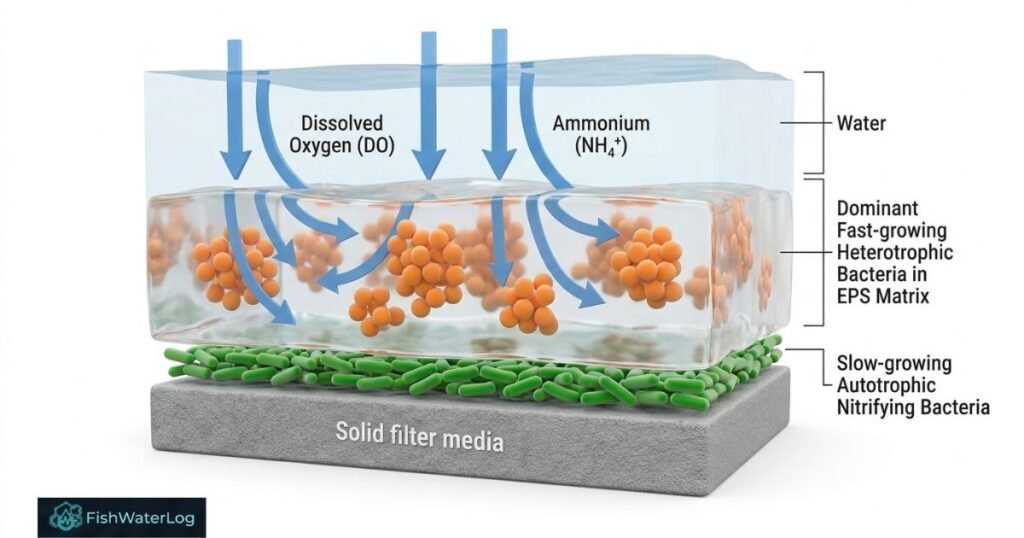
Causal Cascade of High C:N Biofilter Failure
The degradation of biological filter performance follows a predictable cascade when organic loading increases:
- Organic Accumulation: Unfiltered particulate and dissolved organic carbon levels rise in the water column, driving the effective C:N ratio above 0.5.
- Heterotrophic Proliferation: Fast-growing heterotrophic populations exploit the abundant carbon, out-dividing slow-growing nitrifiers by several orders of magnitude.
- Biofilm Overgrowth: Heterotrophic biomass forms a thick outer layer over the biological media, consuming dissolved oxygen before it reaches deeper strata.
- Autotrophic Starvation: Nitrifiers trapped beneath the heterotrophic layer experience oxygen and space starvation, halting ammonia and nitrite conversion.
- Water Quality Collapse: Unconverted total ammonia nitrogen (TAN) and nitrite (NO2-) accumulate in the water column, threatening aquatic livestock. If your system experiences this severe ecological stall, immediately execute our emergency protocol to Fix a Nitrogen Cycle Crash in Aquariums to safeguard your livestock.
Dual-Substrate Monod Kinetics & Guild Competition
The competitive exclusion of autotrophic nitrifiers by heterotrophic saprophytes is defined by dual-substrate Monod growth kinetics, incorporating electron donors (TAN or DOC) and electron acceptors (Dissolved Oxygen, DO):
μ_A = μ̂_A * (S_NH4 / (K_NH4 + S_NH4)) * (S_O2 / (K_O2,A + S_O2)) – b_A
μ_H = μ̂_H * (S_DOC / (K_DOC + S_DOC)) * (S_O2 / (K_O2,H + S_O2)) – b_H
Heterotrophs possess a significantly higher maximum specific growth rate (μ̂_H ≈ 2.0–6.0 day⁻¹) and yield coefficient (Y_H ≈ 0.60–0.67 g cell COD/g COD) compared to autotrophic nitrifiers (μ̂_A ≈ 0.5–1.2 day⁻¹, Y_A ≈ 0.10–0.15 g cell COD/g NH4-N). Furthermore, heterotrophs exhibit a much lower oxygen half-saturation constant (K_O2,H ≈ 0.1–0.2 mg/L) than autotrophs (K_O2,A ≈ 0.5–1.0 mg/L), allowing them to consume dissolved oxygen near the outer biofilm surface before it can diffuse into deeper nitrifying strata.
Quantitative Impact on Nitrification Performance
Research on biofilter performance demonstrates an inverse relationship between the C:N ratio and the Total Ammonia Nitrogen (TAN) removal rate:
- At C:N = 0 (Pure Autotrophic System): Nitrifying bacteria form a thin, dense biofilm where 100% of the surface area and oxygen flux are dedicated to ammonia and nitrite oxidation.
- At C:N = 0.5: The influx of organic carbon stimulates heterotrophic proliferation. The TAN removal efficiency drops by 30% compared to a purely autotrophic system.
- At C:N = 0.6 to 1.2: Heterotrophic biomass dominates the biofilm surface. Nitrification capacity decreases by 50% to 70%.
- At C:N > 2.0: Heterotrophic bacteria outcompete nitrifiers almost completely for both space and oxygen. Nitrification slows drastically, causing sudden spikes in water-column ammonia (NH3/NH4+) and nitrite (NO2-). Persistent organic carbon surges degrade water chemistry and compromise teleost immunity, making an understanding of freshwater aquarium ecosystem fish disease protocols essential when treating gill lamellar damage and secondary bacterial infections.
Mechanism of Physical Biofilter Smothering
The decline in nitrification performance at elevated C:N ratios occurs via physical biofilter smothering. Heterotrophic bacteria produce substantially more cell mass per unit of carbon oxidized (high biomass yield) compared to the minimal cell mass produced by nitrifiers per unit of nitrogen oxidized.
Heterotrophic cell expansion leads to pore occlusion, where biomass bridges across microscopic pores in biofilter media (such as porous ceramic rings, sintered glass, or fine foam sponges), restricting water velocity and bulk transport through the filter media. Simultaneously, the boundary layer thickness of the biofilm expands, reducing the diffusion coefficient of ammonium (NH4+) and dissolved oxygen (O2) through dense heterotrophic mats and preventing these compounds from reaching nitrifiers buried underneath.
As the inner autotrophic layer starves, its cellular attachment to the solid substrate weakens, leading to mass detachment (sloughing) of the nitrifying community. This structural breakdown explains why an established biofilter can suddenly fail under heavy organic loading; the failure stems from rapid heterotrophic overgrowth that physically smothers nitrifying populations. Accurately determining precise dosing, water exchange volumes, and un-ionized ammonia ratios in your freshwater aquarium ecosystem parametric calculator log ensures you never overshoot water chemistry parameters.
Biofilm Matrix Dynamics & Microbial Succession (EPS)
Biofilms are organized microbial communities embedded within a self-produced matrix of Extracellular Polymeric Substances (EPS) attached to abiotic or biotic surfaces. In an ecosystem in tank, biofilms line every available surface, including substrate grains, plant leaves, glass panels, and biological filter media.
Composition and Physics of the EPS Matrix
The Extracellular Polymeric Substance (EPS) matrix accounts for over 90% of the total dry biomass of a mature biofilm, with bacterial cells representing less than 10%. EPS is composed of several functional components:
- Polysaccharides: Structural polymers that form a hydrated gel framework, maintaining biofilm hydration and structural integrity.
- Proteins & Enzymes: Extracellular enzymes that break down complex macromolecules in the surrounding water column into absorbable monovalent nutrients.
- Extracellular DNA (eDNA): Functions as a structural adhesive and facilitates horizontal gene transfer between neighboring bacterial cells.
- Lipids & Humic Substances: Hydrophobic components that modulate surface charge and control chemical transport through the matrix. Quantifying complex organic carbon fractions and refractory compounds according to Standard Methods 5510 for Aquatic Humic Substances establishes the analytical benchmark for assessing dissolved organic loads within a freshwater aquarium ecosystem.
c-di-GMP Signaling & Quorum-Sensing Matrix Dispersal
Biofilm consolidation and active dispersal are regulated by intracellular cyclic diguanylate monophosphate (c-di-GMP) concentrations and cell-density-dependent quorum-sensing (QS) signaling cascades. Elevated intracellular c-di-GMP levels stimulate extracellular polysaccharide secretion, maintaining a dense, attached biofilm state.
When localized oxygen starvation or nutrient depletion occurs within dense heterotrophic layers, cellular phosphodiesterases (PDEs) hydrolyze c-di-GMP into 5′-phosphoguanylyl-(3′-5′)-guanosine (pGpG) and GMP. This intracellular decline downregulates EPS matrix synthesis, upregulates motility genes, and triggers the secretion of extracellular matrix-degrading enzymes (proteases, alginate lyases). Simultaneously, accumulated N-acyl homoserine lactones (AHLs) reach critical quorum-sensing thresholds, causing rapid matrix dissolution and catastrophic biofilter sloughing.
Microbial Succession Stages in Biofilters
The establishment of a functional biofilter biofilm follows five discrete developmental phases:
- Conditioning Film Formation (0–6 Hours): Organic molecules (humic acids, trace proteins) adsorb onto clean media surfaces via electrostatic and van der Waals forces, altering local surface charge and hydrophobicity.
- Pioneer Heterotrophic Attachment (Days 1–3): Fast-growing heterotrophic bacteria reversibly, then irreversibly, attach to the conditioned surface using flagella and pili before secreting primary EPS biopolymers.
- Autotrophic Colonization (Days 7–21): Slow-growing AOB and NOB attach to the preliminary heterotrophic EPS matrix, which provides a sheltered micro-environment with reduced fluid shear stress. Managing this fragile colonization phase is highly critical when learning how to cycle a fish tank with fish safely.
- Maturation and Micro-Channel Architecture (Days 21–40): The biofilm forms a three-dimensional structure with cell clusters intersected by fluid-filled interstitial channels. These channels facilitate convective transport of bulk water, delivering oxygen and NH4+ while removing carbon dioxide (CO2) and hydrogen ions (H+).
- Steady-State Dispersion & Sloughing (> Day 40): Fluid shear stress or localized nutrient deprivation triggers enzymatic degradation of the EPS matrix. Planktonic cells detach and disperse to colonize unpopulated surfaces throughout the tank. Research on teleost pathology and parasitic stress published in the Journal of Fish Diseases confirms that water quality disruptions in a freshwater aquarium ecosystem severely impair fish immune response and increase susceptibility to secondary clinical infections.
Ecosystem Management & Bio-Optimization Protocol
To prevent heterotrophic smothering and maintain balance within a freshwater aquarium ecosystem, physical, chemical, and biological inputs must be managed to keep the biofilter’s effective C:N ratio below 0.5.
Mechanical Separation of Organic Carbon
The primary driver of high C:N ratios in biofilters is the dissolution of Particulate Organic Matter (POM) into Dissolved Organic Matter (DOM) within filter chambers. Mechanical filtration media (foam pads, poly-fill, or fleece rollers) must be positioned upstream of biological media to capture organic solids before they decay. These mechanical pre-filters must be cleaned or replaced regularly in tank water to remove captured organic carbon from the system loop before it solubilizes into DOC.
Substrate Stratification and Carbon Sequestration
Substrate architecture significantly influences benthic nutrient dynamics. Nutrient-rich substrates containing organic matter should be localized to the bottom layers of the tank bed. Capping these soils with 1.5 to 2 inches of coarse sand (1–3 mm grain size) or fine gravel creates a physical barrier that restricts organic carbon leaching into the water column while allowing macrophyte roots anaerobic access to stored nutrients.
Biological Filter Media Selection and Flow Mechanics
To prevent heterotrophic pore occlusion, biofilter media must balance total surface area with open pore geometry. Highly microporous media (pore sizes < 10 microns) rapidly clog with heterotrophic biomass and EPS gel under organic loading. Coarse macroporous media (reticulated polyurethane foam of 20–30 PPI or moving-bed media) maintain continuous water flow and open channels. Water velocity through the media must supply dissolved oxygen and clear acidic byproducts (H+) without creating excessive shear stress that strips nitrifying biofilms.
Step-by-Step Setup and Maintenance Protocol
Creating a resilient freshwater aquarium ecosystem requires a structured setup sequence followed by disciplined operational care to maintain long-term biological balance:
- Substrate & Base Layer: Layer nutrient-dense aqua soil at the bottom and cap with 1.5 to 2 inches of inert sand or fine gravel to prevent nutrient leaching into the water column.
- Hardscape Placement: Position non-reactive hardscape (slate, granite, driftwood) to create natural shelter zones and epiphyte anchoring points.
- Flora Planting Strategy: Anchor fast-growing background stem plants (Rotala, Vallisneria) alongside midground epiphytes and carpeting flora to maximize vegetative nitrate uptake.
- Equipment Integration: Install mechanical pre-filtration, submersible heating (24°C–27°C), and full-spectrum LED lighting calibrated for a 6–8 hour photoperiod.
- Water Conditioning & Bio-Inoculation: Neutralize municipal chlorine/chloramines with sodium thiosulfate conditioners and seed the filter media with nitrifying bacterial cultures.
- Maintenance Routine: Perform 10–20% weekly partial water changes, gently rinse mechanical pre-filters in extracted tank water monthly, and test nitrogen parameters regularly.
Biological Diagnostics and Ecosystem Troubleshooting
Even mature aquatic setups can experience sudden biological disturbances. Identifying underlying microbial causes allows targeted remediation without destabilizing nitrifying colonies:
- Bacterial Blooms (Cloudy Water): Driven by free-swimming heterotrophic bacterial proliferation decomposing excess organic carbon. Avoid massive water changes; reduce feed input and increase surface aeration to allow autotrophic nitrifiers to outcompete planktonic heterotrophs over 3–7 days.
- Excessive Algae Proliferation: Triggered by photon imbalance or excess dissolved nutrients (NO3–, PO43-). Reduce photoperiod to 6 hours, increase fast-growing plant biomass, and introduce dedicated algae-grazing invertebrates.
- Surface Gasping & Oxygen Depletion: Indicates depressed dissolved oxygen (DO < 3.0 mg/L) or elevated free ammonia/nitrite toxicity. Perform an immediate 30–50% water change with dechlorinated water and increase mechanical agitation at the air-water interface.
To maintain a healthy aquatic habitat, tracking your freshwater aquarium levels is absolutely essential, as even minor chemical shifts can disrupt biological filtration. Below is a comprehensive diagnostic guide detailing the key aquarium levels freshwater systems require to prevent heterotrophic smothering and maintain long-term biological balance:
Organic Carbon Profiling & SUVA₂₅₄ Bioavailability
Monitoring Total Organic Carbon (TOC) and Dissolved Organic Carbon (DOC) using UV spectrophotometry at 254 nm (UV₂₅₄) allows aquarists to differentiate between harmless refractory carbon and dangerous Biodegradable Dissolved Organic Carbon (BDOC). Normalizing UV₂₅₄ against total DOC yields the Specific UV Absorbance index (SUVA₂₅₄):
SUVA₂₅₄ = (UV₂₅₄ (cm⁻¹) / DOC (mg/L)) * 100
A low SUVA₂₅₄ index (< 2.0 L/(mg·m)) signifies low-molecular-weight BDOC (unconsumed feed fractions, simple proteins) that fuels rapid heterotrophic growth and triggers biofilter smothering. Conversely, a high SUVA₂₅₄ index (> 4.0 L/(mg·m)) indicates complex, highly aromatic humic/fulvic acids derived from soil or driftwood, which resist rapid microbial breakdown and do not destabilize nitrifying biofilters.
Synthesis & Ecological Balance
Systemic stability in a freshwater aquarium ecosystem depends on managing microscopic microbial dynamics alongside macro-scale tank conditions. While traditional nitrogen cycle models focus on basic inorganic conversions (NH4+ -> NO2- -> NO3-), real-world biological filtration is governed by spatial and kinetic competition within multi-species biofilms.
Elevated organic carbon inputs shift biofilter dynamics toward heterotrophic dominance, suppressing autotrophic nitrifiers through oxygen depletion and physical smothering. By maintaining an effective biofilter C:N ratio below 0.5—supported by pre-filtration, substrate capping, controlled stocking, and planted aquascaping—aquarists can prevent biofilm occlusion and foster a resilient ecosystem in tank. Utilizing laboratory-grade multiparameter telemetry specified in YSI Aquaculture Water Quality Solutions ensures precise dissolved oxygen and thermal compensation metrics across a high-tech freshwater aquarium ecosystem.
Frequently Asked Questions
What is the ideal Carbon-to-Nitrogen (C:N) ratio for a freshwater aquarium ecosystem biofilter?
The ideal molar C:N ratio within a freshwater aquarium ecosystem biofilter is below 0.5. At this ratio, heterotrophic bacteria do not overpopulate the biofilm surface, allowing autotrophic nitrifiers unhindered access to dissolved oxygen and ammonia.
How does organic waste cause ammonia spikes in an ecosystem in tank?
Accumulated organic waste elevates Dissolved Organic Carbon (DOC) within an ecosystem in tank. Fast-growing heterotrophic bacteria rapidly multiply across biofilter media, forming a dense outer layer over the biofilm that consumes available oxygen and disrupts safe freshwater aquarium levels.
What is the function of Extracellular Polymeric Substances (EPS) in a biofilter?
In aquatic biofilms, the EPS matrix is a hydrated biopolymer gel that anchors bacterial communities to filter media. However, excess organic carbon triggers overproduction of this gel, clogging micro-pores in media and restricting oxygen diffusion to nitrifying populations, which alters the crucial aquarium levels freshwater setups depend on.

8 thoughts on “Freshwater Aquarium Ecosystem: C:N Ratio & Biofilm Guide”