

The successful cultivation of submerged vascular plants within the boundaries of a closed thermodynamic system—colloquially known as a planted aquarium—requires an uncompromising adherence to the physical and biochemical laws governing aquatic horticulture. Historically, the aquatic hobbyist community has operated on a foundation of anecdotal evidence, subjective visual assessments, and scientifically obsolete measurement frameworks. This reliance on legacy content has systematically generated one of the most pervasive, frustrating, and financially draining challenges within the aquascaping domain: the uncontrolled, exponential proliferation of nuisance algae.
To establish immediate technical superiority in the design and maintenance of these ecosystems, modern aquatic horticulturists must aggressively abandon archaic paradigms. The foundation of a healthy, algae-free system rests entirely on dialing in an optimal aquarium lighting photoperiod alongside precise electromagnetic radiation thresholds. By establishing a rigorous planted aquarium light schedule to stop algae, aquarists can eliminate the guesswork behind how many hours of light for planted tank setups are truly necessary to sustain vegetative growth without over-saturating the water column.
Achieving this ecological equilibrium requires mastering the broader aquarium light spectrum, choosing the ideal kelvin rating fish tank environment, and configuring an automated led light schedule aquarium setup. Furthermore, calibrating the specific par rating for low tech planted tank layouts versus high-energy CO2 systems ensures that higher plants maintain absolute metabolic dominance over opportunistic algae spores.
Table of Contents
The Physics of Aquatic Illumination: Eradicating Legacy Metrics
To establish absolute technical control over your system, understanding the foundational mechanics of aquarium plant care is essential. Failing to calibrate illumination metrics with an accurate aquarium lighting photoperiod remains the primary driver of metabolic collapse and uncontrolled algal blooms in modern aquascaping.
To exert total control over a planted aquarium, it is mandatory to discard measurement systems that do not reflect the physical reality of the organisms inhabiting the environment. Failing to calibrate illumination metrics with an accurate aquarium lighting photoperiod remains the primary driver of metabolic collapse and uncontrolled algal blooms in modern aquascaping.
The Fallacy of the Watts Per Gallon Methodology
For over half a century, the architectural design of aquarium lighting systems was dictated by the “watts per gallon” (WPG) rule. This antiquated benchmark suggested that a successful planted tank required a specific ratio of electrical wattage to total water volume. However, modern lighting physics reveals critical flaws in this approach:
- Electrical Draw vs. Photonic Emission: A watt is strictly a unit of electrical power consumption and heat dissipation, measuring energy transfer rather than usable photosynthetic light.
- Technological Disruption: Modern LED arrays feature vastly superior electrical-to-photonic conversion efficiencies compared to legacy T12, T8, or metal halide fixtures. A high-efficiency 30W RGB LED fixture routinely projects far more usable photons into the water column than a 150W fluorescent array.
- Systemic Imbalance: Designing an led light schedule aquarium layout based solely on wattage creates an extreme mismatch between applied energy and plant assimilation capacity, driving severe algal blooms.
The Inadequacy of Human-Centric Photometric Units (Lumens and Lux)
Transitioning from wattage to photometric ratings like lumens, lux, and candela creates equally severe biological miscalculations:
- Anthropocentric Calibration: Lumens are mathematically weighted toward the human visual system, which peaks heavily in the green-yellow spectrum at approximately 555 nanometers.
- Deceptive Brightness: A light source emitting pure green light registers an extraordinarily high lumen output while providing minimal photosynthetic drive compared to equal energy emitted in blue or red bands.
- Spectral Misalignment: Aquatic plants absorb energy across the 400 to 700 nanometer range via specialized pigments. High-lumen fixtures often appear brilliant to the human eye while failing to supply the balanced aquarium light spectrum required to fuel the Calvin cycle and sustain vegetative growth.
The Quantum Reality of Planted Aquariums: PAR and PPFD
The objective, scientifically validated measurement of light available for aquatic photosynthesis is captured through quantum metrics that quantify individual photons within biologically active wavebands. Relying on quantum data rather than perceived brightness allows aquarists to fine-tune the aquarium lighting photoperiod to match the exact physiological demands of their flora.
Photosynthetically Active Radiation (PAR) Defined
- Spectral Boundary: Photosynthetically Active Radiation (PAR) designates the solar waveband spanning from 400 to 700 nanometers that photosynthetic organisms absorb to drive photochemical reactions.
- Definitional Standard: PAR itself is not a unit of measure, but a definitional bandwidth encapsulating the visible light spectrum utilized by higher plants.
- Colloquial Usage: When hobbyists discuss target PAR values, they are referring directly to the instantaneous rate of photonic delivery—measured as Photosynthetic Photon Flux Density (PPFD).
Photosynthetic Photon Flux Density (PPFD) as a Benchmark
PPFD measures the exact quantity of photosynthetically active photons striking a one-square-meter area per second, expressed in µmol·m⁻²·s⁻¹:
- Spatial Gradient: PPFD is a point-in-time spatial measurement that varies drastically across the vertical and horizontal dimensions of the tank.
- Substrate-Level Target: All authoritative targets must be evaluated at the substrate to ensure creeping carpets receive adequate photonic drive. Calibrating an accurate par rating for low tech planted tank setups prevents light-induced metabolic failure in bottom-dwelling species.
- Hardware Calibration: Aquarists looking to precisely calibrate their system’s intensity can explore specialized optical equipment by reviewing industry standards for a [submersible quantum PAR meter] designed specifically for the refractive index of water.
Fresnel Reflection and Aquatic Light Attenuation
Understanding photonic decay through the water column explains why surface intensity never matches benthic levels:
- Fresnel Reflection: A mismatch between the refractive indices of air and water causes roughly 4% of incident photons to reflect immediately off the surface.
- Photonic Attenuation: As light travels downward, suspended particulates, dissolved tannins, and water molecules scatter and absorb photons—disproportionately stripping red wavelengths.
- Exponential Intensity Loss: A surface reading of 300 µmol·m⁻²·s⁻¹ can drop to less than 50 µmol·m⁻²·s⁻¹ at a depth of 40 centimeters. Maintaining a balanced planted aquarium light schedule to stop algae requires quantifying this exponential decay at the deepest plant nodes rather than guessing surface output.
Daily Light Integral (DLI): The Master Ecological Metric
While PPFD dictates the instantaneous rate of incoming photons, a plant’s biological response, growth rate, and ultimate morphology are governed by the cumulative total of photonic energy received across an entire 24-hour circadian cycle. This aggregate daily dose is known as the Daily Light Integral (DLI). Calibrating DLI is the definitive method to determine how many hours of light for planted tank ecosystems are required without triggering photosynthetic saturation.
Calculating the Daily Light Dose
DLI represents the total number of photosynthetically active photons delivered to a specific surface area over a full day, formally expressed in moles of light per square meter per day (mol·m⁻²·d⁻¹).
- Cumulative Light Volume: DLI functions like measuring total daily rainfall (a cumulative volume) rather than the instantaneous flow rate of a shower (PPFD).
- Mathematical Derivation: DLI bridges the gap between instantaneous LED intensity and the exact duration of the aquarium lighting photoperiod.
- Standard Formula: DLI = PPFD × Photoperiod (in hours) × (3600 seconds/hour) / 1,000,000.
- Practical Equivalence: Exposing aquatic flora to a moderate intensity of 50 µmol·m⁻²·s⁻¹ for 10 hours yields the exact same DLI (1.8 mol·m⁻²·d⁻¹) as delivering a high intensity of 100 µmol·m⁻²·s⁻¹ for only 5 hours.
Physiological Thresholds and Light Saturation Points
Applying DLI calculations prevents aquarists from exceeding the genetic processing limits of aquatic flora:
- Compensation vs. Saturation: Every aquatic plant possesses a light compensation point (where photosynthesis equals respiration rate) and a light saturation point (the threshold beyond which additional light yields zero photosynthetic gain).
- Photoinhibition Mechanics: Pushing a plant past its saturation point triggers photoinhibition, causing severe photonic damage to the photosynthetic apparatus.
- Algal Scavenging: In closed aquatic systems, providing a DLI that exceeds vascular plant saturation is the primary catalyst for severe algal outbreaks, as unutilized photonic energy is immediately exploited by opportunistic spores.
- Automated Control: Implementing a structured planted aquarium light schedule to stop algae relies on programming a consistent led light schedule aquarium timer to lock in optimal DLI boundaries.
Biochemical Pathways of Aquatic Photosynthesis
To fully comprehend why a meticulously crafted planted aquarium light schedule to stop algae is effective, one must explore the fundamental biochemical engine of the tank: photosynthesis. Understanding how light is chemically converted into biomass highlights the exact metabolic vulnerabilities that nuisance algae exploit when an aquarium lighting photoperiod is misaligned with nutrient availability.
Light-Dependent Reactions and the Electron Transport Chain
The light-dependent phase occurs within the chloroplasts across the thylakoid membranes, operating as the system’s photonic energy collector:
- Photolysis and Excitation: Photons within the active aquarium light spectrum strike Photosystem II (PSII), exciting chlorophyll electrons while an oxygen-evolving complex splits water molecules (H2O) into oxygen gas (O2), protons (H+), and electrons.
- Oxygen Pearling: Released oxygen saturates the water column, generating the visible pearling bubbles prized in high-energy aquascapes.
- Energy Carrier Generation: Excited electrons travel through the plastoquinone pool, cytochrome b6f complex, and Photosystem I (PSI), establishing a proton gradient that drives ATP synthesis and reduces NADP+ to NADPH.
- Instantaneous Kinetics: Light-dependent reactions operate almost instantaneously, generating massive quantities of volatile energy carriers as long as PPFD is delivered.
The Calvin-Benson Cycle and Carbon Fixation
ATP and NADPH cannot be stored and must be immediately consumed by light-independent reactions occurring in the chloroplast stroma:
- Inorganic Carbon Uptake: Vascular plants absorb dissolved carbon dioxide (CO2) directly from the water column.
- Enzymatic Fixation via RuBisCO: The enzyme RuBisCO fixes inorganic CO2 into glyceraldehyde-3-phosphate (G3P), synthesizing structural carbohydrates, glucose, and cellulose to build physical plant tissue.
- The Photobiological Bottleneck: Light-dependent reactions supply continuous energy, while the Calvin cycle provides structural biomass. If light intensity or photoperiod duration exceeds ambient CO2 availability, excess excitation energy backs up, causing severe cellular stress.
- Balancing Energy Flow: Calibrating the correct par rating for low tech planted tank setups or high-tech CO2 systems ensures light-dependent energy generation never outpaces carbon fixation capacity.
The Metabolic Bottleneck: Gap Content and the Science of Algae
The vast majority of legacy aquatic content incorrectly states that “too much light causes algae.” This is a severe oversimplification. Light itself does not spontaneously generate algae; rather, nuisance algae proliferate due to a catastrophic cellular failure within higher plants caused by a metabolic bottleneck. Understanding this critical knowledge gap elevates the aquarist from a reactive hobbyist to a proactive biochemist when designing an aquarium lighting photoperiod.
Liebig’s Law of the Minimum and Macro-Nutrient Dependency
The physiological health of an aquatic ecosystem is governed by Liebig’s Law of the Minimum, which dictates that biological growth is limited not by total resources available, but strictly by the single scarcest resource—the limiting factor:
- Carbon Scarcity: Running an extended 12-hour photoperiod provides massive photonic energy, causing light-dependent reactions to furiously generate ATP and NADPH. However, the Calvin cycle requires dissolved inorganic carbon to function, whereas atmospheric gas exchange maintains only 2 to 4 ppm of dissolved CO2 in un-injected water.
- The Calvin Cycle Stall: When rapid light-dependent reactions outpace the sluggish diffusion of ambient CO2, the Calvin cycle stalls completely. The plant runs out of carbon building blocks, leaving high-energy ATP and NADPH carriers with nowhere to deposit their energy.
- Nutrient Interdependency: To ensure that macronutrient depletion does not become a secondary limiting factor during periods of intense carbon assimilation, we strongly recommend reviewing our comprehensive guide on [balancing NPK fertilizers in closed aquatic ecosystems] found in our internal database.
Oxidative Stress, ROS Accumulation, and Photodamage
When a metabolic bottleneck occurs, aquatic plants cannot safely dissipate trapped photonic energy:
- Electron Transport Backlog: Because the Calvin cycle is paralyzed, electrons back up throughout the thylakoid electron transport chain while Photosystem II continues absorbing photons.
- Reactive Oxygen Species (ROS): Trapped excitation energy reacts aberrantly with intracellular oxygen, generating highly destructive molecules including superoxide anion radicals, singlet oxygen, and hydrogen peroxide.
- Cellular Photodamage: ROS accumulation triggers severe lipid peroxidation, degrading thylakoid membranes and rupturing chloroplast organelles. Exceeding the optimal planted aquarium light schedule to stop algae without adequate carbon saturation directly causes severe physical photodamage.
Glutathione Depletion and Dissolved Organic Carbon Leakage
Under prolonged oxidative stress, plants divert energy away from physical growth toward emergency cellular survival and detoxification:
- Antioxidant Exhaustion: Plants synthesize endogenous antioxidants—primarily relying on the oxidation of the tripeptide glutathione to scavenge destructive free radicals.
- Cellular Necrosis: Operating an uncalibrated led light schedule aquarium setup rapidly overwhelms detoxification capacity, causing severe glutathione depletion and cell wall degradation.
- The Algal Trigger: As plant tissues degrade, they leak dissolved organic carbon (DOC), volatile simple sugars, and trace amounts of ammonia (NH3) directly into the water column. This organic effluent acts as the primary chemical stimulant that awakens dormant algal spores throughout the tank.
The Ecological Dominance of Nuisance Algae
Nuisance algae in planted aquarium layouts are not merely aesthetic eyesores; they represent the ecosystem’s innate biological response to a severe thermodynamic imbalance. When higher vascular plants enter a metabolic bottleneck and leak organic carbon, opportunistic algae spores seize the unutilized light energy and nutrients to proliferate rapidly.
Algae are ancient, highly adaptive, non-vascular photosynthetic organisms. Within the confines of an aquarium, they represent the ecosystem’s innate immune response to a thermodynamic imbalance. When higher plants fail, algae arrive to sequester the excess energy and nutrients, preventing the system from collapsing into complete anoxia.
Evolutionary Biology of Algal Proliferation
Nuisance algae hold a massive evolutionary advantage in imbalanced systems. Because they are largely unicellular or simple filamentous structures, they boast a phenomenal surface-area-to-volume ratio. Furthermore, they entirely lack the complex, energy-expensive morphological structures of vascular plants—they do not have to build roots, stems, phloem, or waxy cuticles.
Consequently, their basal metabolic overhead is practically zero. They require only microscopic, trace fractions of CO2 and macronutrients to execute rapid, explosive cellular division. When the higher plants enter a metabolic bottleneck and leak organic waste, the algae seize upon the ambient ammonia. Fueled by the excessive, unutilized light energy provided by the aquarist’s prolonged photoperiod, the algae outcompete the paralyzed vascular plants with absolute ease.
Morphological Profiling of Light-Induced Algal Blooms
The exact species and morphology of the resultant algal bloom provide direct, highly accurate diagnostic data regarding the specific failure point in the lighting or carbon parameters.
| Algae Typology | Morphological Appearance | Biological Trigger / Primary Bottleneck | Remediation Strategy |
|---|---|---|---|
| Filamentous Green Algae (Hair, Thread, Spirogyra) | Long, stringy green structures intertwining through the upper canopy of plant leaves and hardscape. | Direct linear correlation with excessive PPFD (intensity) and extended photoperiods exceeding 9 hours. Occurs when DLI massively outstrips available CO2. | Manually extract biomass. Reduce photoperiod strictly to 5–6 hours. Lower LED intensity by 20–30%. |
| Green Dust Algae (GDA) | A fine, powdery green film that rapidly coats the aquarium glass, often re-emerging within hours of being scraped clean. | Symptomatic of extremely high surface-level PAR, extended duration, and a lack of biological maturity in the tank’s biofilm and microbial filter. | Trim lighting intensity drastically. Utilize a strict continuous timer. Allow the lifecycle of the biofilm to mature (up to 3 weeks) before aggressive scraping. |
| Black Beard / Brush Algae (BBA) | Stiff, dark grey, reddish, or black tufts gripping tenaciously to wood, rocks, and the decaying margins of slow-growing epiphyte leaves. | Severe fluctuations in dissolved CO2 concentrations across the daily photoperiod; heavy organic waste accumulation leaking from stressed plants. | Ensure CO2 injection activates 1 hour prior to the photoperiod to ensure saturation. Stabilize the bubble rate. Prune heavily affected, necrotic plant leaves. |
| Planktonic Algae (Green Water) | The water column becomes highly turbid, opaque, and bright green, reducing visibility to near zero. | Sudden ammonia spikes (often from disturbed substrate or mass plant melting) combined with an extreme, unbuffered DLI. | Immediate implementation of a full 72-hour blackout protocol. Deployment of inline Ultraviolet (UV) sterilization. |
The Inefficiency of Fragmented Photoperiods
In a misguided attempt to resolve algal blooms or conserve CO2, many aquarists implement a “siesta” schedule—a timer setup that splits the daily photoperiod into multiple disjointed segments (e.g., four hours on, three hours off, four hours on). This methodology demonstrates a profound misunderstanding of photosynthetic enzymology and is heavily detrimental to vascular plant health. Calibrating a continuous, uninterrupted aquarium lighting photoperiod remains essential to prevent chronic metabolic disruption in submerged flora.
The RuBisCO Enzyme and Enzymatic Lag
The light-independent reactions of the Calvin cycle rely entirely on Ribulose-1,5-bisphosphate carboxylase-oxygenase, universally known as RuBisCO. RuBisCO is the primary enzyme responsible for fixing inorganic CO2 into an organic state. For a deeper understanding of the specific enzymatic kinetics involved in carbon fixation and photorespiration, researchers should examine contemporary studies detailing RuBisCO activation pathways and photosynthetic efficiency.
Biochemically, RuBisCO is famously inefficient, slow, and requires massive amounts of cellular energy and precise intracellular conditions to activate. When the aquarium lights turn on, the light-dependent reactions begin instantly, but the Calvin cycle does not. It takes a considerable amount of time—often up to an hour or more—for the plant to fully ramp up RuBisCO activation and reach peak photosynthetic carbon assimilation. This delay is known as enzymatic lag.
Debunking the “Siesta” Schedule Myth
Fragmenting the daily lighting window is biologically antagonistic to higher plants. By forcing the lights off in the middle of the day, the aquarist forces the plant to shut down its Calvin cycle. When the lights turn back on a few hours later, the plant must expend immense amounts of stored metabolic energy to undergo the grueling RuBisCO activation process all over again. This drastically reduces the total net carbon assimilation of the vascular plants across the day.
Conversely, microalgae possess highly streamlined, opportunistic metabolic pathways that do not suffer from severe enzymatic lag. They begin utilizing available light and dissolved nutrients almost immediately upon illumination. Therefore, a split schedule actively suppresses and exhausts complex higher plants while leaving simple algae completely unhindered. Establishing a continuous, automated led light schedule aquarium setup with an uninterrupted planted aquarium light schedule to stop algae is an absolute mandate for long-term ecosystem stability.
Strategic Execution of the Aquarium Lighting Photoperiod
Following a structured, scientifically grounded planted tank guide is critical to guarantee that higher plants establish total ecological dominance over the aquatic environment. By imposing a strict, biologically synchronized aquarium lighting photoperiod, you can optimize chloroplast efficiency and lock in long-term vegetative stability.
To guarantee that higher plants establish total ecological dominance over the aquatic environment, the aquarist must impose a strict, biologically synchronized aquarium lighting photoperiod based on the chronological maturity of the system. Configuring a disciplined led light schedule aquarium setup prevents systemic oxidative stress and secures long-term vegetative stability.
The Dark Start Protocol for Nascent Systems
The period of highest risk for cultivating aggressive algae in new planted tank setups occurs during the initial four to six weeks. Active aquascaping soils leach massive quantities of ammonia into the water column before the autotrophic biological filtration is fully established, creating a high-risk window for severe spore germination.
The period of highest risk for algal proliferation occurs during the initial four to six weeks of an aquarium’s lifespan. Active aquascaping soils are densely packed with organic nitrogen, leaching massive concentrations of ammonia (NH3) into the water column. Simultaneously, the biological filter media lacks the established nitrifying colonies required to process this waste. Exposing this ammonia-rich environment to light makes severe algal blooms a biochemical certainty. Selecting the appropriate base layer dictates initial ammonia release dynamics, as detailed in our complete substrate for planted tanks guide.
To circumvent this risk, advanced aquascapers employ the “Dark Start” protocol:
- Zero Photoperiod Execution: Hardscape is assembled, active soil is added, and the tank is flooded with filtration running, but plants are excluded and LED lighting remains completely deactivated (a zero-hour photoperiod) for 3 to 4 weeks.
- Nutrient Export: Large water changes (50% to 80%) are executed periodically to physically export leached ammonia.
- Safe Transition: Once nitrifying bacteria are established and ammonia readings drop to zero, plants are introduced and the lighting schedule begins in a biologically stable environment.
Formulating the Planted Aquarium Light Schedule to Stop Algae
Once biological filtration is established and plants are rooted, consistency is critical. Aquatic flora calibrate their internal circadian rhythms and enzymatic output against the daily illumination cycle. Operating an automated digital timer or smart plug eliminates human variability and stabilizes photobiological performance.
The definitive planted aquarium light schedule to stop algae is structured across two primary remediation phases:
- Phase 1: New Tank Acclimation (First 4 to 6 Weeks): Set the timer for a strict, continuous 5 to 6 hours of illumination. This conservative safe zone provides sufficient DLI for plants to rebuild roots and adapt chlorophyll density without exceeding unstable CO2 levels.
- Phase 2: Active Algae Remediation: If an established tank develops filamentous or brush algae, immediately retract the timer back to the 5 to 6 hour benchmark. This compresses DLI and cuts the photonic surplus feeding the algae while sustaining basal plant metabolism until balance returns.
Determining How Many Hours of Light for Planted Tank Ecosystems
For established, biologically mature systems, evaluating how many hours of light for planted tank setups are necessary depends strictly on artificial carbon injection:
- Phase 3: Mature Low-Tech Equilibrium: Systems operating without pressurized CO2 are constrained by the slow diffusion of atmospheric carbon. Maintaining a balanced 7 to 8 hour photoperiod alongside an appropriate par rating for low tech planted tank setups delivers peak aesthetic growth without inducing CO2 exhaustion. Extending beyond 8 hours forces plants into carbon starvation and severe oxidative stress.
- Phase 4: Mature High-Tech Optimization: High-energy systems featuring fast-growing stem plants, rich substrates, and pressurized CO2 (~30 ppm) can sustain an 8 to 9 hour photoperiod. This maximizes growth velocity and deep pigmentation. Running any planted tank beyond 10 to 12 hours yields zero additional growth, wastes electricity, and sharply increases the risk of an algal crash.
Accounting for Ramp-Up Windows (Sunrise & Sunset Modes):
Modern app-controlled RGB LED fixtures frequently feature programmable 30 to 60-minute “ramp-up” and “ramp-down” transitions to simulate natural dawn and dusk. When calculating your effective aquarium lighting photoperiod, only the peak PAR window (the duration where light intensity operates at full target output) counts toward your plant’s metabolic capacity and Daily Light Integral (DLI). Low-intensity transitional phases (typically under 15–20 µmol PAR) provide visual aesthetics for the hobbyist and reduce sudden stress on livestock, but they do not generate sufficient photon flux to fully activate the RuBisCO enzyme or drive heavy carbon fixation. Consequently, a schedule programmed for a 30-minute ramp-up, 6 hours at 100% peak PAR, and a 30-minute ramp-down should be treated biologically as a strict 6-hour photoperiod, not a 7-hour cycle.
Establishing Precise Intensity Baselines
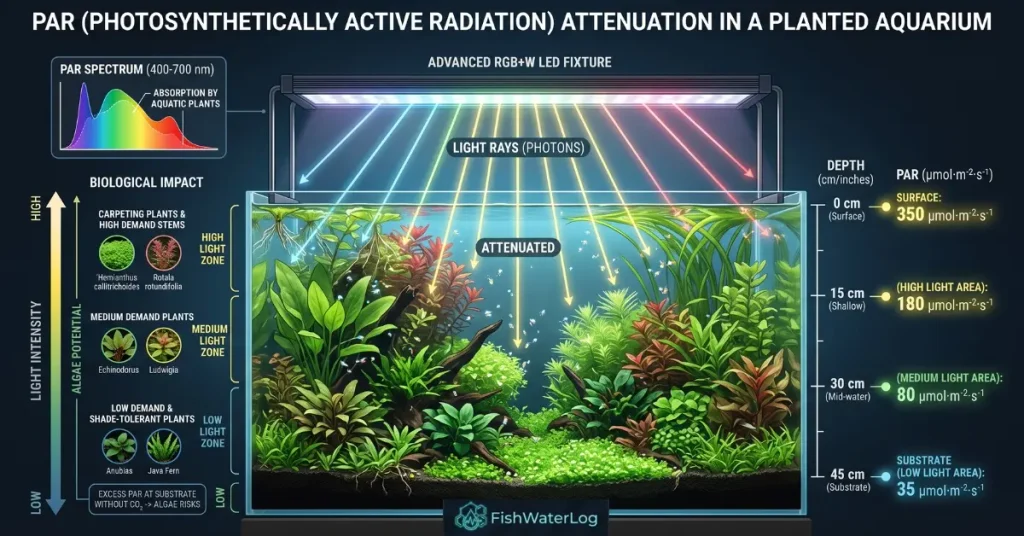
While duration determines the length of the photosynthetic window, intensity (measured in PPFD/PAR at the substrate) dictates the velocity of biochemical reactions within that window. Providing the correct target intensity across your automated led light schedule aquarium setup defines your system’s biological margin of error. High PAR acts as a metabolic accelerator; it drives faster vegetative development but exponentially increases the risk of an ecological collapse if nutrient or CO2 levels fluctuate.
Par Rating for Low Tech Planted Tank Environments
Low-tech aquariums, entirely reliant on atmospheric gas exchange, operate under a severely restricted carbon ceiling. Consequently, photon density must be kept aggressively low to prevent over-driving the thylakoid electron transport chain:
- The Shade / Epiphyte Threshold (20–40 µmol PAR): This is the mandatory operational range for slow-growing, low-light obligates such as Anubias barteri, Cryptocoryne wendtii, Microsorum pteropus (Java Fern), and Bucephalandra species. Operating within this baseline satisfies metabolic requirements while completely suppressing Green Spot Algae on slow-growing foliage.
- The Standard Low-Tech Threshold (40–60 µmol PAR): This is the optimal par rating for low tech planted tank setups running non-CO2 injected systems. It delivers adequate penetration to maintain low-demand stem plants and carpeting species like Marsilea hirsuta. Pushing non-CO2 systems beyond 60 µmol PAR at the substrate will inevitably trigger Green Dust and filamentous algae, as photonic energy outpaces atmospheric carbon replenishment.
- Biological Light Attenuation via Floating Plants: For fixed-output LED fixtures lacking electronic dimmers, surface floating species such as Salvinia minima, Phyllanthus fluitans (Red Root Floater), and Limnobium laevigatum (Amazon Frogbit) serve as a dynamic, natural PAR shield. A controlled 30% to 50% surface cover physically scatters photons, safely dropping benthic PAR from dangerously excessive levels down into the protected 30–50 µmol range while simultaneously sequestering excess water-column nitrogen.
For systems with minimal photon intensity, aquarists can cultivate resilient species by exploring our detailed index of low light aquarium plants for beginners tailored for non-CO2 setups.
High-Energy Parameters for CO2-Injected Systems
When pressurized CO2 is introduced via precision dual-stage regulators and diffusers, artificial carbon saturation eliminates the atmospheric bottleneck. Submerged flora can safely process vastly higher photon flux densities across the active aquarium lighting photoperiod without suffering oxidative photodamage:
- The Nature Aquarium Threshold (60–90 µmol PAR): This is the optimized sweet spot for most commercial aquatic plants, supporting demanding carpeting species such as Hemianthus callitrichoides ‘Cuba’ and Eleocharis acicularis (Dwarf Hairgrass). It delivers dense, compact horizontal growth while maintaining a manageable maintenance and trimming schedule.
- The High-Energy / Exotic Threshold (90–150 µmol PAR): This extreme intensity is required strictly to force specific morphological adaptations in rare taxa. High PAR induces profound internodal compaction and forces the expression of protective anthocyanin pigments, yielding the vibrant red, purple, and orange hues in species like Rotala macrandra, Ludwigia pantanal, and Hygrophila pinnatifida.
- The Biological Ceiling: At 90–150 µmol PAR, the margin for error is zero; a single day of failed carbon injection will result in rampant algal blooms. Sustained levels exceeding 200 µmol PAR provide zero horticultural benefit and destabilize the planted aquarium light schedule to stop algae.
Spectral Considerations and Photomorphogenesis
While PAR quantifies the sheer volume of photons, the spectrum dictates the exact wavelength of those photons. The parameters surrounding the aquarium light spectrum and the ideal kelvin rating fish tank choices are subjects of intense, often misinformed debate within the horticultural community, much of it clouded by commercial marketing attempting to promote proprietary lighting blends.
Deconstructing the Aquarium Light Spectrum
A persistent biological misconception suggests that plants only utilize red (650–680 nm) and blue (420–450 nm) wavelengths for photosynthesis. This fallacy stems from the absorption peaks of extracted Chlorophyll a and b observed in isolated in vitro laboratory settings. Commercial brands frequently exploit this data to market “Photosynthetically Usable Radiation (PUR)” fixtures that emit a harsh, unnatural purple hue.
In the physical reality of a living leaf within a closed aquatic environment, photosynthetic dynamics operate differently:
- Deep Canopy Penetration: Green light (500–600 nm) is remarkably effective at driving photosynthesis within a complex three-dimensional leaf matrix. While red and blue photons are rapidly absorbed by uppermost chloroplasts, green light penetrates deep into the cellular strata and cascades into the lower canopy.
- Full-Spectrum Efficiency: Chasing specialized PUR fixtures or heavily skewed red/blue grow lights offers negligible biological advantages and creates a visually unappealing display.
- Modern RGB LED Engineering: High-end RGB (Red, Green, Blue) LED fixtures are engineered to deliver balanced, full-spectrum PAR while dramatically enhancing the visual contrast, depth, and coloration of aquatic flora and fauna.
Resolving the Kelvin Rating Fish Tank Dilemma
The Kelvin rating (e.g., 6500K, 8000K, 10000K) is strictly a measurement of correlated color temperature, describing the visual hue of the light source as perceived by the human eye rather than its utility to aquatic plants:
- 6500K Daylight Spectrum: Closely approximates natural midday sunlight, presenting a balanced, slightly warm yellowish-white output traditionally favored in planted aquariums.
- 8000K to 12000K Cool Spectrum: Introduces a crisper, cooler, bluer aesthetic that enhances the appearance of vibrant green foliage and mimics light penetration in clear, natural waterways.
- Growth Equivalence: Kelvin rating does not dictate photosynthetic drive; a 6500K fixture and an 8000K fixture delivering identical PAR at the substrate yield the exact same rate of plant growth.
- Aesthetic vs. Biological Control: Selecting a specific kelvin rating fish tank light is purely an aesthetic choice for the aquarist, whereas algae control depends entirely on managing your aquarium lighting photoperiod and enforcing an automated planted aquarium light schedule to stop algae.
Advanced Algal Remediation Protocols
When an aquarist fails to synchronize their DLI with the system’s biological carbon capacity, nuisance algae will inevitably dominate. Novice aquarists often resort to chemical algaecides (such as glutaraldehyde derivatives or copper sulfate). These should be explicitly avoided, as they introduce severe toxicity risks to sensitive invertebrate livestock (such as Caridina shrimp) and merely treat symptoms without addressing the underlying metabolic bottleneck. The permanent solution relies on strict environmental modulation, adjusting the aquarium lighting photoperiod, and deploying targeted photobiological interventions. Chemical treatments severely threaten sensitive grazing colonies, making it crucial to maintain stable environments as outlined in our cherry shrimp water parameters guide.
Phased Photoperiod Compression
If filamentous or dust algae appear on mature foliage or hardscape, execute a mechanical clean-up by manually siphoning algal biomass, scrubbing hardscape with a toothbrush, and aggressively trimming heavily infested leaves. Algae-coated leaves are biologically compromised and cannot recover; removing them prevents further organic decay and nutrient recycling.
Simultaneously, enforce a structured planted aquarium light schedule to stop algae through phased parameter reductions:
- Reduce Photonic Intensity: Utilize the LED fixture’s programmable dimmer to drop peak PPFD intensity by 20% to 30%. This immediately reduces excitation energy overloading Photosystem II, mitigating oxidative stress and halting the production of damaging reactive oxygen species (ROS).
- Compress Duration: Retract the automated timer to a strict, continuous 5 to 6 hour window.
- Hold Parameters Steady: Lock this compressed led light schedule aquarium setup for a minimum of 3 to 4 weeks. Complex vascular plants require sustained stability to repair degraded cellular tissues, adjust chlorophyll density, and re-establish biological dominance. Continuously altering light settings every few days keeps the ecosystem in perpetual shock and prevents recovery.
- Audit Ambient Light Interference: Even with a strict timer, placing an aquarium near windows or under unshaded room fixtures creates uncontrolled low-intensity photon leakage throughout the day. This passive illumination continuously elevates the system’s baseline Daily Light Integral (DLI), secretly preventing algae starvation during dark hours. Ensure tanks undergoing algae remediation are shielded from indirect sunlight and bright ambient room lighting.
Proper mechanical extraction prevents dislodged detritus from decaying in the substrate, which can be executed using the techniques in our fish tank vacuum siphon guide.
Total Extinction: Blackout Protocols and UV Sterilization
For severe disruptions that do not respond to photoperiod compression—such as sudden outbreaks of Cyanobacteria (blue-green algae) or planktonic green water—complete light deprivation is the required protocol:
- 72-Hour Light Deprivation: Wrap the aquarium completely in opaque materials (dark blankets, blackout sheets, or heavy cardboard) to eliminate ambient room light, leaving the tank in total darkness for 72 consecutive hours. During this window, shut off CO2 injection and maximize surface agitation to keep livestock oxygenated.
- Metabolic Survival Differential: Vascular plants possess extensive carbohydrate reserves within their roots and stems, allowing them to survive total darkness via the tricarboxylic acid (TCA) cycle. Microalgae lack structural reserves and rely on instantaneous photosynthesis; deprived of light, they suffer catastrophic, widespread cellular death.
- Post-Blackout Export: Following the 72-hour blackout, reset the timer to a conservative 5-hour photoperiod and immediately perform a large (50% to 70%) water change to physically export necrotic algal organic matter before decomposition triggers an ammonia spike.
- Inline UV Clarification: If suspended green water persists, integrate an inline Ultraviolet (UV) sterilizer into the filtration outflow to degrade the cellular DNA of free-floating spores, clarifying the water column without reducing the PAR delivered to benthic flora.
Conclusion
The successful cultivation of a vibrant, algae-free planted aquarium is not achieved through guesswork or chemical suppression, but through the strict application of photobiological science. Discarding obsolete measurements like watts and lumens in favor of quantum metrics like Photosynthetically Active Radiation (PAR) and Daily Light Integral (DLI) allows aquarists to precisely balance light output with systemic bio-capacity.
Virtually all algae blooms stem from a metabolic bottleneck triggered when the aquarium lighting photoperiod or intensity vastly outpaces available dissolved inorganic carbon ($CO_2$) and macronutrients. This imbalance induces severe oxidative stress, glutathione depletion, and organic waste leakage from higher plants, fueling opportunistic algal spores.
Enforcing a targeted planted aquarium light schedule to stop algae—limiting recovering and nascent tanks to 5 to 6 hours while capping mature layouts at 7 to 9 hours—ensures optimal carbon fixation without light-induced stress. Calibrating the right par rating for low tech planted tank setups and managing an automated, uninterrupted led light schedule aquarium respects RuBisCO enzyme activation kinetics, transforming planted tank management into a predictable, highly controllable horticultural science.

3 thoughts on “Aquarium Lighting Photoperiod: Stop Algae in Planted Tanks”