

The deliberate integration of botanical tannins in freshwater aquarium environments represents a sophisticated intersection of aquatic biochemistry, microbial ecology, and zoological physiology. Historically, the hobby viewed water tinting as a mere cosmetic byproduct of decorative driftwood. However, contemporary limnology reveals that mastering protocols like extracting humic and fulvic acids for aquariums fundamentally alters the structural parameters of closed aquatic biotopes. In natural Neotropical habitats—such as the Rio Negro—dense forest canopies continuously deposit allochthonous matter, infusing waterways with bio-active compounds that dictate ion transport and microbial colonization. To fully grasp how these organic inputs alter biological filtration, practitioners should review a comprehensive freshwater aquarium ecosystem guide to understand baseline aquatic metabolic processes.
Replicating these extreme blackwater ecosystems requires managing the complex biochemical dynamics that occur when organic biomass breaks down. Introducing dried botanicals initiates the sustained leaching of complex lignin polyphenols, delivering therapeutic antimicrobial water tinting that suppresses opportunistic pathogens while sheltering light-sensitive species. Furthermore, aquarists often struggle with water clarity metrics, misunderstanding the negligible tannin conductivity impact where deeply stained water registers near-zero mineral hardness.
Crucially, operating these habitats requires advanced hydrochemical safeguards—especially when managing ph crash in zero kh blackwater tank setups where conventional carbonate hardness is intentionally eliminated to suit acidophilic dwarf cichlids. Balancing this organic buffer against the progressive catappa leaf decomposition organic load prevents biochemical oxygen demand spikes while establishing an authentic, biologically resilient aquatic biome.
Table of Contents
The Biochemical Architecture of Tannins and Humic Substances
To manipulate blackwater chemistry effectively, one must delineate the specific organic compounds released during botanical degradation. The overarching category of “humic substances” comprises humic acid, fulvic acid, and humin, while the broader category of plant-derived polyphenols includes various classes of tannins. Integrating botanical tannins in freshwater aquarium layouts introduces these bio-active molecules, directly altering ionic availability and ecological resilience.
Structural Classification of Tannins
Tannins are large, astringent, polyphenolic biomolecules synthesized by plants primarily as a defense mechanism against herbivory and microbial degradation. They possess multiple phenolic rings and sufficient hydroxyl and carboxyl groups to form strong complexes with macromolecules, particularly proteins. In closed aquatic systems, tannins are broadly divided into two primary structural classes:
- Hydrolyzable Tannins: These are esters of phenolic acids, predominantly gallic acid or ellagic acid, attached to a central carbohydrate core (usually glucose). When subjected to water and mild acids, they easily hydrolyze into their constituent monomers. Terminalia catappa (Indian Almond) is profoundly rich in hydrolyzable tannins, most notably punicalagin—a massive ellagitannin with a molecular weight of 1084.71 g/mol (C48H28O30). Upon entering the water column, punicalagin hydrolyzes into ellagic acid and smaller phenolic compounds, delivering potent radical scavenging, biological activity, and therapeutic antimicrobial water tinting.
- Condensed Tannins: Also referred to as proanthocyanidins, these compounds are non-cleavable oligomers and polymers of flavan-3-ol units. Unlike their hydrolyzable counterparts, condensed tannins do not readily break down in water. Instead, they provide sustained, long-term release of organic material and structural integrity to submerged wood and specialized seed pods, functioning as a continuous source of recalcitrant lignin polyphenols.
Humic and Fulvic Acid Differentiation
Humic substances represent the terminal stage of organic matter degradation, formed through complex geochemical and biological reactions (humification). Rather than causing uncontrolled instability, understanding the release kinetics is critical when managing ph crash in zero kh blackwater tank biotope setups tailored for sensitive acidophilic dwarf cichlids.
- Fulvic Acids (FA): The highly bioavailable, lower molecular weight fraction (typically 300–1,500 Da) of humic substances. They are distinguished by their complete solubility across the entire pH spectrum (from highly acidic to alkaline) and boast an extraordinarily high oxygen and carbon content (40%–50%). Because of their dense concentration of carboxyl and phenolic hydroxyl groups, fulvic acids are exceptionally potent chelating agents, readily binding multivalent metal cations such as iron (Fe3+) and copper (Cu2+) to render them non-toxic and bioavailable while maintaining a negligible tannin conductivity impact.
- Humic Acids (HA): Possess a significantly larger molecular weight (10,000–100,000 Da) and feature complex aromatic ring structures. While soluble at neutral to alkaline pH, humic acids precipitate out of solution when pH drops below 2.0. Regulating their input alongside the natural catappa leaf decomposition organic load ensures a steady humic buffer.
Advanced protocols for extracting humic and fulvic acids for aquariums allow aquarists to utilize both fractions systematically to stabilize proton buffering, detoxify ambient heavy metals, and maintain chemical equilibrium. For rigorous molecular definitions and extraction methodologies regarding humic and fulvic profiles, researchers rely on the standards established by the International Humic Substances Society.
Extracting Humic and Fulvic Acids for Aquariums
The methodologies deployed for extracting humic and fulvic acids for aquariums dictate the concentration and chemical profile of the resulting water. Advanced aquarists simulate natural humification through targeted thermal decoction or extended passive leaching to introduce botanical tannins in freshwater aquarium environments cleanly and effectively.
Extraction Mechanics and Stepwise Elution
In analytical chemistry, isolating humic components relies on XAD-8 resin adsorption techniques paired with stepwise elution using pyrophosphate buffers across sequential pH gradients. Empirical research demonstrates that earlier eluting fractions at acidic pH possess dense carboxylic functional groups, while later alkaline fractions contain predominantly aromatic and phenolic rings.
Practical Benefits of Thermal Decoction
Boiling botanicals such as Terminalia catappa leaves, alder cones, or aquatic peat mirrors this elution process, forcing rapid extraction of polar fulvic acids:
- Rapid Humic Delivery: Concentrates low-molecular-weight fulvic acids rapidly, bypassing weeks of passive decay.
- Antimicrobial Water Tinting: Delivers therapeutic polyphenols and water coloration without dumping decomposing solids into the primary display tank.
- Negligible Tannin Conductivity Impact: Infuses potent organic chelators and buffers without increasing mineral hardness or electrical conductivity.
- BOD Mitigation: Prevents sudden drops in dissolved oxygen by extracting the active chemistry away from the display tank’s microbial biome.
While brief boiling forces immediate saturation and sinks buoyant pods, excessive boiling strips volatile monoterpenes and delicate flavonoids. Advanced biotope keepers often prefer cold-curing—submerging botanicals in a dedicated container of ambient reverse osmosis water for 7 to 14 days to naturally waterlog materials without thermally exhausting beneficial organic fractions.
Passive Leaching and Aqueous Integration
Placing untreated botanical materials directly into the aquarium facilitates passive leaching, closely mimicking the natural allochthonous leaf litter dynamics of Neotropical forest streams.
Dynamics of Long-Term Submerged Degradation
Allowing raw botanicals to decay submerged inside the display activates a complex biological succession:
- Initial Tannin Flush: Releases highly soluble hydrolyzable tannins—such as punicalagin—and light fulvic fractions within the first several hours to days of submersion.
- Lignin Polyphenols Breakdown: Secondary structural degradation occurs as heterotrophic biofilms slowly digest complex condensed tannins over multiple weeks.
- Bimodal Buffer Establishment: Forms a sustained organic acid reserve, which is indispensable when managing ph crash in zero kh blackwater tank environments housing delicate acidophilic dwarf cichlids.
- Managing Catappa Leaf Decomposition Organic Load: Requires aggressive surface aeration to prevent the biological oxygen demand of decaying leaf tissue from suffocating livestock.
| Botanical Input | Tint Intensity | Acidification Rate | Starting Baseline Dose | Primary Application |
|---|---|---|---|---|
| Terminalia catappa (Large) | High (Amber) | Rapid (12–36 hrs) | 1 leaf per 40 L | Antimicrobial prophylaxis & rapid DOC loading |
| Alder Cones (Alnus glutinosa) | Very High (Deep Tea) | Moderate (24–48 hrs) | 1 cone per 15 L | Active humic & fulvic organic buffering |
| Guava Leaves (Psidium guajava) | Mild (Golden) | Slow (3–5 days) | 1–2 leaves per 30 L | Biofilm grazing surface & slow decay |
| Specialized Seed Pods & Wood | Moderate (Persistent) | Very Slow (Sustained) | 1–2 pieces per layout | Condensed tannins & long-term carbon release |
Management Tip (Leaf Layering): Maintain natural biological succession by practicing progressive leaf rotation. Instead of siphoning out decomposed, skeletonized leaf litter, allow it to form a benthic organic mattress and simply introduce fresh leaves on top at bi-weekly intervals to prevent sudden biological oxygen demand (BOD) crashes.
Managing pH Crash in Zero KH Blackwater Tank Environments
Perhaps the most pervasive and dangerous misunderstanding in mainstream freshwater aquariology is the absolute reliance on Carbonate Hardness (KH) to stabilize pH. Standard literature mandates maintaining a KH of at least 3 to 8 dKH to prevent catastrophic acidification. However, this advice fails completely when managing authentic, ultra-soft botanical tannins in freshwater aquarium systems where carbonate levels are virtually nonexistent (0–1 dKH).
The Myth of Carbonate Dependency
In a traditional setup, the nitrification process (converting ammonia to nitrate) continuously generates free hydrogen ions (H+), which consume dissolved carbonate alkalinity. When KH is depleted, “Old Tank Syndrome” occurs, resulting in a precipitous and fatal drop in pH. However, high-authority websites often fail to recognize that blackwater ecosystems operate on an entirely different buffering paradigm: Organic Alkalinity.
- Mineral Buffer Exhaustion: Traditional inorganic buffers rely on bicarbonate (HCO3-), which binds free protons until exhausted, leaving zero-KH setups vulnerable if managed under conventional assumptions.
- Electrical Conductivity Separation: Unlike mineral salts that elevate hardness, organic buffers provide stability while maintaining an ultra-low tannin conductivity impact, preserving soft-water parameters.
- Faunal Safety: Deploying organic buffers prevents parameter swings, providing a stable habitat tailored specifically for wild-caught or delicate acidophilic dwarf cichlids.
The Bimodal Organic Buffer Mechanism
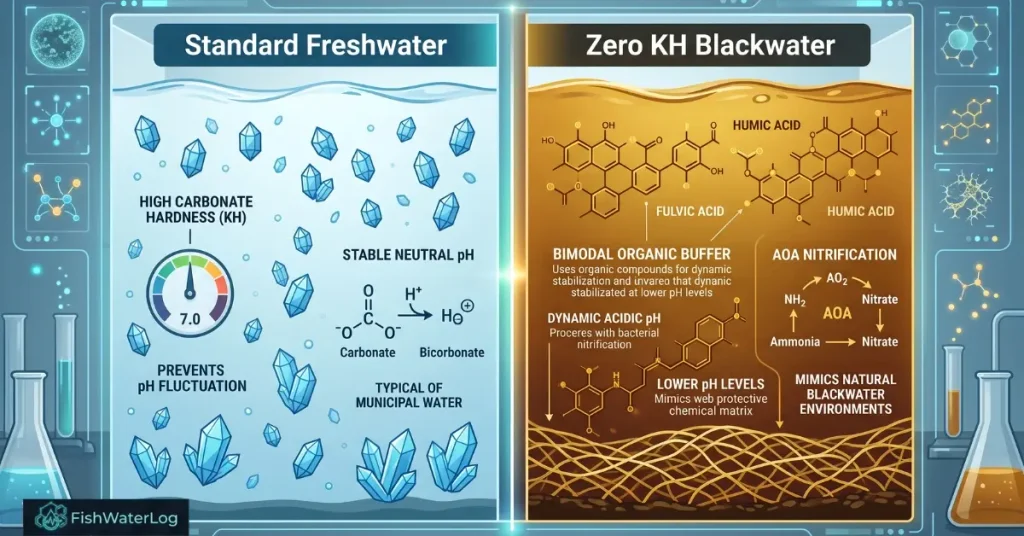
Comparison of standard mineral carbonate hardness (KH) buffering versus humic-driven bimodal organic buffering in zero KH blackwater systems.When managing ph crash in zero kh blackwater tank setups, the humic and fulvic acids themselves act as a highly effective, resilient organic buffer. Unlike simple mineral buffers that have a single, discrete dissociation constant (pKa), humic substances are heterogeneous mixtures. Consequently, their acid-base properties are best described by a continuous bimodal Gaussian distribution of pKa values.
- Carboxylic Acid Range (pKa1): The first peak of this bimodal distribution represents densely packed carboxylic acid groups in humic substances, expressing pKa1 values ranging from approximately 2.43 to 4.88.
- Phenolic Hydroxyl Range (pKa2): The second peak is governed by weaker acidic phenolic groups, which exhibit pKa2 values generally spanning 9.95 to 11.27.
- Structural Polyphenol Breakdown: Sustained elution of complex lignin polyphenols continuously replenishes these weak acid groups as botanical materials decay.
Establishing the Low-pH Chemical Floor
Because the carboxylic groups have pKa values in the strongly acidic range, they serve as an immutable chemical “floor”:
- Proton Quenching: As biological acids drive the water column’s pH downward toward the 4.5–5.5 threshold, the unprotonated carboxylate groups accept excess H+ ions, establishing a dynamic chemical equilibrium.
- Acidosis Prevention: This reaction halts further downward runaway acidification, anchoring the pH naturally without the addition of carbonates.
- Metabolic Biomass Balance: Successfully sustaining this chemical floor requires balancing botanical inputs alongside the ongoing catappa leaf decomposition organic load to prevent oxygen depletion.
- Prophylactic Water Conditioning: Simultaneously, these humic polymers provide therapeutic antimicrobial water tinting, suppressing pathogens while biological acidification stabilizes.
Properly executed protocols for extracting humic and fulvic acids for aquariums allow aquarists to prime the organic buffer before introducing livestock, securing long-term biological stability in carbonate-depleted biotope systems.
Microbial Dynamics in Acidic Freshwater Systems
The chemical environment dictated by heavy botanical use forces a radical shift in the aquarium’s microbiome. Conventional aquariums rely heavily on ammonia-oxidizing bacteria (AOB) such as Nitrosomonas and nitrite-oxidizing bacteria (NOB) such as Nitrobacter. These autotrophic bacteria thrive in alkaline, carbonate-rich waters. However, as the pH falls below 7.0, their efficiency plummets, and below pH 6.0, they enter dormancy or perish entirely. Introducing botanical tannins in freshwater aquarium systems initiates this structural transition, fundamentally reorganizing the biofiltration hierarchy.
Ammonia-Oxidizing Archaea (AOA) vs. Traditional Nitrifiers
In low-pH blackwater environments, biological filtration is commandeered by entirely different clades of microorganisms adapted to extreme oligotrophic habitats. Ammonia-Oxidizing Archaea (AOA), such as Nitrosopumilus maritimus, along with complete ammonia-oxidizing (comammox) Nitrospira and Nitrotoga species, take over the nitrogen cycle.
- Metabolic Persistence: Studies of specific gene expressions, such as amoA mRNA and 16S rRNA, confirm that AOA retain active transcriptomic profiles and successfully oxidize ammonia in highly acidic, zero-KH regimes where traditional AOB fail completely.
- Substrate Affinity: Archaea exhibit an affinity for substrate concentrations orders of magnitude lower than conventional nitrifiers, ensuring continuous processing in nutrient-poor soft water.
- Biofilm Integration: These specialized microbes embed within the protective matrix generated by decomposing lignin polyphenols, establishing a resilient biological filter alongside natural aquatic botanicals.
Nitrogen Cycle Stability at Low pH
A critical chemical phenomenon occurs alongside this microbial succession. At pH levels below 6.0, the equilibrium between highly toxic unionized ammonia (NH3) and relatively benign ionized ammonium (NH4+) shifts almost entirely in favor of ammonium.
- Proton Trapping Dynamics: Because ambient protons (H+) immediately bind to any free ammonia, acute toxicity to fauna is neutralized biochemically.
- Faunal Protection: This chemical ionization creates a safe operating window for delicate acidophilic dwarf cichlids, even while the slower-growing Archaea establish their colonies.
- Osmoregulation and Optics: These low-pH transformations occur alongside a negligible tannin conductivity impact, while natural humic elution provides therapeutic antimicrobial water tinting that inhibits secondary aquatic pathogens.
Managing Ammonia Shifts and System Equilibrium
While the biological conversion of nitrogenous waste by Archaea may proceed at a slower metabolic rate than bacterial nitrification in hard water, livestock remain safe due to the ionized state of ammonium.
- Chemical Shock Hazards: Catastrophic danger arises if an uninformed aquarist attempts to rapidly raise the pH with alkaline mineral buffers, which instantly deprotonates safe ammonium back into lethal free ammonia gas.
- Organic Load Restraint: Maintaining system health requires closely pacing additions to manage the catappa leaf decomposition organic load, preventing excessive heterotrophic oxygen depletion.
- Pre-Dosing Protocols: Utilizing controlled methods for extracting humic and fulvic acids for aquariums allows the practitioner to lower pH gradually, ensuring seamless biological transition while managing ph crash in zero kh blackwater tank designs.
If transitioning a tank too rapidly causes unexpected parameter swings, knowing exactly how to fix a nitrogen cycle crash is imperative to protect livestock during the microbial shift.
Catappa Leaf Decomposition Organic Load and Ecosystem Metabolism
The implementation of botanical tannins in freshwater aquarium systems is a balancing act of biomass. As dried leaves, pods, and wood are submerged, they initiate a succession of decay that contributes heavily to the catappa leaf decomposition organic load. Managing these inputs correctly balances ecosystem metabolism while establishing stable hydrochemical conditions.
Degradation of Lignin Polyphenols
Once submerged, botanicals are rapidly colonized by heterotrophic bacteria, aquatic fungi, and structured biofilms. This microbial succession unfolds through distinct metabolic phases:
- Rapid Soluble Elution: Initial degradation consumes readily available simple carbohydrates and highly soluble hydrolyzable tannins within days.
- Enzymatic Cleavage: Specialized extracellular enzymes secreted by the biofilm slowly break down recalcitrant structural compounds, primarily condensed tannins and complex lignin polyphenols.
- Secondary Food Web Development: The resulting biofilm matrix generates an energy-rich secondary grazing layer, serving as vital supplemental nutrition for grazing invertebrates, dwarf shrimp, and larval fry.
Biochemical Oxygen Demand and Biofilm Proliferation
This intense metabolic processing comes with a major physiological consequence: rapid dissolved oxygen depletion. Heterotrophic bacteria consuming the catappa leaf decomposition organic load require massive amounts of dissolved oxygen (DO).
- Hypoxia Hazards: Introducing excessive botanical biomass all at once drives a spike in biological oxygen demand (BOD) that can strip the water column of oxygen, inducing fatal asphyxiation in sensitive livestock.
- Oxygenation Countermeasures: Sustaining both heterotrophic decomposition and Ammonia-Oxidizing Archaea requires heavy surface agitation, open-air gas exchange, or wet/dry trickle filtration.
- Biomass Priming Protocols: Rather than overloading raw leaf litter, aquarists frequently rely on extracting humic and fulvic acids for aquariums via boiling, delivering active organic compounds without triggering an unmanageable BOD spike in the main display.
To ensure heterotrophic bacterial blooms do not deplete system saturation during leaf breakdown, tracking real-time levels with an aquarium dissolved oxygen meter is essential for sensitive livestock.
The Biofilm Acclimation Phase: During the initial 3 to 7 days of submerged decay, a white, translucent heterotrophic biofilm commonly coats botanical surfaces. Rather than a sign of fouling, this mucilage functions as a high-density, nutrient-rich secondary foraging web for dwarf shrimp, fry, and grazing benthic microfauna—it should never be siphoned or scrubbed away.
Tannin Conductivity Impact and the Attenuation of PAR
Aquarists conditioning environments for delicate Neotropical species must maintain strict, ultra-soft water parameters. A persistent source of confusion is how an aquarium displaying dense amber coloration can simultaneously register minimal Total Dissolved Solids (TDS).
Electrical Conductivity vs. Dissolved Organic Carbon
The tannin conductivity impact functions on a completely different chemical principle than dissolved mineral salts:
- Mineral Conductivity Mechanics: Standard TDS pens determine values by measuring Electrical Conductivity (EC), which requires mobile, inorganic ions such as calcium (Ca2+), magnesium (Mg2+), sodium (Na+), and chloride (Cl-).
- Non-Ionic Organic Polymers: Humic and fulvic acids are massive, covalently bonded macromolecules that do not dissociate into free, charge-carrying electrolyte ions.
- True Blackwater Baselines: A biotope can contain dark, tea-colored concentrations of dissolved organic carbon (DOC) while the TDS meter reads an extraordinarily low 10 to 50 ppm, creating an ideal ion-poor setting for acidophilic dwarf cichlids.
- Low-Mineral Buffer Integration: This separation of organics from mineral hardness enables stable organic buffering when managing ph crash in zero kh blackwater tank designs.
Because authentic blackwater requires near-zero baseline mineral hardness, relying on precise RO DI filtration prevents unwanted mineral spikes before organic conditioning.
Photosynthetically Active Radiation and Aquatic Optics
The accumulation of Colored Dissolved Organic Matter (CDOM) fundamentally changes the underwater light spectrum, altering Photosynthetically Active Radiation (PAR) dynamics:
- Shortwave Absorption: Dissolved humic matter selectively absorbs shorter, high-energy wavelengths, rapidly filtering out ultraviolet (UV), violet, and blue light spectrums.
- Spectral Red-Shifting: As irradiance travels downward through tinted water, it shifts into the deeper amber and red wavelengths.
- Natural Algae Suppression: Depleting blue and green spectrums within the upper water column inhibits photosynthetic pathways in suspended green water and nuisance algae without synthetic algicides.
- In-Situ Photoprotection: Shielding against harsh UV penetration replicates natural river canopies, protecting delicate fish eggs, embryos, and sensitive gill membranes alongside the natural benefits of antimicrobial water tinting.
If water tinting becomes excessively dark or biological oxygen demand spikes unexpectedly, macroporous synthetic polymer resins can selectively remove dissolved organic matter (CDOM) to restore light transmission without altering mineral hardness or stripping essential cations. Conversely, standard activated carbon should be restricted to brief emergency corrections, as continuous chemical filtration aggressively binds the very humic acids and chelated trace elements required for long-term organic buffering.
Physiological Adaptations of Acidophilic Dwarf Cichlids
The physiological realities of zero KH, low pH, and depleted mineral content drive profound evolutionary adaptations in endemic Neotropical species. Deploying botanical tannins in freshwater aquarium systems allows aquarists to sustain acidophilic dwarf cichlids, such as Apistogramma agassizii, alongside characins like the Cardinal Tetra (Paracheirodon axelrodi), replicating the exact hydrochemical conditions required for their long-term survival and reproduction.
Branchial Osmoregulation in Mineral-Poor Waters
Freshwater teleosts are hyperosmotic to their surrounding environment, creating an osmotic gradient where water continuously invades internal tissues while vital electrolytes diffuse outward into the water column. In mineral-depleted habitats, maintaining systemic sodium (Na+) and chloride (Cl-) balances imposes severe metabolic and bioenergetic demands.
- Branchial Ion Uptake: The gill epithelium serves as the primary site of gas exchange, acid-base regulation, and active ionoregulation.
- Proton-Pump Coupling: Specialized fishes deploy apical membrane proton pumps, such as V-type H+ ATPase (VHA), generating an electrical gradient that drives the active uptake of Na+ from highly dilute water via specialized transporters (such as the Wieczorek Exchanger).
- Paracellular Tightening via DOC: Dissolved organic carbon (DOC) derived from humic substances binds directly to the gill surface epithelium, tightening branchial paracellular junctions to significantly reduce the passive efflux of endogenous ions into the surrounding water.
- Minimal Mineral Distortion: These protective membrane dynamics operate alongside a negligible tannin conductivity impact, allowing stable cellular ionoregulation without requiring elevated mineral hardness.
Intracellular pH Regulation and Carbon Dioxide Tolerance
Natural blackwater habitats are saturated with decaying forest detritus, creating localized zones that are heavily supersaturated with dissolved carbon dioxide (pCO2) far beyond atmospheric equilibrium.
- Extracellular Blood Shifts: Because extremely soft water provides virtually no bicarbonate (HCO3-) reserves for standard extracellular buffering, these species tolerate dramatic drops in blood pH.
- Intracellular Priority: Fish from these ecosystems preserve life by maintaining the rigid regulation of intracellular pH over extracellular balance, utilizing energetic cellular ion pumps to keep vital organ tissues chemically stable.
- Buffer Reliability: Maintaining this physiological stability inside closed systems relies on managing ph crash in zero kh blackwater tank parameters via natural organic acidity rather than unpredictable synthetic additives.
Mitigation of Heavy Metal Toxicity via DOC
In highly acidic aquatic environments, trace dissolved metals such as copper (Cu) and aluminum (Al) become exponentially more bioavailable and toxic to fish gills.
- Carboxyl Chelation: Densely packed carboxyl and phenolic groups on humic and fulvic macromolecules act as potent chelating agents.
- Metal Complexation: These organic ligands bind free cationic metals into inert, stable organometallic complexes, preventing them from interacting with sensitive branchial binding sites.
- Safe Humic Delivery: Utilizing controlled methods for extracting humic and fulvic acids for aquariums allows aquarists to provide continuous metal detoxification while managing the ongoing catappa leaf decomposition organic load.
Antimicrobial Water Tinting and Pathogen Resistance
The integration of botanical tannins establishes systemic, non-pharmacological health benefits for aquatic fauna, driven primarily by natural antimicrobial water tinting.
Protein Precipitation and Bacteriostatic Action
Tannins are complex polyphenols with an affinity for precipitating microbial proteins, neutralizing potential pathogens through multiple bio-mechanical pathways:
- Membrane Destabilization: Hydrolyzable tannins, such as ellagitannins derived from Terminalia catappa, interact directly with the lipid bilayers and surface proteins of pathogenic microorganisms.
- Enzymatic Neutralization: Free-floating polyphenols disrupt pathogen cell wall integrity, inhibit cellular adhesion, and denature extracellular enzymes essential for bacterial invasion.
- Sustained Polyphenol Elution: The progressive breakdown of structural condensed tannins and insoluble lignin polyphenols ensures continuous, background bacteriostatic action throughout the water column.
Resistance to Flavobacterium columnare
One of the most lethal and widespread pathogens in freshwater aquariology is Columnaris disease, caused by the virulent Gram-negative bacterium Flavobacterium columnare.
- Targeted Pathogen Suppression: Laboratory and clinical aquaculture trials show that tannic acid and related humic fractions exert direct antibacterial action against F. columnare, reducing bacterial adhesion and cell viability.
- Prophylactic Defense: Maintaining high concentrations of dissolved humic substances suppresses waterborne bacterial titers before infections can colonize host fish tissues.
- Antibiotic Reduction: Conditioning the water column with botanical extracts enhances the innate immune defenses of acidophilic dwarf cichlids, minimizing the need for conventional, resistance-prone antibiotic treatments.
Extensive empirical data documenting the bactericidal effects of plant-derived polyphenols on aquatic diseases can be accessed through peer-reviewed literature housed on PubMed Central.
While humic substances suppress waterborne pathogens naturally, severe systemic bacterial outbreaks should be cross-referenced with established clinical fish disease protocols for targeted recovery.
Data Synthesis: Water Chemistry and Biochemical Parameters
To distinctly map the chemical disparities between traditional aquatic husbandry and botanical blackwater systems, the following structured benchmarks delineate the functional parameters and biochemical categorizations. Deploying botanical tannins in freshwater aquarium systems shifts water quality management from traditional mineral-driven hardness to complex organic carbon dynamics.
Comparative Water Parameter Targets
| Parameter | Standard Freshwater Tank | Blackwater Botanical Tank | Primary Controlling Agent |
|---|---|---|---|
| pH Level | 6.5 – 7.5 | 4.5 – 6.0 | Humic & Fulvic Acid pKa thresholds |
| Carbonate Hardness (KH) | 3 – 8 dKH | 0 – 1 dKH | Source water stripping (Reverse Osmosis) |
| TDS / Conductivity | 150 – 300 ppm | 10 – 80 ppm | Lack of mineral salts |
| Primary Nitrifiers | Nitrosomonas / Nitrobacter | Ammonia-Oxidizing Archaea (AOA) | pH-driven microbial succession |
| Light Penetration (PAR) | High (Full Spectrum) | Low (Red-Shifted) | CDOM / Tannin absorption |
| Nitrogen State (Low pH) | Highly toxic NH3 equilibrium | Non-toxic NH4+ dominance | Protonation due to excess H+ ions |
Plant-Derived Organic Compounds in Aquaria
| Compound Class | Primary Source in Aquaria | Solubility & Behavior | Systemic Function |
|---|---|---|---|
| Fulvic Acid | Alder Cones, Peat, Catappa | Soluble at all pH levels, low MW | Heavy metal chelation, immediate pH buffering |
| Humic Acid | Peat, Decayed Wood | Precipitates < pH 2.0, high MW | Slow-release organic buffering, complexation |
| Hydrolyzable Tannins | Terminalia catappa Leaves | Readily hydrolyzes in water | Antimicrobial action, protein precipitation |
| Condensed Tannins | Driftwood, Specialized Bark | Highly resistant to hydrolysis | Structural carbon, sustained long-term release |
Key Biochemical Management Takeaways
- Organic Buffer Stability: Maintaining these precise blackwater parameters ensures seamless biological stabilization when managing ph crash in zero kh blackwater tank designs populated by acidophilic dwarf cichlids.
- Controlled Extraction: Applying proven methods for extracting humic and fulvic acids for aquariums allows targeted delivery of bio-active compounds while preventing unmanageable catappa leaf decomposition organic load spikes in closed systems.
- Pure Water Maintenance: Because covalently bonded humic molecules lack free metallic ions, they generate therapeutic antimicrobial water tinting alongside a negligible tannin conductivity impact.
- Structural Carbon Reservoir: The slow decay of recalcitrant lignin polyphenols provides a continuous baseline of humic precursors that sustain the secondary aquatic food web and stabilize the biotope over time.
Conclusion
Integrating botanical tannins in freshwater aquarium environments transcends basic aesthetics, establishing an authentic biochemical foundation that governs microbial ecology and water quality. Rather than relying on rigid carbonate reserves, aquarists can maintain stability by leveraging methods for extracting humic and fulvic acids for aquariums. These polyfunctional organic fractions provide an immutable chemical floor, which is the foundational key to managing ph crash in zero kh blackwater tank designs.
Sustaining these biotope systems requires carefully balancing botanical biomass against the ongoing catappa leaf decomposition organic load. This controlled decay feeds beneficial heterotrophic biofilms and fuels specialized Ammonia-Oxidizing Archaea, bypassing the limitations of conventional nitrifiers in acidic parameters. Simultaneously, the slow release of complex lignin polyphenols yields valuable therapeutic benefits through antimicrobial water tinting that inhibits virulent pathogens like Flavobacterium columnare, all while maintaining a negligible tannin conductivity impact.
Ultimately, mastering these organic buffering mechanics provides essential branchial protection and photoprotective water optics tailored specifically for acidophilic dwarf cichlids. Embracing dissolved organic carbon transforms standard aquarium keeping into high-level limnological stewardship, producing resilient, biologically complete blackwater ecosystems.
Frequently Asked Questions
Will the addition of heavy botanical tannins crash my biological filter?
If the pH is driven below 6.0 too rapidly, traditional autotrophic nitrifying bacteria (AOB) will cease functioning. However, the tank does not “crash” permanently. Over time, Ammonia-Oxidizing Archaea (AOA) and acid-tolerant Nitrospira will colonize the media to process waste. During this transition, toxicity is mitigated because free ammonia (NH3) ionizes into non-toxic ammonium (NH4+) in acidic water.
Why doesn’t the heavy brown tint cause a massive spike in my TDS meter?
Standard TDS meters measure electrical conductivity via dissolved mineral ions (like calcium and magnesium). The tannin conductivity impact is negligible because humic and fulvic acids are massive, covalently bonded organic polymers rather than free-floating mineral ions. You can achieve deep tinting while maintaining the ultra-low TDS required by sensitive soft-water fish.
How do I manage the physical detritus generated by leaf breakdown without causing an ammonia spike?
The physical breakdown of lignin polyphenols generates a high biochemical oxygen demand (BOD) as heterotrophic bacteria consume the matter. You must manage this by adding botanicals slowly, ensuring aggressive water surface agitation to maintain high dissolved oxygen levels, and employing detritivorous invertebrates (adapted to low pH) to assist in the mechanical breakdown of the leaf litter.

3 thoughts on “Botanical Tannins in Freshwater Aquarium: 7 Fulvic Tips”